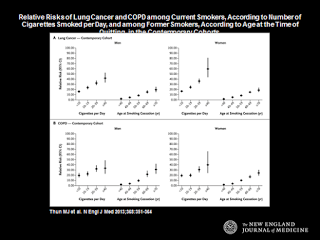
No other cause of illness or death is more important than smoking. This is the clear message of two new studies of large numbers of Americans conducted by Jha etaland by Thun etaland published by the New England Journal of Medicine on January 24, 2013.
About 19% of Americans smoke regularly today, down from about 40% a few decades ago. Good progress. But for those who do smoke, diseases leading to death are common. Smokers mortality is about 3 times that of nonsmokers and essentially equal between men and women. Certain diseases have been clearly linked to smoking and these caused about 60% of the smokers’ deaths – ischemic heart disease (heart attacks and related), stroke, chronic lung disease and lung cancer being the most common.
The Thun study compared data from three time periods reaching back 50 years. Overall mortality declined by 50% over those 50 years in large part as a result of progress against heart disease. But this was a benefit largely enjoyed only by the nonsmokers since smoking exacerbates coronary artery disease.
Thun made some key observations. First, smoking deaths continue to increase among women because women who smoke smoke as much as do men. Second, death from all causes is at least 3X higher for smokers than for nonsmokers with at least two thirds of all deaths in smokers directly related to smoking. Third, the rate of death from chronic lung disease (COPD) is rising among both men and women. They hypothesize that this rise in incidence is related to the changes in cigarettes over the years that encourage deeper inhalation with more toxins reaching the periphery of the air sacs. Using the same reasoning, they suggest that deeper inhalation than in the past may be causing the increased incidence of peripheral lung cancers especially adenocarcinomas rather the more centrally located mostly squamous cell cancers that were more common in the past. Fourth quitting smoking lowers death rates very substantially and quitting before the age of 40 can eliminate the relative risk of early death.
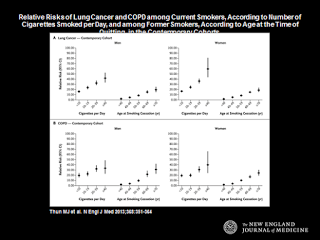
In the Jha study, the increased risk for ischemic heart disease among smokers compared to nonsmokers was about 3.5 i.e., smokers had 3.5 times as many deaths from heart disease as did the nonsmokers. Since heart disease is more frequent than lung cancer or chronic lung disease, this represented a large and common cause of death for smokers. Considering just women for example, among the 23,839 women who smoked in the study, 251 died of heart disease compared to 382 of the 67,574 women who never smoked. Lung cancer caused fewer total deaths but the relative risk for smokers was very high – 18 – based upon 289 women who smoked and died of lung cancer compared to 83 lung cancer deaths for the larger number of women who never smoked.
These two studies are a stark reminder that smoking is not simply a health hazard. It directly leads to very substantially increased risks of death from heart disease, stroke, chronic lung disease and lung cancer, among others. In the Jha study, 62% of the smokers’ deaths were attributable to smoking.
Attempts to curtail the initiation of smoking and to assist with smoking cessation are important – perhaps the single most important – health promotion and disease prevention goals for America.