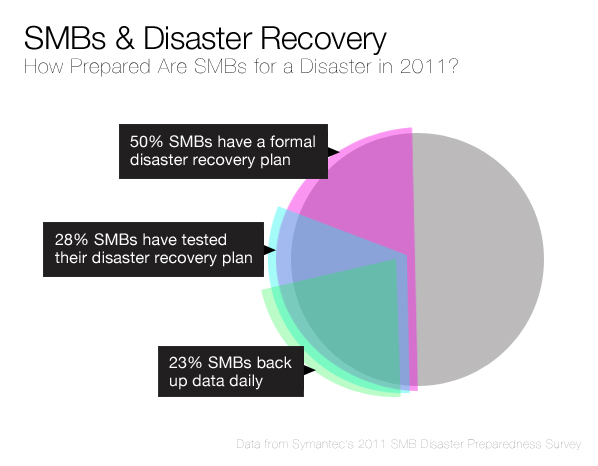
Only half of SMBs surveyed reported having a formal disaster recovery plan in place, according to Symantec’s 2011 SMB Disaster Preparedness Survey. Small to medium-sized businesses (SMBs) can benefit from disaster recovery outsourcing options since it reduces the cost of capital and planning to invest in an offsite backup and data recovery plan.
Only half of SMBs surveyed reported having a formal disaster recovery plan in place, according to Symantec’s 2011 SMB Disaster Preparedness Survey. Small to medium-sized businesses (SMBs) can benefit from disaster recovery outsourcing options since it reduces the cost of capital and planning to invest in an offsite backup and data recovery plan.
If your critical applications and data are down, you can lose potential and existing customers – or, if you lose or destroy patient data, it can result in lawsuits and costly fines (see HIPAA violations). Disaster recovery planning is no longer a luxury, but a serious preventive measure that needs to be formally addressed for the sake of business continuity.
Designing an IT disaster recovery plan or investing in a fully redundant data center with application and data replication can take valuable time and resources better spent elsewhere. Finding an experienced vendor that can provide the latest technology and 24×7 support is key to protecting your data. They can provide full disaster recovery testing, which is another costly and time-consuming effort that can’t be overlooked. Finding out your disaster recovery plan doesn’t work in the middle of a disaster is the worst time to find out. Yet, only 28 percent of SMBs have actually tested recovery plans, according to the SMB survey.
More Read

SMBs, Disaster Recovery and Cloud Computing in 2011
Disaster Recovery Principles
A recovery time objective (RTO) refers to the maximum length of time that a system can be down after a failure or disaster occurs before the company is negatively impacted by the downtime. The SMB survey reveals that the average cost of downtime for an SMB is $12,500 per day. At this rate, many SMBs can’t afford to be down for one day, let alone a week.
Another principle is the recovery point objective (RPO) that specifies a point in time that data must be recovered and backed up. The RPO determines the minimum frequency and at which intervals backups need to occur, whether every hour or every 5 minutes. According to the SMB survey, less than half of SMBs back up their data weekly, and only 23 percent back up daily.
Unfortunately, a lot of traditional disaster recovery options provide a model that is time-consuming, costly to SMBs and involves several steps before full data recovery can be established. This includes tape backup, which is complex, highly error-prone and may take days or weeks for recovery. Hot site disaster recovery also doubles the cost of the production environment and requires two fully replicated solutions – primary production center servers and applications have to be consistently replicated in both data centers on an ongoing basis.
One alternative is cloud computing for disaster recovery. A disaster recovery cloud can meet RTOs of just hours, drastically improving on traditional disaster recovery RTOs. Each step is outlined below:
- Virtualize your servers – remove hardware dependencies.
- Offsite backup – RPOs can vary from 24 hours to just 5 minutes with more comprehensive disaster recovery solutions. Offsite backup includes shipping server backup to an offsite data center.
- Warm site disaster recovery – this is to protect your environment, including servers and network by backing them up. This also includes failover to a shared or private disaster recovery cloud.
- Hot site disaster recovery – this is to protect your system with automatic failover. With a disaster recovery cloud, you can achieve a faster RTO and RPO. Failback to production (returning production to its original location) can take less than an hour.
Find more disaster recovery resources here:
Benefits of Disaster Recovery in Cloud Computing
Webinar Series: Cloud Computing for Backup & Disaster Recovery
Sources
Symantec 2011 SMB Disaster Preparedness Survey