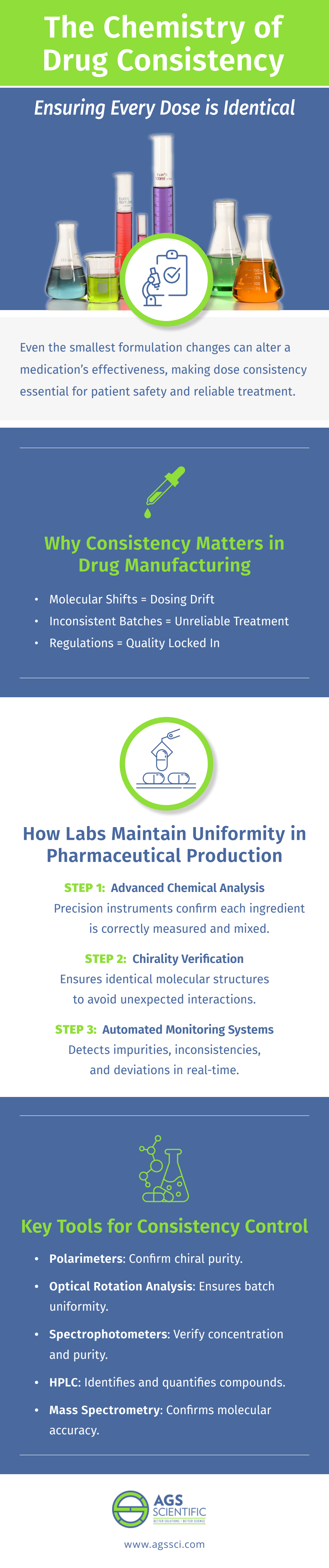
Pharmaceutical quality control helps ensure that every medication has the intended identity, strength, purity, and stability each time it is used. Patients and healthcare providers depend on consistent drug quality for predictable treatment outcomes, so manufacturers must control ingredients, production processes, and testing from beginning to end.
How Pharmaceutical Quality Control Starts With Ingredients
Every medication contains an active pharmaceutical ingredient and inactive ingredients that support manufacturing, stability, and absorption. Each component must meet defined quality specifications before production begins.
Variations in raw materials can change how a medication dissolves, how long it remains stable, or how well it delivers the intended dose. Manufacturers test incoming materials for identity, purity, and strength. Reliable sourcing also reduces differences between production batches.
Which Manufacturing Controls Protect Drug Quality?
Consistency depends on repeating the same pharmaceutical manufacturing process under controlled conditions. Teams monitor temperature, humidity, mixing time, compression force, and coating procedures to catch unwanted variation.

Modern pharmaceutical facilities use validated equipment and written procedures to maintain uniformity from batch to batch. Automated systems can flag process deviations before products move forward. These controls support the Food and Drug Administration’s Current Good Manufacturing Practice (CGMP) requirements, which are the minimum federal standards for drug manufacturing.
How Does Pharmaceutical Testing Verify Performance?
Finished medications undergo several laboratory tests before distribution. Scientists may evaluate potency, dissolution, moisture content, microbial quality, impurities, and physical appearance.
Testing alone cannot prove that every unit in a batch is acceptable because laboratories examine only a sample. The FDA gives an example in which a manufacturer may test 100 tablets from a batch of 2 million tablets. That is why quality must be built into the process rather than checked only at the end.
Specialized analytical instruments help detect impurities that could affect product quality. Laboratories may use mercury analyzers for material testing or environmental monitoring when mercury is a relevant risk; available methods include cold vapor atomic absorption and direct analysis by thermal combustion. The International Council for Harmonisation of Technical Requirements for Pharmaceuticals for Human Use (ICH) Q3D(R2) guideline calls for risk-based assessment and control of elemental impurities, including mercury. Broader impurity testing may also rely on carefully qualified pharmaceutical impurity reference standards.
How Does Drug Stability Testing Support Safe Use?
Medications must remain effective throughout their labeled shelf life. Drug stability testing exposes products to set temperatures, humidity levels, and other conditions to measure how their physical, chemical, and microbial properties change over time.
The results guide expiration dates, packaging choices, and storage instructions. Protective packaging can limit exposure to moisture, oxygen, and light that might reduce quality. Patients also play a role: follow the storage directions on the label, and keep medications away from excessive heat or moisture.
Why Does Quality Oversight Continue After Approval?
Quality monitoring does not stop when a medication reaches the market. Manufacturers continue reviewing production data, investigating complaints, tracking stability results, and watching for changes in manufacturing performance.
Regulatory agencies inspect pharmaceutical facilities to verify compliance with CGMP requirements. This oversight, a key part of pharmaceutical policy and law, helps identify contamination, process failures, and other problems that could affect patients. It also gives manufacturers evidence they can use to improve a process without weakening established controls.
Reliable medications come from a connected system, not one final test. For a practical next step, manufacturers should trace each critical ingredient and process control to a test result, investigation procedure, and responsible quality team. Strong quality control in pharmaceutical production gives clinicians greater confidence in what they prescribe and helps patients receive the same intended dose throughout treatment.