
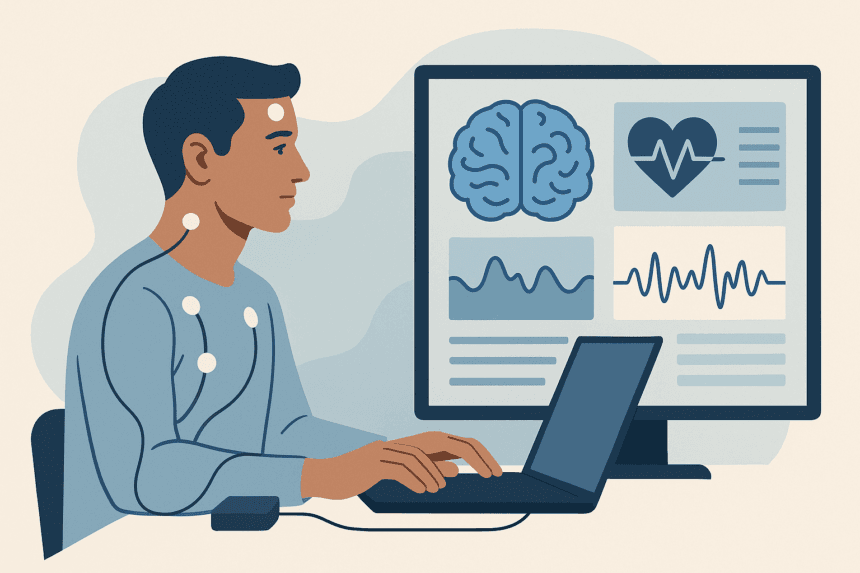
Biofeedback conditioning uses real-time feedback from body measurements to teach patients to change those responses; in addiction treatment, breathing-based training may help with craving, but the German trial examined here did not establish a lasting abstinence benefit.
In a 2015 German study of alcohol dependence, patients practiced breathing while watching a balloon move on a computer screen. A sensor attached to the earlobe measured their pulse. The balloon rose or fell as the variation between heartbeats changed, giving them feedback during the exercise.
The sessions lasted 20 minutes. A physician explained how to follow a breathing cue on the screen. Patients attended six sessions over two weeks and continued their usual rehabilitation care, including counseling. Researchers compared their progress with patients who received the same standard care without biofeedback.
This is one form of biofeedback, called heart rate variability (HRV) training. It measures changes in the time between beats rather than simply counting how fast the heart is beating.

The research raises two separate questions: can the training help with craving or anxiety during treatment, and does that help someone remain abstinent after leaving? The researchers examined the second question in a one-year follow-up published in 2017, which did not establish a statistically significant improvement in abstinence.
What changed during treatment with biofeedback
Craving improved earlier in the biofeedback group. But the heart rhythm measurements showed no statistically significant improvement. The trial involved 48 patients, split evenly between two groups. Everyone received rehabilitation care; half also attended the six biofeedback sessions.
Researchers tracked craving with a questionnaire. In the biofeedback group, the average score fell from 13.7 before training to 8.6 immediately afterward. That change was statistically significant compared with the group’s starting score.
Patients receiving standard care alone also reported less craving at later assessments, so the results need some care: an earlier improvement in one group does not, by itself, establish that its treatment worked better than the other.
Anxiety scores fell in the biofeedback group at the three- and six-week follow-ups. The researchers did not find a statistically significant reduction in anxiety in the control group.
The heart measurements gave a less clear result. One measure of heart rate variability moved upward after training, but the change was not statistically significant. Other HRV measures showed no significant change either. Patients could report feeling better without the recordings showing a clear improvement in the heart rhythm measures being studied.
A 2026 review by Ariel Dart Roxburgh and colleagues in Addiction found a small reduction in craving across 12 breathing-intervention studies involving 696 participants, but the review found no significant difference in craving effects between HRV biofeedback and other breathing interventions. That leaves a practical question for clinics: what benefit does the feedback equipment add beyond breathing practice?
After patients went home
The German trial’s one-year follow-up did not establish an abstinence benefit. A year after discharge, the team sent out questionnaires asking whether patients had drunk alcohol since leaving rehabilitation. Twenty-seven people answered. The other 21 never returned the survey.
Among those who replied, ten of the 15 patients who had received biofeedback reported staying alcohol-free. Six of the 12 patients in the comparison group said the same. The numbers favored biofeedback, but the difference did not reach statistical significance.
With so many replies missing, the researchers ran the comparison again. This time, they counted every person who hadn’t answered as having returned to drinking. That was an assumption for the calculation; the team did not know what had happened to those patients. The second analysis still could not establish an abstinence benefit.
The team also went back to measurements taken during treatment. Neither the craving and anxiety scores nor the heart rate variability readings showed a significant association with abstinence a year later. A larger study would be needed to investigate whether those measurements could help predict addiction recovery.
The patients behind the results
The German study tested biofeedback as an addition to residential rehabilitation, not as a stand-alone treatment. Patients stayed there for 12 weeks, attending group therapy and individual counseling. Staff fitted the biofeedback appointments into that schedule and reminded patients when to attend.
Everyone entering the trial had already spent at least five days without alcohol. A physician checked for withdrawal symptoms before enrollment. That means the study offers no evidence about using biofeedback during alcohol withdrawal.
Recruitment also left out people with depression, diabetes or heart disease, among other conditions. Two people screened for the trial could not join because they had depression. The researchers excluded certain medications as well, including antidepressants and beta blockers, because they could affect the measurements.
Those choices narrowed the group being studied. A clinician treating someone with both alcohol dependence and depression would have to look beyond this trial for evidence relevant to that patient.
Nor did the researchers test biofeedback on its own. Both groups continued receiving rehabilitation care throughout the experiment.
Discussing biofeedback with a treatment provider
Before signing up, have the clinic walk you through an appointment. Where does the sensor go? What appears on the screen, and who explains what to do with that information? Those details make technology in addiction treatment easier to understand than a service name on a website.
Holland Pathways advertises biofeedback therapy. Its staff can clarify which method they offer and whether it resembles the breathing practice studied here. The research described in this article did not evaluate Holland Pathways.
Take that explanation into the discussion of your care plan. You should know where the sessions fit, what they cost and how the clinician will judge whether they’re helping. A change on the screen is something to discuss alongside what you experience between appointments.
If you’re expected to continue biofeedback training after discharge, get the instructions before leaving. Ask whether equipment is needed and who can help when you have questions.