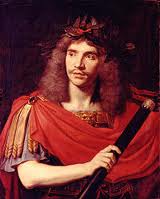
“Doctors pour drugs of which they know little, to cure diseases of which they know less, into patients of whom they know nothing.”
Moliére, 17th century playright

“Doctors pour drugs of which they know little, to cure diseases of which they know less, into patients of whom they know nothing.”
Moliére, 17th century playright

A 17th century fighter against fraud and abuse
When physicians take themselves too seriously it would be healthy to remind ourselves of the somewhat less than auspicious aspects of the profession. Moliére, the delightful French playright of the 17th century, made a successful career out of exposing quacks and charlatans in his classic Le Malade Imaginaire, Le Misanthrope, The Doctor in spite of himself, and Tartuffe.
Let me suck some of your blood

Greeks did it, we did it, and we still do
The guy who is doing the bloodletting is an iathros -physician, in classical Greek. Did you know that when physicians caused a disease, we gave it the opaque name iatrogenic, way before the malpractice era? It actually sounds so scientifically respectable it shielded the offending doctor from loss of respect, or ridicule, or loss of life in some cultures. But is the practice dead?

Modern-day bloodletting; great improvement over leeches

Dr Dalrey, aka Dr. Quack
The good doctor was one of the richest physicians of his time. In fact, there is a theory that the term “quack” originated from “quicksilver”, and was dedicated to him. A more plausible source, in my opinion, is from “quack” to shout, in old English, and “salve” meaning therapy. In other words, quacksalver is one who loudly promotes his salves. What would you call today’s drug advertisements shouting at us from every TV program?
The quitessential American enterpreneur
What is the American contribution to breakfast food? The cereal, of course. Until the introduction of corn flakes breakfast was invariably ham and eggs. The person who introduced this food was Dr. John Harvey Kellogg.

Dr kellogg’s formula; eat your morning cereals, and follow up with daily enemas
He was quite bizzare. In addition to elaborate diets he advocated cleansing enemas, vibration therapy, light therapy, to name a few. To cure what? everything from headaches, to eczema, arthritis and chest pain. Bizzare or not, he was wildly popular and his corn flakes, manufactured in his plant at Battle Creek, Michigan, is still with us today. But that’s not all: A number of entrepreneurs from Battle Creek, including Sylvester Graham (“Graham Crackers”) and CW Post (“Post Cereals”), soon climbed upon the bandwagon with their manufacture of breakfast cereals and health foods. Have you ever suspected that the cereal aisle in your favorite supermarket is so heavy with medical history, albeit not very glorious?
Another quintessential American invention is snake oil. Yes, I am not kidding. Patent medicine salesmen hawked this product in every little town in America, and quickly high-tailed it out of town, before being strung out by the angry townspeople on the first available tall tree.

It isn’t just a metaphor; here is proof
Speaking of legacy: did you know that the ubiquitous vibrator has a terribly male-chauvinistic origin? Female depression and emotional excesses were thought to originate from the uterus, and were classified as hysteria (form the Greek word hystera, for uterus); so what a better way to cheer up a sad uterus then an invigorating vibratory stimulaton? Dr. Swift swooped it, to the delight of many a female patient.

Did they teach it in med school in those days?
And the best of them all is…
Dr. Jason Salber sent me this one. This is utterly unbelievable, but true nonetheless. Physicians gave patients tobacco smoke enemas for various medical purposes, primarily for resuscitation of drowining victims. A rectal tube inserted into the anus was connected to a fumigator and bellows that forced the smoke up the rectum. the warmth of the smoke was thought to promote respiration. Unfortunately, no drowning victim was thusly resuscitated, but the treatment did leave a legacy: the expression of “blowing smoke up your ass”. Don’t believe me? Click on this link Nash_Spring2012_1up (dragged).
Mondo bizzaro. Although, on reflection, we shouldn’t rush to judgment. I am sure that one hundred years from now some smart aleck, not unlike the present writer, will poke fun at the way we practice medicine today. I will leave you with the sage words of William Osler, the father of modern American medicine:
The philosophies of one age have become the absurdities of the next, and the foolishness of yesterday has become the wisdom of tomorrow…
William Osler, MD (1902)