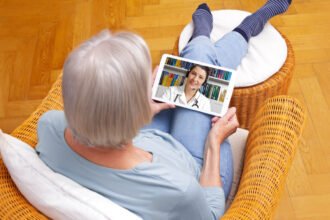
Who says doctors don’t make house calls anymore? As a healthcare professional, it’s true that you won’t be knocking on a patient’s door to give a consultation and write a prescription, but that doesn’t mean that you won’t be invited into anybody’s home for a routine checkup. Such is the world of telemedicine.
Who says doctors don’t make house calls anymore? As a healthcare professional, it’s true that you won’t be knocking on a patient’s door to give a consultation and write a prescription, but that doesn’t mean that you won’t be invited into anybody’s home for a routine checkup. Such is the world of telemedicine.
With just a click of a button, doctors now have the ability to reach out to their patients through a Skype-style chat. It’s certainly convenient, but is it a safe and effective way to practice?
Insurance Companies Don’t Like It

Some of the biggest opponents for telemedicine are insurance companies. For starters, Medicare is being very resistant to this change. Medicare often sets the standards for other insurance policies, and if they don’t approve, it’s difficult to get in the door with any insurance company. Medicare believes that allowing telemedicine services will significantly increase costs for one thing.
For another, they’ve heard one too many doctors say that physical visits are much more effective. These doctors believe that telemedicine increases the risks of misdiagnoses, which leads to a myriad of legal, physical, and financial issues.
Many state legislatures and medical boards are also struggling with the idea of granting doctors and insurance companies the legal ability to use and bill telemedicine. Texas is one of the principal states that’s fighting to slow the technological advancements that make this kind of doctor’s visit possible.
Why Many Hospitals Are Pushing the Issue
Telemedicine has been around and worked successfully for years. Granted, the use of video conferencing with patients has mostly been utilized in remote areas where patients had no access to a doctor. Still, it’s turned out to be an extremely effective way to administer care, diagnose patients, and dole out prescriptions. This is one of the many reasons that several hospitals and state medical boards are working to institute telemedicine across the country.
Advocates also insist that these modern house calls will significantly reduce overhead in the long run. Imagine a clinic entirely devoted to virtual visits. There would be no need for much of the heavy equipment, office space, and staff that you would see in a traditional office.
As it turns out 71 percent of emergency room visits are unnecessary, but that doesn’t mean the patient gets out of the bill. Health care administrators that are seeking for this reform believe that this type of clinic would cut the cost for patients by up to $50.
But Is It Effective?
The other reason that medical boards are pushing the issue is that it’s effective in many circumstances, though the concerns that the opposing view brings are valid. Now that virtually everyone has access to telemedicine, it brings up a wide array of concerns, with liability at the forefront.
However, when used correctly, telemedicine can help to save both doctors and patients a lot of hassle. How many times do you recall examining a patient in a similar manner: The patient comes in, and you look them up and down. They describe their symptoms, and you ask a series of questions. By the end of this process, you’ve diagnosed the issue and prescribed medicine without ever touching them. This kind of visit is pretty common in clinics and urgent care settings.
Besides that, this kind of medicine eliminates the problem of office hours. Telemedicine has healthcare professionals on call around the clock, unlike your local clinic or urgent care. This means that when a six-year-old patient comes down with strep throat in the middle of the night or on a weekend, she can get a prescription right away rather than waiting until Monday morning.
Many doctors report loving this branch of medicine for the sheer serenity it brings. While they’re in their virtual clinic, doctors are away from the hustle and bustle of a clinic or hospital and can focus on just one patient without distraction.
It’s true that people will abuse the privilege. They will try to call in for something when they should go into the physical clinic instead. However, a good doctor will be able to recognize when they can’t diagnose something over the web, and at that point, the doctor can advise a patient to go to a nearby healthcare establishment for a full checkup. After that, the liability falls on the patient.
The question is not so much whether or not it’s effective, because it clearly is in many circumstances. The issue revolves around whether or not insurances and medical boards across the country will approve telemedicine, and whether or not patients will abuse it.
Because it has not been widely instituted, it’s not clear whether or not it will create more problems than it solves. There will always be room for improvement, but when instituted with a set of protective policies, procedures, and guidelines, telemedicine could be the new frontier for medicine.