We use cookies, including third-party cookies from Google to serve personalized ads through AdSense, to operate this site and understand how it is used. By continuing to browse, you accept this use. See our Privacy Policy and Terms of Use for details, including how to opt out of personalized advertising.
Accept
Health Works CollectiveHealth Works CollectiveHealth Works Collective
  • Health
    • Mental Health
  • Policy and Law
    • Global Healthcare
    • Medical Ethics
  • Medical Innovations
  • News
  • Wellness
  • Tech
Search
© 2023 HealthWorks Collective. All Rights Reserved.
Reading: American Ambivalence Towards Health Care Costs
Share
Notification Show More
Font ResizerAa
Health Works CollectiveHealth Works Collective
Font ResizerAa
Search
Follow US
  • About
  • Contact
  • Privacy
© 2023 HealthWorks Collective. All Rights Reserved.
Health Works Collective > Policy & Law > American Ambivalence Towards Health Care Costs
Policy & Law

American Ambivalence Towards Health Care Costs

Brad Wright
Brad Wright
Share
3 Min Read
SHARE

“Bending the curve”–slowing the rate of health care cost growth–continues to be front and center in the health policy and health services research world. It’s imperative that we do something to bring costs under control, but the more I think about it, the more my cynicism dominates my thinking. As I see it, the American people are the biggest hurdle to the implementation of cost-saving reforms. Now that has nothing to do with political preferences or party affiliations. Rather, I am talking about the attitude most Americans have towards health care spending.

“Bending the curve”–slowing the rate of health care cost growth–continues to be front and center in the health policy and health services research world. It’s imperative that we do something to bring costs under control, but the more I think about it, the more my cynicism dominates my thinking. As I see it, the American people are the biggest hurdle to the implementation of cost-saving reforms. Now that has nothing to do with political preferences or party affiliations. Rather, I am talking about the attitude most Americans have towards health care spending.

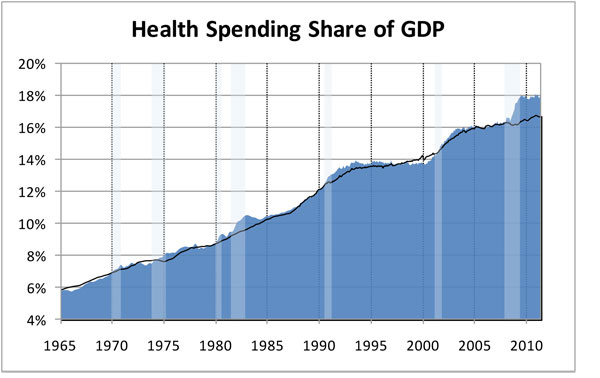
Most Americans (especially those under 65) see the need for cuts in Medicare, for example, but they don’t want to see their own benefits reduced in any way. If you don’t believe that, ask yourself how the GOP can have so much support for cutting spending, while the only real point in the last 50 years when health care spending growth slowed was during the era of managed care that resulted in a tremendous popular backlash and a move to PPOs. If you want data, here’s a nice chart:

Essentially, it is a classic example of the “us” versus “them” problem. Notable variants include the “we” versus “they” dilemma and the “I” versus “you” conundrum. The central issue in each case is our tendency to apply a different standard to the “us” “we” or “I” than we apply to the “them” “they” or “you.” For example, “I” would like to have access to the best health care in the world, but “I” would not necessarily like to pay for “you” to have it, too. When it comes to me and my family, “we” want what is best for “us” and as for everyone else, “we” leave it up to “them” to do the best “they” can. But, if the “I” can be expanded to the “we” or “us” and still make sense, then why can’t we expand our scope so that “we” includes all Americans? Many would say that that sort of solidarity is just not the American way. Duly noted. Then perhaps we should use the one thing that we all share to unite us.

More Read

The Global Eye Tracking System Market Is Expected To Skyrocket In The US
HHS Updating Regulations to Recognize Changing Technology
Debating Healthcare
Physician Burnout: Three Symptoms, Three Phases, Three Cures
Minnesota Announces New Strategies Dealing with Opioid Abuse

Visit B.Wright Consulting


TAGGED:health care costs
Share This Article
Facebook Copy Link Print
Share

Stay Connected

1.5KFollowersLike
4.5KFollowersFollow
2.8KFollowersPin
136KSubscribersSubscribe

Latest News

How to Choose an On-Demand Medical Interpreting Provider for Your Hospital -- AI-generated illustration
How to Choose an On-Demand Medical Interpreting Provider for Your Hospital
Health care
August 12, 2026
The Chemistry Of Drug Consistency -- AI-generated illustration
The Chemistry Of Drug Consistency
Policy & Law
August 12, 2026
Dental Materials Through The Decades -- AI-generated illustration
Dental Materials Through The Decades
Dental health Infographics Specialties
August 12, 2026
DNP or PhD: What Each Actually Means for Your Nursing Career -- AI-generated illustration
DNP or PhD: What Each Actually Means for Your Nursing Career
Career Nursing
August 12, 2026

You Might also Like

Gemma at the dell Social Innovation Lab
Global Healthcare

Nothing is Impossible: Global Women’s Water Initiative

October 29, 2012

Still Missing: Price Transparency in Healthcare

March 6, 2014
comparative negligence
News

Not Knowing About Comparative Negligence Can Worsen Your Medical Debt

April 12, 2023

How Employers Plan to Respond to the New Health Reform Law

May 24, 2011
Subscribe
Subscribe to our newsletter to get our newest articles instantly!
Follow US
© 2008-2026 HealthWorks Collective. All Rights Reserved.
  • About
  • Contact
  • Privacy
Welcome Back!

Sign in to your account

Username or Email Address
Password

Lost your password?