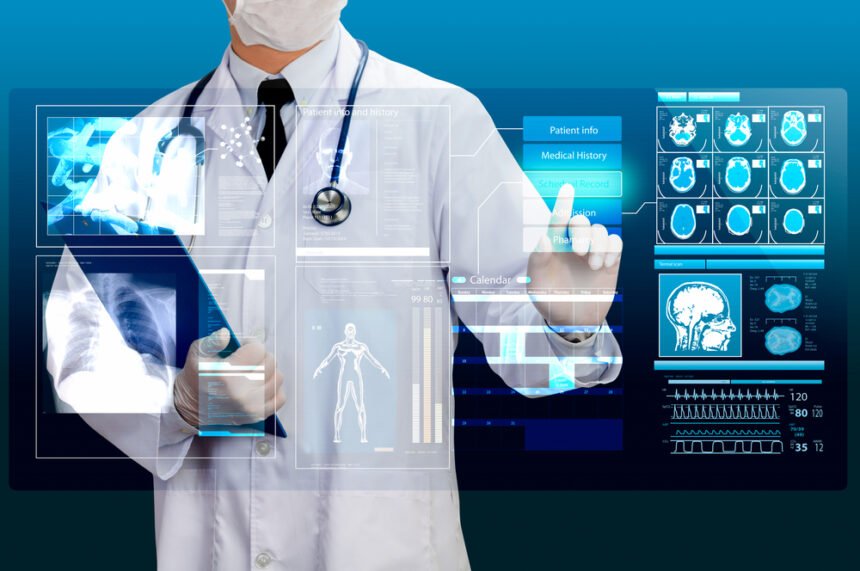
The use of radioactive substances in diagnosis and treatment has led to the use of digital tools like smart tools and computer which give accurate and quickest test. But the most attractive and modern form is the artificial intelligence that is incorporated with PACS Radiology services as a result, problems that one might overlook are detected, the time factor is saved.
How Diagnostic Imaging integrates with Artificial intelligence
The greatest desire of an individual is to do things most suitably. Currently, the workflow is electronic. Therefore more chances are created to use modern technology to make work more efficient and presentable. The concept of interpreting images has remained to be a fundamental challenge to radiologists. For instance, technology should make one more dependable in interpreting relevant images. Research has shown that artificial intelligence is integrated with Diagnostic Imaging. Images typically go to PACS and a similar copy to artificial intelligence. The images are interpreted, and the outcomes are preserved. When the radiologist is interpreting, the PACS gives information to the third ?party thus delivering the results.Availability of artificial intelligence is shown by an icon on the desktop. The icons are always color ? coded making it simple for to understand. Green one indicates that there are no deviations. Red icons suggest that there are abnormalities in the outcomes. A decision can be made either to includes finding or not in the report. The process needs time understand the images. If a study is opened afterward, the results might not be traced back. Within 6 to 7 minutes the findings are recorded. If results are determined earlier, there are possibilities of the artificial intelligence to call for an instant result from a radiologist, thus tampering with study prioritization.
Chances of reading a study with Al ?algorithm are minimal since algorithms are limited and very particular, each aiming at specific findings. The limited algorithm can only assess the lungs and density measurement of the bones. Only works on CTs of the chest and pelvis.
How to get the results that radiologist could fail
Radiologists have little knowledge of the technology of only identifying the aspects mentioned above. Even though algorithms might minimize the chances of missing, you can make findings on your own. For instance, when evaluation a chest CT for lung cancer, you should focus on concrete evidence.Abnormality of the bone is an example that might be missed when examining breast test. But with the help of algorithm, a calculation is done, and the density of the bone is estimated. The information is not usually gotten when looking at study thus adding value. As the progress goes on, additional value is expected for the approach. A person can miss things, but algorithm may make it possible for breast cancer to be identified.
Problems of using Artificial intelligence
Artificial intelligence is incorporated smoothly into a workflow. The technology is inconspicuous and doesn’t slow down. There is a need to work with current clinics. The existing algorithms indicate deviations are available, which is fair for limited types of abnormalities evaluated. Developing accurate algorithms is the primary challenge that each has a negative impact. A radiologist is best at their work. Therefore it is a challenge to come up with a unique algorithms that improve the skills. The effect is that some of the clinics have been influenced by reports from radiology. Our radiologists often read CTs for trauma, and artificial intelligence shows that the patient may have osteoporosis.As a result, radiologists view technology integrated into workflow and gets amazed on how efficient it can be. Generated results can be available for interpretation since there is no additional burden. Even though algorithms are minimal, outcomes of the future are shown. The above discussion has shown how artificial intelligence is merging With Diagnostic Imaging. These have a positive impact in our technology which enhances smooth workflow. Clinicians also benefit from the integration thus adding value on results after a test.