We use cookies, including third-party cookies from Google to serve personalized ads through AdSense, to operate this site and understand how it is used. By continuing to browse, you accept this use. See our Privacy Policy and Terms of Use for details, including how to opt out of personalized advertising.
Accept
Health Works CollectiveHealth Works CollectiveHealth Works Collective
  • Health
    • Mental Health
  • Policy and Law
    • Global Healthcare
    • Medical Ethics
  • Medical Innovations
  • News
  • Wellness
  • Tech
Search
© 2023 HealthWorks Collective. All Rights Reserved.
Reading: Biological Growth Factors in Wound Care Drive Big Revenue Growth, Too
Share
Notification Show More
Font ResizerAa
Health Works CollectiveHealth Works Collective
Font ResizerAa
Search
Follow US
  • About
  • Contact
  • Privacy
© 2023 HealthWorks Collective. All Rights Reserved.
Health Works Collective > Business > Finance > Biological Growth Factors in Wound Care Drive Big Revenue Growth, Too
BusinessFinanceTechnology

Biological Growth Factors in Wound Care Drive Big Revenue Growth, Too

PatrickDriscoll
PatrickDriscoll
Share
2 Min Read
SHARE

Extensive research has demonstrated that wound fluid is rich in growth factors. Growth factors are naturally occurring proteins found primarily in platelets and macrophages. They are needed for normal wound healing to promote growth and migration of fibroblasts, endothelial cells and keratinocytes.

Extensive research has demonstrated that wound fluid is rich in growth factors. Growth factors are naturally occurring proteins found primarily in platelets and macrophages. They are needed for normal wound healing to promote growth and migration of fibroblasts, endothelial cells and keratinocytes. The functions of growth factors include; attraction of cells to the wound site (chemotaxis), stimulation of cell division/ proliferation (mitogenic competence/progressive), differentiation of cells into specific phenotypes (transformation), and stimulation of cells to perform functions or secrete other growth factors. Growth factors bind to receptors on the cell surface where they activate cellular proliferation and/or differentiation. There are a number of growth factors which are involved in wound healing at different points in time. Many are quite versatile and capable of stimulating cellular division in different cell types; others are specific to a particular cell type.

Below is a list of the growth factors involved in wound healing:

  • Epidermal growth factor
  • Transforming growth factor-?
  • Hepatocyte growth factor
  • Vascular endothelial growth factor
  • Platelet derived growth factor
  • Fibroblast growth factor 1 and 2
  • Keratinocyte growth factor

(The origins, effects and companies pursuing development of these growth factors is described in link.)

More Read

doctor-patient relationships
The Doctor-Patient Relationship of Today
Genes May Reduce Guesswork for ADHD, Depression Treatments
Mobile Medicine: Apps To Manage Your Health
Are Doctors Prepared for Impending Changes to Medical Billing Practices?
3 Often-Neglected (But Powerful) Internet Marketing Tools for Healthcare

Since the market for growth factors in wound management is very new, there are as yet only a few players, but with compound growth in this market pushing well over 20% annually, the lucrative market will stimulate a burst of new entrants over the next few years. Currently, Smith & Nephew holds a dominant position due to its acquisition of Healthpoint Biotherapeutics (pre-acquisition market shares shown separately, below).
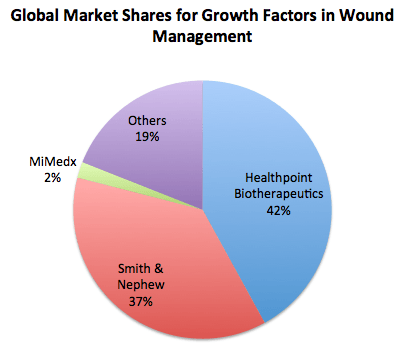
growth factors in wound management

Additional companies include Citagenix, Cytomedix, Daewoong Pharmaceutical, Macrocure and others.

Source: MedMarket Diligence, LLC; Report #S249.

TAGGED:wound care
Share This Article
Facebook Copy Link Print
Share
By PatrickDriscoll
Follow:
I serve the interests of medical technology company decision-makers, venture-capitalists, and others with interests in medtech producing worldwide analyses of medical technology markets for my audience of mostly medical technology companies (but also rapidly growing audience of biotech, VC, and other healthcare decision-makers). I have a small staff and go to my industry insiders (or find new ones as needed) to produce detailed, reality-grounded analyses of current and potential markets and opportunities. I am principally interested in those core clinical applications served by medical devices, which are expanding to include biomaterials, drug-device hybrids and other non-device technologies either competing head-on with devices or being integrated with devices in product development. The effort and pain of making every analysis global in scope is rewarded by my audience's loyalty, since in the vast majority of cases they too have global scope in their businesses.Specialties: Business analysis through syndicated reports, and select custom engagements, on medical technology applications and markets in general/abdominal/thoracic surgery, interventional cardiology, cardiothoracic surgery, patient monitoring/management, wound management, cell therapy, tissue engineering, gene therapy, nanotechnology, and others.

Stay Connected

1.5KFollowersLike
4.5KFollowersFollow
2.8KFollowersPin
136KSubscribersSubscribe

Latest News

Flat editorial illustration: Healthcare ethics-and-law training, shown through a coached clinical role-play where structured disc
Medical Ethics and the Law: The Training Behind Professionals Who Resolve Healthcare Disputes
Uncategorized
November 6, 2026
Flat editorial illustration: The article connects routine occupational health screening with early exposure detection and better
What Routine Workplace Health Monitoring in Medical Environments Actually Prevents
Uncategorized
November 6, 2026
Flat editorial illustration: The article contrasts structured prelicensure education with ongoing, practice-focused development f
Academic vs. Clinical Education: How Teaching Settings Shape Nursing Learners and Outcomes
Uncategorized
November 6, 2026
Flat editorial illustration: Health-editorial illustration of the two-way relationship between substance use and disrupted sleep,
How Sleep Disruption Feeds the Addiction Cycle and What You Can Do About It
Addiction Recovery Mental Health Wellness
November 6, 2026

You Might also Like

competition
BusinessFinance

Convenience: The Frightening Undercurrent of Healthcare Competition

March 12, 2014

First Steps in Inbound Marketing for Medical Device Companies

August 15, 2014
Telemedicine conceptual illustration.
Medical InnovationsTechnology

CIO Perspective: IDC Predicts Virtual Care Will Become Routine by 2018

April 7, 2016
Business

6 Marketing Strategies to Get More Patients

July 29, 2016
Subscribe
Subscribe to our newsletter to get our newest articles instantly!
Follow US
© 2008-2026 HealthWorks Collective. All Rights Reserved.
  • About
  • Contact
  • Privacy
Welcome Back!

Sign in to your account

Username or Email Address
Password

Lost your password?