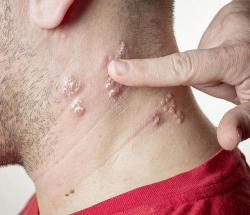
People who have had shingles — a viral infection that causes a painful rash — face an increased risk of stroke, according to a study appearing online in Neurology. “Anyone with shingles, and especially younger people, should be screened for stroke risk factors,” Judith Breuer, M.D., of University College London, stated in a press release. Although her research did not also establish whether vaccinating people against shingles might reduce the risk of stroke, she noted, “Current recommendations are that anyone 60 years and older should be vaccinated [against shingles]. The role for vaccination in younger individuals with vascular risk factors needs to be determined.”
Cause and Effect
Shingles is caused by the varicella-zoster virus, which lies dormant within your nerve roots after you have recovered from chicken pox. In some people, the virus reactivates years later and causes shingles. In others, the virus remains dormant. Shingles is most common in people between the ages of 60 and 80, though anyone can develop the symptoms. In fact, about 50 percent of Americans will experience shingles before they reach the age of 80. The distinctive rash, which usually affects only a small section of one side of the body, lasts seven to 10 days in most cases and takes two to four weeks to fully heal. Along with this extremely painful rash, symptoms of the infection may also include fluid-filled blisters, itching, fever and chills, headache, fatigue, and a general achiness. For some people shingles will occur more than once.
To conduct the current study, a team of researchers accessed medical records within the UK national health system database. The team retrospectively reviewed the records of 106,600 people who had shingles and 213,200 people of similar ages who never had shingles for an average of six years after the shingles diagnosis. For some people, the review of records stretched as far back as 24 years. The researchers soon discovered a pattern.
People under the age of 40 were 74 percent more likely to have a stroke if they had had shingles. This remained true even after the researchers adjusted for risk factors such as obesity, smoking and high cholesterol. People under 40 were also 50 percent more likely to have a heart attack and 2.4 times more likely to have a transient ischemic attack (TIA or warning for a stroke) if they had had shingles. For people over 40 who had endured the disease, the numbers were less dramatic but still significant; they were 15 percent more likely to have a TIA and 10 percent more likely to have a heart attack than those who never had the illness.
Breuer said better screening and treatment for stroke risk factors, including diabetes, high cholesterol, and high blood pressure, may explain why older people are at lower risk for stroke and other heart-related events when compared to younger people.
“The shingles vaccine has been shown to reduce the number of cases of shingles by about 50 percent,” Breuer said. “Studies are needed to determine whether vaccination can also reduce the incidence of stroke and heart attack. However, what is also clear is that factors that increase the risk of stroke also increase the risk of shingles, so we do not know if vaccinating people can reduce the risk of stroke per se.” In September 2013, the UK’s National Health Service began offering a shingles vaccination program for the elderly. Within that population as well as other groups, such as immunosuppressed individuals, including those receiving cancer treatments or those living with HIV, shingles may develop complications and become a serious, even life-threatening condition.
Breuer’s study was supported by the National Institute for Health Research, University College London Hospitals Biomedical Research Center, and Sanofi Pasteur MSD, the European pharmaceutical company that produces a shingles vaccine. The Centers for Disease Control and Prevention recommends the shingles vaccine, specifically, Zostavax, for use in people 60 years old and older to prevent shingles. Results from a clinical trial involving thousands of adults over the age of 60 found Zostavax reduced the risk of shingles by about half (51 percent); it was most effective in people between 60 and 69, yet it also provided some protection for people older than that.
Recently it was discovered that this vaccination can have some serious side effects like blindness, hearing loss, and even shingles. There has been a Zostavax lawsuit started by people who were negatively impacted by this vaccine.
Source: Breuer J, Pacou M, Gauthier A, Brown MM. Herpes zoster as a risk factor for stroke and TIA. Neurology. 2014.
(shutterstock)