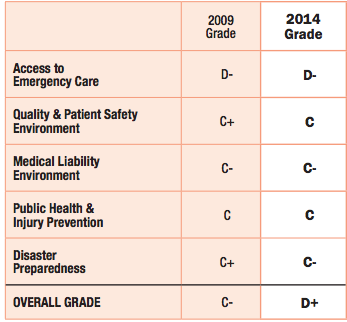
The American College of Emergency Physicians (ACEP) has just released a report card on Emergency Care in the US and it isn’t pretty. The overall grade was a D+, down from the 2009 grade of a C. Most parents would ground their kid if s/he came home with these types of grades, but how do you ground an ER? For one of the richest countries on earth, it is one more damning set of dismal findings about the state of our healthcare non-system.
The American College of Emergency Physicians (ACEP) has just released a report card on Emergency Care in the US and it isn’t pretty. The overall grade was a D+, down from the 2009 grade of a C. Most parents would ground their kid if s/he came home with these types of grades, but how do you ground an ER? For one of the richest countries on earth, it is one more damning set of dismal findings about the state of our healthcare non-system.
The Report Card
The College prepared the report by convening a task force of emergency physicians, chaired by John Mark Hirshon, MD, MPH, PhD, FACEP (no slacker in the credentials department). They graded care based on five categories using 136 “objective measures” from public data sources, such as the CDC, the National Highway Traffic Safety Administration, CMS and the AMA.
ACEP 2014 Emergency Care Report Card

Access to Care
The overall grade was largely determined by the almost failing grade in the category “Access to Care.” It is comprised of data on availability and capacity of EDs, workforce, and patient load. According to the report it is only going to get worse as ED visits have increased at double the growth of the US population for the past 20 years. Access to Care counted as 30% of the total grade.
In black are the states that got an F in Access:
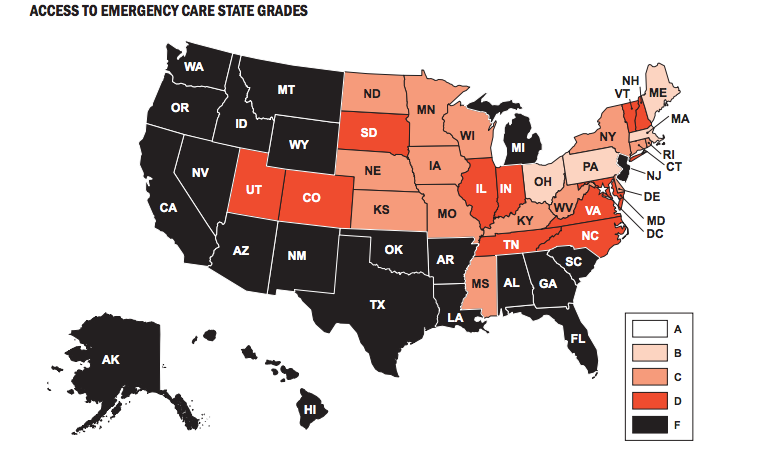
States Grades on Access to Emergency Care from ACEP Emergency Care Report Card 2014
Quality and Patient Safety Environment
Contributing 20% of the grade, this category includes such things as funding for quality improvement within the EMS system, a funded state EMS director, adverse event reporting, prescription drug monitoring, and protocols or systems for stroke and heart attack care. The overall grade was a C, but states such as Alaska, Texas and Louisiana all received Fs.
Medical Liability Environment
This also counted for 20% of the total grade and takes into account the legal atmosphere (number of lawyers per emergency physician (assuming a big number is bad!), insurance availability (both number of insurers as well as average premium) and tort reform (is there a liability cap on non-economic damages?). Since docs love to point to malpractice as a major contributor to healthcare costs, it shouldn’t be a surprise that the overall grade was a C-, rather the surprise is that four states (Idaho, Texas, Colorado and Kansas) got A’s (mainly based on caps to pain and suffering awards I believe).
Public Health and Injury Prevention
This only counted for 15% of the score even though many of the conditions treated in the ED are preventable (e.g., drunk driving car crashes). Prevention is not just the perview of prevention specialists, ACEP can make a difference via its education & lobbying efforts. The overall score for this category is a C. Alaska, many of the Southern states and Wyoming got F’s on this measure.
Disaster Preparedness
Overall score for this category was another C-. It counted for 15% of the total score. Pretty dismaying given the recent run of horrific natural disasters related to climate change (SuperStorm Sandy, the Oklahoma tornadoes) and unnatural disasters, such as the shootings at Sandy Hook and the Aurora, Colorado movie theater as well as the bombing of the Boston Marathon. Only two areas, North Dakota and District of Columbia received A grades in disaster.
State by State Rankings
The report provides details on the grades and rankings of each of the states and the District of Columbia. Want to see how your state is doing? Check this out:
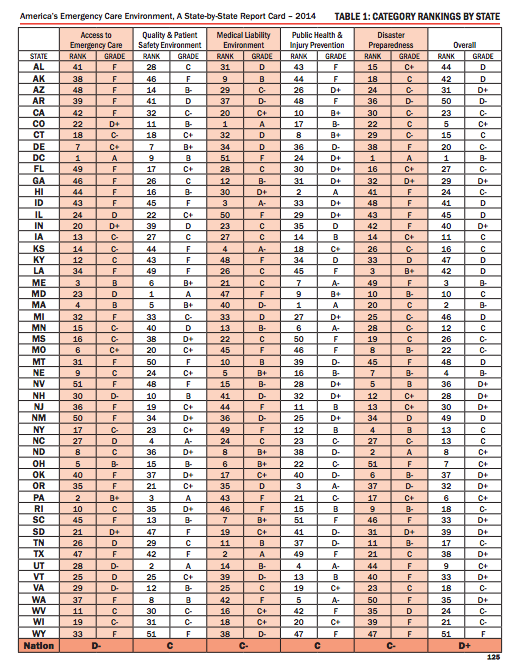
State by State Rankings Emergency Care from the 2014 Edition of ACEP’s Emergency Care Report Card
Here is a link to the full report.
So, What to Do?
ACEP has a list of recommendations that you can find in the report. They are all reasonable, but unlikely to be implemented across the board. What is missing from the list is a suggestion that it is simply unacceptable for any state to receive an F in any aspect emergency care. Poorly performing states should be required to remedy their issues in a defined time period or face sanctions. We aren’t going to move the needle without accountability. It should no longer be ok to invoke states’ rights when it comes to the provision of life-saving services. We shouldn’t have geographies in the US where access to emergency services is on par with under-developed or developing countries. No one should be at risk of dying from a treatable emergency condition because of red vs blue state politics.
Yes, it will cost money – but we waste a ton on inefficient and ineffective public services (e.g., bridges to nowhere or worse, politically motivated traffic jams on said bridges. What are we waiting for? The next ACEP report card that moves the overall score from a D+ to an F? Shame on all of us.