

Managing volunteer communication in healthcare starts with understanding how every interaction shapes a participant’s experience. From an initial welcome, thoughtful guidance shows newcomers what to expect as they settle into unfamiliar hospital surroundings. As early interest grows into ongoing involvement, steady support helps sustain the commitment people bring to their roles.
- Common Communication Challenges in Healthcare Volunteer Programs
- Tactical Tips for Stronger Volunteer Communication
- 1. Choosing the Right Communication Channels for Each Message
- 2. Making Communication a Two-Way Street
- 3. Setting Clear Expectations and Role Boundaries Early
- 4. Centralizing Volunteer Scheduling and Information
- 5. Tracking Volunteer Hours for Reporting and Grants
- Top Software Options for Managing Volunteer Communication
- FAQ
- What are the forms of communication between staff and volunteers?
- How do you choose the right communication channels for volunteers?
- How can volunteer communication be made a two-way street?
- What software helps manage volunteer communication?
- Building a Culture of Clear Volunteer Communication
To manage volunteer communication in healthcare, recording contact preferences during onboarding and separating duties from clinical tasks provides a clear foundation. Centralizing schedules in a single portal enables coordinated shift management alongside monitored channels for fast question resolution.
To manage volunteer communication in healthcare, record each participant’s preferred contact channels during onboarding, separate volunteer duties from clinical tasks in writing, and centralize schedules in a single portal. Pair automated shift reminders with a monitored inbox and a designated floor contact so volunteers can verify last-minute changes quickly.
- Keeping everyone informed across multiple locations and shifts requires an assigned coordinator to own each update.
- Recording contact preferences in volunteer profiles gives departments a clear reference for picking the right channels.
- Before volunteers start their first shift, a written role description must separate their duties from clinical tasks.
Common Communication Challenges in Healthcare Volunteer Programs
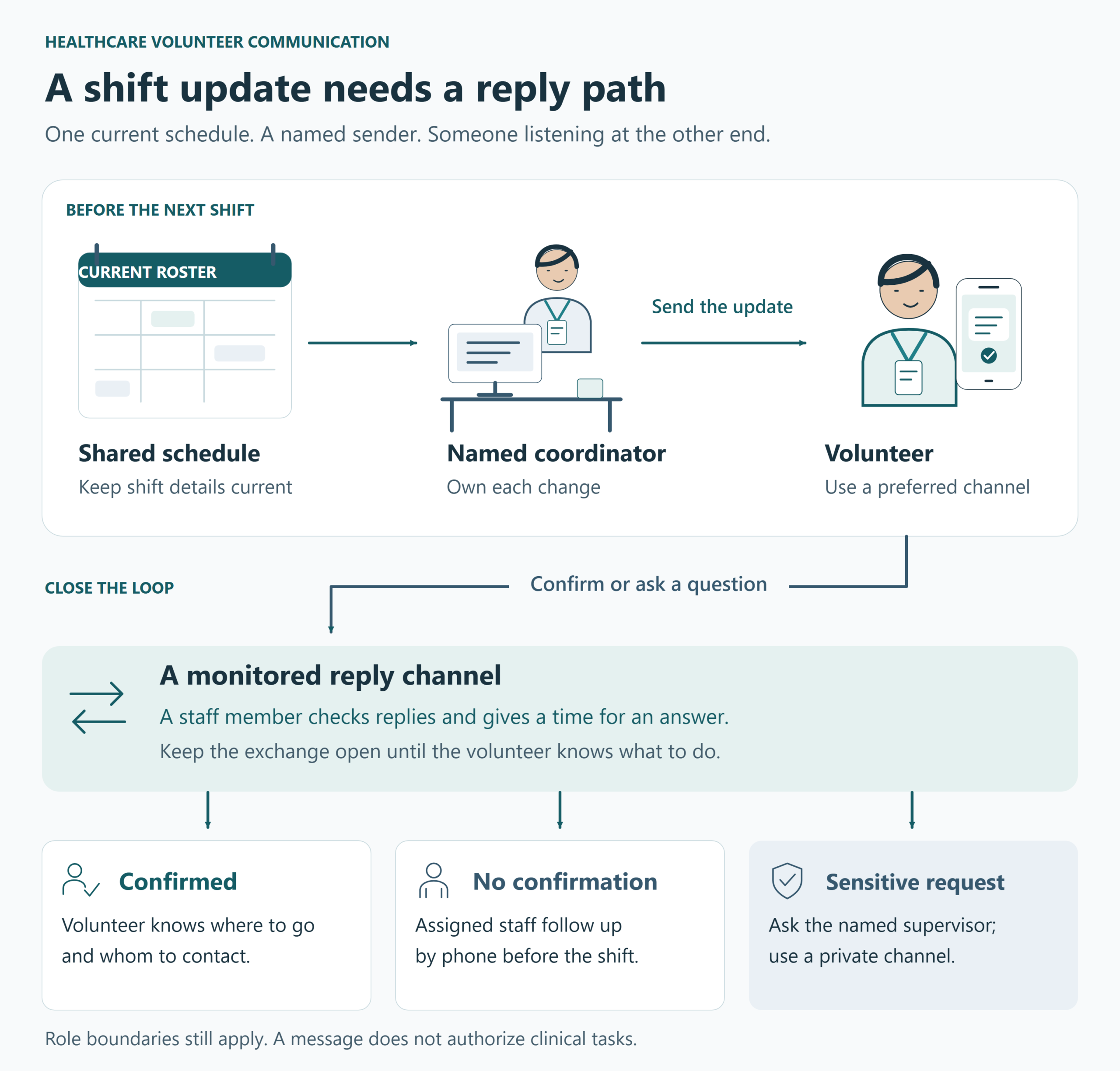
A volunteer arriving for an afternoon shift might get one set of instructions from the program office, only to hear something different at the department desk. Across multiple locations and shifts, keeping everyone informed requires an assigned coordinator to own each update instead of assuming another team handled it.
Even when someone owns that task, schedules stored in spreadsheets are tough to reconcile with last-minute updates sent through group texts. Piecing together the latest arrangements steals time away from welcoming newcomers, especially as programs grow. Meanwhile, training renewals and health screenings generate extra messages that managers must squeeze into the same workday.
For volunteers, the stakes get much higher when a request involves patient contact or confidentiality instead of a simple schedule change. Without clear boundaries around their duties, someone asked to handle an unfamiliar task might hesitate to question a staff member. Knowing exactly whom to consult gives that volunteer a safe way to check before acting.
Qualitative interviews with volunteers supporting pediatric hospital care in Italy identified unclear roles and staff turnover as barriers to collaboration, while structured information sharing strengthened working relationships. The study also cited earlier research showing that cooperation supports quality service, which shows why hospitals must fix internal communication gaps.
Tactical Tips for Stronger Volunteer Communication
To close those gaps, volunteer leaders can build a shared routine for delivering updates and answering questions. Grounding that routine in the actual situations people face during an ordinary shift keeps it practical instead of adding another set of instructions to memorize.
1. Choosing the Right Communication Channels for Each Message
During orientation, managers should ask volunteers which contact methods they reliably check before deciding how to share different updates. Recording those preferences in volunteer profiles gives departments a clear reference for picking the right channels and sending notices only to the affected people.
When a location change needs confirmation before the next shift, the communication plan should specify who checks responses. If a volunteer hasn’t replied by the deadline, that staff member can follow up by phone instead of assuming the message went through.
2. Making Communication a Two-Way Street
Even after volunteers confirm receipt, they might need to ask how an update affects their shift. When software sends out an announcement, a monitored inbox or quick check-in gives them a clear channel for questions. Whoever handles the inquiry should state when an answer will be ready so the volunteer isn’t left waiting.
Research backs up the value of two-way dialogue. A pandemic-era survey linked nonprofit leaders’ communication practices directly to how much they valued retention. While the study didn’t track exact retention rates, its authors emphasized building trust and listening during uncertain times. Explaining the reasoning behind a decision shows respect, even when the hospital can’t grant a specific request.
It can be tempting to think about volunteer communications as just that, speaking to your volunteers. But really, your communication strategy should also work the other way. Think about how you can encourage volunteers to communicate with you.
Addison Waters, Content Writer, Get Connected by Galaxy Digital, in The Effective Volunteer Communication Guide, in Addison Waters, The Effective Volunteer Communication Guide3. Setting Clear Expectations and Role Boundaries Early
Before volunteers start their first shift, a written role description must separate their duties from tasks requiring clinical or administrative staff. Walking through how to handle a request for patient information during orientation turns abstract rules into practical guidance. Running through realistic scenarios also lets participants test their understanding before facing the real thing on the floor.
To handle situations outside standard duties, the hospital should name a primary contact and a backup to cover absences. Having that chain of command ready gives volunteers someone to call when an unfamiliar request comes up. According to Residency Advisor guidance on clinical volunteering, participants who encounter a patient safety or privacy mistake should speak to their supervisor or volunteer coordinator right away to state what happened and ask what steps to take next. When responsibilities shift, targeted messages can flag who needs updated guidance before a supervisor walks them through the new expectations.
4. Centralizing Volunteer Scheduling and Information
Once managers pick a volunteer management system to hold schedules and contact info, they need to assign someone to keep those records current. A clear process for submitting changes supports that upkeep, while user permissions control who can edit entries or just view them. Regular audits catch double-bookings before different departments act on conflicting schedules.
Deciding where to store onboarding documents takes separate planning, especially when files contain sensitive health records. Instead of dumping every file into the scheduling platform, staff must follow hospital privacy and ASPR TRACIE healthcare volunteer management guidelines to pick the right storage system. Keeping privacy rules front and center lets teams balance convenience with strict access controls.
5. Tracking Volunteer Hours for Reporting and Grants
When hospitals track service hours for grant applications or funder reports, reporting requirements should dictate what volunteers log. If a platform includes time tracking, clear instructions must explain how to enter hours and whom to contact about missing entries. Setting up a correction process early lets participants fix mistakes well before grant deadlines.
If leadership translates those hours into dollar figures, the calculation needs a documented formula that follows the funder’s rules. Listing the financial estimate separately from raw logged hours makes it obvious which number reflects time given and which shows an assigned dollar value. That separation keeps readers from mistaking volunteer time for actual cash donations.
Top Software Options for Managing Volunteer Communication
Volunteer leaders can evaluate software against their daily communication routines to find tools that fit how staff and participants actually work. The platforms below offer distinct features for managing those interactions, giving healthcare organizations a solid starting point for choosing the right system.
| Platform | Communication features described | Program-management features described | Questions to verify before rollout |
|---|---|---|---|
| Volgistics | Administrator-to-volunteer messaging; branded volunteer portal | Scheduling, configurable fields and tailored reports | Which messaging settings fit the program, and do the documented security controls meet hospital requirements? |
| Offero | Automated shift reminders and participant feedback collection | Multi-site scheduling; onboarding and credential-expiry tracking | Who verifies screening and credential records before a volunteer is cleared for a shift? |
| VolunteerHub | Email and text messaging; automated and on-demand outreach | Hospital volunteer program coordination | Who monitors replies, handles exceptions and routes sensitive questions to a private channel? |
Volgistics
Volgistics pairs administrator-to-volunteer messaging and scheduling in a configurable system designed to let hospitals hide unused fields and build tailored reports. Managers can toggle features on or off during setup. They can also brand the volunteer portal with custom colors and images, giving participants a familiar place to check their schedules.
According to vendor materials, online support helps with setup at no extra cost, with staff coverage scheduled across weekdays and partial weekends. IT teams reviewing data protection can check Volgistics’ security documentation to evaluate its hosting architecture and encryption controls against hospital standards.
Offero
Hospitals managing assignments across multiple departments or clinics can evaluate Offero for multi-site scheduling across volunteers and administrators. Its workflow tools include automated shift reminders and participant feedback collection, alongside onboarding tracking for background checks and training.
Healthcare programs can also configure alerts to monitor immunizations, health screenings, and expiring credentials. While centralizing those records gives staff a shared view, the hospital still needs to decide who verifies pending items before clearing a volunteer for a shift. Assigning that duty during setup keeps final clearance decisions with the right department.
VolunteerHub
Healthcare teams evaluating VolunteerHub can use its email and text messaging tools for hospital program coordination. Its hospital volunteer management package includes automated outreach alongside on-demand messaging, giving coordinators ways to contact participants based on timing and urgency.
Getting the most from those tools starts with deciding which updates follow a predictable pattern and which need human judgment. A routine shift reminder fits automation well, whereas a sensitive question requires a thoughtful reply through a private channel. During setup, managers should assign someone to monitor replies and handle exceptions before an automated workflow sends a poorly timed message.
FAQ
What are the forms of communication between staff and volunteers?
Hospitals use four main forms of communication with volunteers: in-person orientations with written role cards, email broadcasts for policy updates and training links, opt-in SMS text alerts for urgent shift changes, and direct phone or floor supervisor check-ins when a question involves patient boundaries.
How do you choose the right communication channels for volunteers?
Survey volunteers during orientation to log which channels they check before a shift, then match each message to its urgency. Routine schedules and training files belong in email or a portal, while same-day room changes require text alerts backed by a phone call if unconfirmed.
How can volunteer communication be made a two-way street?
Pair every broadcast announcement with a monitored reply inbox and tell volunteers when to expect an answer. Coordinators can also send post-shift surveys and hold brief floor check-ins so participants can flag unclear duties before small misunderstandings cause turnover.
What software helps manage volunteer communication?
Healthcare facilities frequently evaluate platforms such as Volgistics, Offero, and VolunteerHub to coordinate shift assignments and volunteer messaging. Each platform provides distinct communication tools, such as administrator messaging, automated reminders, or text and email capabilities, which coordinators can compare against their program workflow and screening needs.
Building a Culture of Clear Volunteer Communication
When arrival instructions conflict across departments, volunteer leaders have a clear communication gap to fix. Tracing how a message travels to a volunteer usually reveals where ownership breaks down. From there, coordinators can test one fix and review it after a few shifts, using real feedback to guide the next tweak instead of overhauling the entire program at once.