Seeing the fast-growing market for personal connected health devices displayed at the recent Consumer Electronics Show, I couldn’t help but reflect on how far consumer connected health has come. Not too many years ago we spent a lot of energy sorting out how we would get home-derived vitals signs out of a device, out of the home, and into our database. We first used analog phone lines, which are increasingly going the way of the 8-track tape.
Seeing the fast-growing market for personal connected health devices displayed at the recent Consumer Electronics Show, I couldn’t help but reflect on how far consumer connected health has come. Not too many years ago we spent a lot of energy sorting out how we would get home-derived vitals signs out of a device, out of the home, and into our database. We first used analog phone lines, which are increasingly going the way of the 8-track tape. Cellular communication is exploding so we’re focused in that direction now. It’s not perfect yet, but it is a given that any tracking device you want to employ in connected health can and should be wirelessly enabled so you can easily move its data over the mobile internet. Costs need to go down and there is still some unnecessary technical complexity, but this is problem that is almost solved.
Now what? When you focus on solving a problem so intently it is sometimes hard to look beyond. Wirelessly connected sensors enable an important design principle of connected health: feedback loops. Once you capture the data from these devices, the first important thing to do with it is feed it right back to the consumers/patients from whence it came. Why?
Feedback loops are great for establishing awareness and for changing your mindset about your health.

They help us keep our health top of mind. There is a bit of narcissist in all of us and having the ability to gaze at our health data at a moment’s notice is compelling….for a while.
Inevitably we get bored or distracted. More is required. This figure from our paper on the use of text messaging to promote sunscreen use shows it nicely. The control group (lower curve) had access to a classic feedback loop – a device that recorded each time they used their sunscreen. You can see how their adherence decays quickly. We’ve seen this in many of our studies. It’s quite reproducible. Psychologists call this habituation, meaning once you get used to something, you tend to get bored by it and move onto something else. We are wired to pay attention to shiny new toys! I read about this effect as applied to relationships recently and learned of another term, hedonistic adaptation. I had to chuckle.
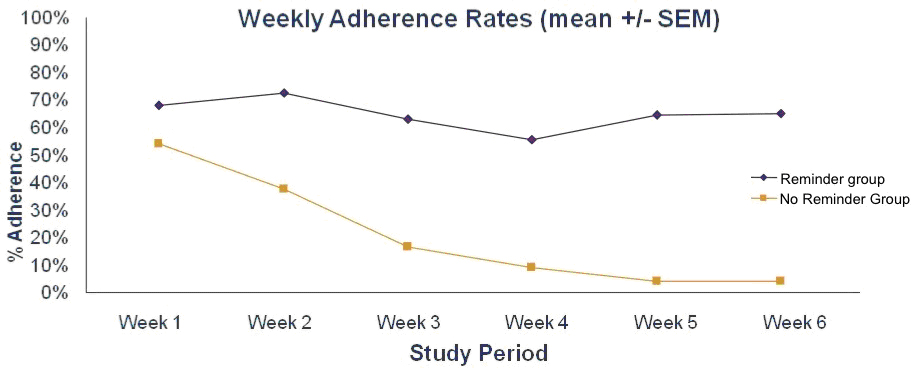
For years when we were measuring the effect of an intervention (examples include virtual coaching, the varied, automated messaging that improved blood pressure and led to the founding of Healthrageous, or our use of text messaging to promote sunscreen use) we did not appreciate that each of these would predictably do better than a control group. The commonality to all of these interventions is regular interaction with the study participants using some sort of changing messaging. This leads to conclusion number 2.
Feedback loops plus varied, contextual messaging are much more powerful than feedback loops alone.
Another thing we noticed repeatedly is that neither of these effects is 100%. This is also illustrated in the above figure. There are always 10% or so of individuals who keep up with the feedback loop alone (they don’t seem to habituate) and we can only get about 60-70% of folks to stay adherent with any given population-based approach.
That leads to the question: how do we keep more folks maximally engaged and responsive to their tracking data?
My sense is that we’re all wired to respond to different motivators. If we could learn enough about what motivates you to send you targeted, individualized, engaging messages on a regular basis that made your tracking data relevant, I think we’d achieve it. These messages would change over time as you grow and change in your quest for improved health.
We’re early in this journey, but I want to share two attempts to understand this phenomenon.
At the Center, we’re studying an algorithmic approach to engagement. Taking in information on an individual’s motivational state and matching that with their measured activity level and location data, the algorithm sends twice-daily, automated, motivational text messages. We’ve enrolled a panel of diabetics to test if such a tool can help them improve their activity level. I can’t say how it works because we’re in the midst of the trial right now.
Healthrageous combines tracking and other data to offer automated coaching to its participants as well as opportunities for them to use other motivational strategies such as social networking, challenges, games and incentives. I just saw an update on their progress the other day. They’ve enrolled over 12,000 individuals and have had great success in engagement (72% at week 16 and significant improvement in a number of health indicators such as activity and weight). Their combination of objective, biometric inputs and motivational messaging is proving to be a winner at scale.
It’s still early going. But we must figure out the engagement trick and individualize it. It will improve the health of our population greatly. We don’t have a choice but to act.