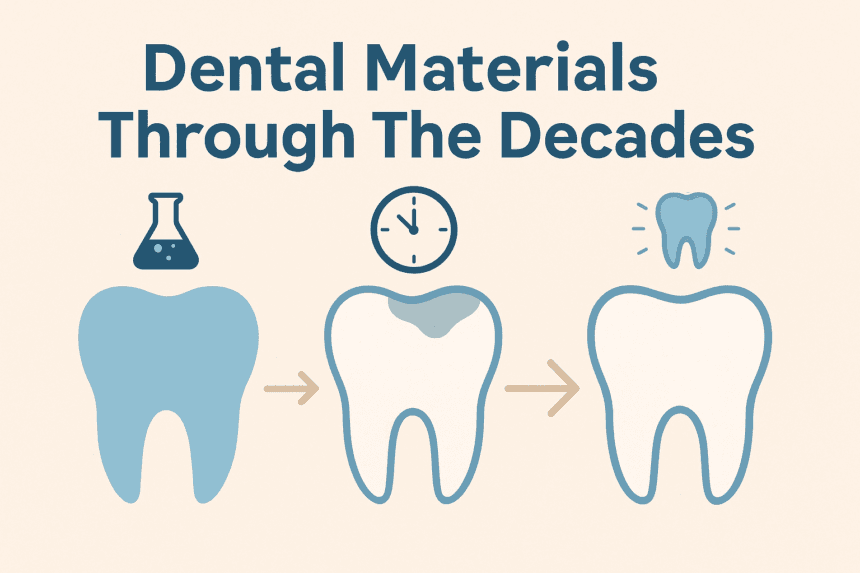
The history of dental materials shows a clear shift from strong, visible metals to tooth-colored, adhesive restorations made with digital tools. Scientific advances have expanded the options available to dental professionals, allowing treatment plans to better match each patient’s clinical needs, cosmetic goals, and budget. The result is more choice across dental health care, not one material that works best in every case.
Why Early Dental Materials Put Strength First
Before modern restorative dental materials became widely available, dentists relied on options known for durability. Gold was commonly used for crowns, bridges, and inlays because it resisted corrosion and tolerated years of chewing forces. Dental amalgam also became a standard choice for fillings in back teeth because of its strength, affordability, and long service life.
These materials have deep roots in the evolution of dentistry. The American Dental Association records that amalgam filling material entered the United States between 1833 and 1850, while a cohesive gold-foil method followed in 1855.
Gold and amalgam performed well, but they remained highly visible. As patients placed greater value on natural-looking smiles, demand grew for dental restoration materials that could match the color of enamel.
How Composite Resins Changed Restorative Dentistry
Composite resin changed routine dental care by providing tooth-colored fillings that blend with surrounding enamel. Better bonding systems also allowed dentists to preserve more healthy tooth structure during many restorative dentistry procedures.
Modern composites combine a polymer resin matrix, inorganic filler particles, and a coupling agent. Filler size and resin chemistry affect strength, polish, handling, and wear. One challenge remains: methacrylate polymerization can create marginal gaps and weaken the bond to the tooth as the material contracts during curing.
Changes in fillers, curing methods, and adhesives have improved wear resistance, polish retention, and color stability. These qualities make composites suitable for many front and back teeth, depending on the size and location of the restoration. Adhesive dentistry can also require less removal of healthy tooth structure than older techniques that depended mainly on mechanical retention.
Why Ceramic Materials Improved Esthetics
Ceramics brought a new level of natural appearance to dental restorations. Porcelain, lithium disilicate, and zirconia are used for crowns, veneers, bridges, and implant restorations, although their strength, translucency, and clinical uses differ. No single ceramic is ideal for every tooth.
Computer-aided design and computer-aided manufacturing (CAD/CAM) have changed how many ceramic restorations are made. Digital impressions create a three-dimensional model, while computer-guided milling shapes the restoration from a ceramic block. These workflows can support precise fabrication and, in some practices, same-day treatment.
What Happens to Precious Metals After Removal
Modern dentistry considers material recovery as well as clinical performance. Precious metals from older crowns, bridges, casting buttons, sprues, and laboratory grindings may retain value after a restoration is removed or fabricated.
Specialized processing through a dental lab refinery that contains lightweight scrap before melt assay and analysis can recover gold, platinum, palladium, silver, and other valuable metals. This step is different from ordinary waste recycling because mixed dental alloys must be processed and tested to determine their metal content. Recovery reduces material loss and may return value to a dental practice or laboratory.
What Comes Next for Modern Dental Materials
Current research focuses on stronger ceramics, longer-lasting composite resins, better adhesives, and bioactive materials designed to interact with tooth structure. Researchers are also working to control curing stress, reduce bacterial activity at restoration margins, and support mineral repair. Digital workflows are improving how clinicians plan, design, and fabricate restorations, but material selection still depends on the tooth, bite forces, moisture control, and patient needs.
The evolution of dental restoration materials gives dentists more ways to balance function, appearance, longevity, cost, and conservation of healthy tooth structure. Patients should ask which material is being proposed, why it suits that tooth, and what care it will require. Those questions turn the history of dental materials into a practical guide for choosing treatment today. Look over the infographic below for more information.