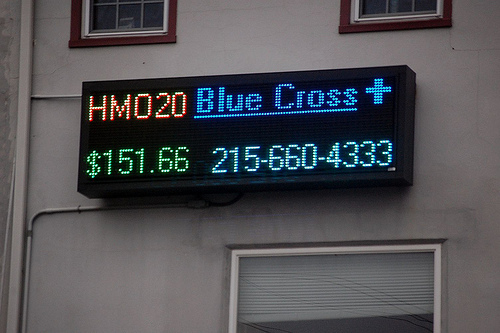
 Get your health plan here!
Health plans are starting to announce the rates they’ll be charging on health insurance marketplaces (aka exchanges) for 2015, the second go-round for Obamacare.
Get your health plan here!Health plans are starting to announce the rates they’ll be charging on health insurance marketplaces (aka exchanges) for 2015, the second go-round for Obamacare. For students of business strategy, healthcare policy and game theory, the results are fascinating to watch.
According to Avalere Health, average monthly premiums will rise 8 percent across the nine states with rate filings so far. Average premiums in Oregon will drop, and in other states they’ll increase between 2.5 and 16 percent. Meanwhile, the variation in price between the lowest and highest priced plan in each states will actually be bigger in 2015 than this year. The Wall Street Journal pursues a different angle, focusing on the 8.5 to 22.8 percent increases proposed by the largest health insurer in each state.
Here’s my take on what’s going on:
- Health plans went into the 2014 market pretty aggressively. They didn’t want to miss out on the biggest increase in newly insured patients ever, so they dived in even though they were unsure of how profitable the business would be
- As expected –and consistent with the intent of Obamacare– customers were able to compare plans on an apples-to-apples basis. Most shoppers paid close attention to price. As a result the health plans with the lowest or second lowest price grabbed the biggest market share in all 10 states the Journal analyzed. That helps explain why the Journal’s 8.5 to 22.8 percent price increase is so much bigger than Avalere’s 8 percent figure. Plans with the lowest prices are increasing rates for two reasons: first, they may have underpriced their products in the first place and are not meeting profitability targets. Second, they hope that consumers won’t bother to switch –since it will be easier just to keep what they have. The amount of switching will depend on how easy the exchanges make life in year two –something that is not known yet. Let’s just say that the big winners from last year are hoping for some friction that makes it easier just to renew
- In an efficient, commoditized market, one would expect prices for similar products to converge rather than widen, which is why it’s so interesting that price variations are actually increasing for 2015. But we can understand this outcome if we consider the market dynamics. Health plans that over-priced last year did not gain as many new customers as they had planned. So this year they’re being especially aggressive, because they want to gain share and feel the need to overcome the inertia of other plans’ customers, who may not feel like spending time shopping for health insurance again or may worry about disrupting their relationships with providers. In addition, new plans are entering the exchanges, and they realize they need to be aggressive to win customers
One thing that neither Avalere nor the Journal emphasized is that while average premiums are rising and top players are raising their rates more, it should be possible for most consumers to obtain lower rates than they paid in 2014 as long as they are willing to change plans.