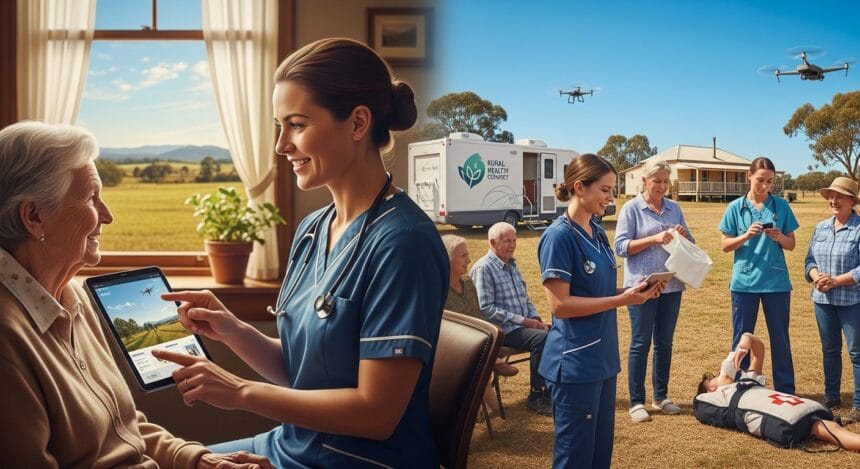
Millions of Americans living in rural communities struggle to access basic healthcare services. These areas face persistent provider shortages, long travel distances to clinics, and higher rates of chronic and preventable disease compared with urban centers. Conventional solutions focused on recruiting physicians have repeatedly failed to close this gap at the scale and speed needed.
Meanwhile, subtle yet significant shifts in nursing are quietly improving access to care. Advanced practice nurses, policy innovations, and evolving education pathways are reshaping rural healthcare infrastructure. Understanding these trends clarifies why nursing’s evolution is one of the most consequential forces in rural health policy today.
This article examines the state of rural healthcare, highlights key nursing workforce trends, and explains how these trends improve access for rural populations, providing a roadmap for sustainable change.
The Rural Healthcare Gap: A Problem Conventional Solutions Haven’t Solved
Rural communities face multiple structural healthcare disadvantages. They often have fewer clinicians per resident, older populations with more chronic illness, and economic conditions that make physician recruitment difficult to sustain. According to the National Rural Health Association, 70 % of rural counties are designated Health Professional Shortage Areas, highlighting the depth of provider scarcity.

Physician-centered solutions often fall short because medical training is long and expensive, and new physicians disproportionately select urban or suburban practice environments. Even loan forgiveness programs and rural rotations fail to overcome long-standing lifestyle and professional preferences. This leaves rural communities structurally dependent on providers unlikely to choose them.
Advanced practice registered nurses (APRNs) are structurally better suited to address these challenges.
Nurses with MSN or DNP credentials can independently provide primary care in many states, delivering preventive care, chronic disease management, and routine medical services. Nurses trained in their own communities bring critical cultural and geographic knowledge, enhancing continuity of care. Advanced practice nursing in rural communities allows APRNs to bridge the rural access gap where physicians often cannot.
The Nursing Trends Quietly Closing the Gap
Rising Education Levels Across the Workforce
The nursing workforce is more educated than ever before. Nearly half of registered nurses now hold a bachelor’s degree or higher, and advanced nursing degrees are increasingly required for leadership, specialized roles, and higher wages.
Higher education directly expands the pool of nurses eligible for advanced practice credentials. APRNs can practice independently in states with full practice authority, enabling them to fill primary care roles traditionally reserved for physicians. This growing pool is critical to sustaining care access in isolated areas.
Among broader nursing trends, increasing education levels are the foundation enabling nurses to meet rural healthcare demands. Highly educated nurses bring evidence-based decision-making skills, better clinical judgment, and greater confidence managing complex patient cases.
Online Graduate Education Removing Geographic Barriers
High-quality online MSN and DNP programs have transformed access to advanced nursing credentials. Rural nurses can now earn graduate degrees without relocating, allowing them to remain embedded in their communities. This eliminates one of the most significant historical barriers to building a local APRN workforce.
Rural RNs who transition to APRN practice locally bring unique value. They already understand patient population needs, possess established trust within the community, and have personal investment in staying long-term. This combination of skill and local knowledge strengthens retention and improves continuity of care—challenges historically unsolved by external recruitment.
A Nursing Shortage Driving Policy Innovation
The persistent nursing shortage has accelerated workforce-focused policy innovation. Retiring nurses and an aging population have increased demand for care, compelling states to explore accelerated clinical training pipelines. Some initiatives include preceptor tax credits, expanded clinical rotations, and rural-focused scholarship and loan forgiveness programs.
Policy innovations affecting APRN supply are especially consequential in rural areas. In cities, APRNs represent one care option among many; in rural communities, they often form the backbone of primary healthcare. Every decision impacting APRN numbers directly affects rural healthcare capacity. Policies that grow and retain local APRNs are, therefore, rural access policies in practice.
Elevating Standards, Improving Outcomes
Rising baseline education requirements for nurses are another major trend. Policies like New York’s BSN-in-10 law require nurses to earn a bachelor’s degree within ten years of licensure. Higher education produces clinicians with stronger evidence-based practice skills, deeper clinical knowledge, and greater autonomy—qualities essential for rural care.
Research shows higher levels of nursing education correlate with improved patient outcomes. Hospitals with more BSN-prepared nurses report lower surgical mortality rates and more effective chronic disease management. In rural areas, where specialist access is limited, these improvements are amplified. Elevated standards ensure that primary care delivered by APRNs maintains high quality and continuity.
What These Trends Mean for Rural Patients and Communities
The intersection of higher education, online graduate access, workforce policy innovation, and elevated practice standards is producing a generation of APRNs uniquely capable of rural practice. This workforce is more widely distributed, better supported, and prepared for independent care than any prior cohort.
For rural communities, the impact is structural. Locally trained APRNs reduce reliance on transient physicians and create sustainable primary care infrastructure. This improves access, fosters patient trust, and strengthens continuity of care.
For patients, the change is immediate and tangible. They gain access to a consistent, qualified primary care provider capable of preventive care, chronic disease management, and health guidance. This reduces avoidable hospitalizations and improves long-term outcomes, advancing health equity in underserved regions.
Conclusion
The rural healthcare crisis remains urgent, but it is not unsolvable. Evidence demonstrates that nursing workforce evolution—through rising education levels, accessible online graduate programs, APRN growth, and policy innovation—is strengthening care delivery where it is needed most.
These nursing trends are not peripheral; they are central solutions for rural healthcare access. They expand the supply of primary care providers, improve quality, and increase retention in isolated communities. Policymakers and healthcare leaders should recognize nursing workforce dynamics as a primary lever in solving rural access issues. By centering nursing trends in rural healthcare policy, we can create sustainable solutions to longstanding disparities and improve outcomes for millions of Americans.