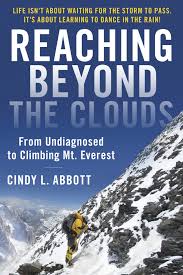
Continuing extrovertic’s interest in Orphan Drug Literature, I read an inspiring book, “Reaching Beyond the Clouds,” by Cindy L. Abbott. The book takes readers from Cindy’s diagnosis with the rare disease Wegener’s Granulomatosis through her successful ascent of Mount Everest.
Continuing extrovertic’s interest in Orphan Drug Literature, I read an inspiring book, “Reaching Beyond the Clouds,” by Cindy L. Abbott. The book takes readers from Cindy’s diagnosis with the rare disease Wegener’s Granulomatosis through her successful ascent of Mount Everest. I thank the OrphanDruganaut post for introducing me to this riveting book. As rare as Wegener’s is (less than 3,000 people are diagnosed each year in the US), the number of American women who have summited Mt. Everest (45), is even smaller.1 Cindy managed to accomplish something even more rare than her disease.
In addition to being an inspirational read, the book provides perspective on how patients with rare and orphan diseases view risk benefit choices. As a consequence of her disease, Cindy had lost much of the sight in her left eye before she even embarked on her mountaineering path. With so little known about the disease progression of Wegener’s, it was a major risk for Cindy to scale any mountain, much less Everest. Would the high altitude conditions result in more vision loss? Would the relentless freezing conditions make her even more susceptible to the frostbite?
Weighing the well-known risks and rewards of summiting Everest, factoring in the additional unknowable risk that her disease posed, Cindy decided to go for it. As she says, “I wasn’t about to allow the disease to become the writer and director of The Life and Times of Cindy Abbott. I had a mountain to climb, and Everest was what I focused on.”
Cindy’s risk benefit trade-off is just an extreme version of the types of decisions parents of patients with rare and orphan diseases make on a daily basis. Do I let my daughter with cystic fibrosis swim in a murky lake with her friends where she could be exposed to potentially exacerbation causing mold? Or do I keep her home and make her feel even less like a normal teenager?
So it stands to reason that these patients and their family members are especially well equipped to consider the trade-off of a new therapy requires; e.g. is the benefit of the drug worth the risk of a potentially dangerous or life-threatening side effect?
The FDA recognizes rare and orphan disease patients may have a different perspective about risk benefit trade-offs than patients suffering from more common and less life-threatening diseases. In fact, the FDA has an entire initiative dedicated to infusing the voice of the patient into the approval process for drugs that treat rare and orphan diseases. The FDA initiative is called, “Patient-Focused Drug Development.”
As outlined in the FDA website, the rational for this effort is that “drug development and FDA’s review process could benefit from a more systematic and expansive approach to obtaining the patient perspective on disease severity and current available options in a therapeutic area.” A key component of this initiative is a series of patient meetings in 20 different therapeutic classes over the course of 2013-14.
The implication for marketers is that if the FDA is stepping up their efforts to get the voice of the patient into their approval process, shouldn’t industry be doing the same? It is a fairly common practice to hold patient advisory boards 1-2 times a year. The larger challenge is incorporating a continual drumbeat of the patient voice into your drug and communications development. Here are two suggestions:
- Meet regularly with individual patients. Make it a practice to bring a patient into your office once a month or at the very least, once a quarter. Set up a series of small meetings with your colleagues and agency partners. Have the patient tell his or her story. One of my clients did this regularly, every time she met a particularly articulate patient. It gave the entire organization an incredible empathy for patients and made it easier to secure funding for patient programs.
- Analyze online patient conversations. With the right tools, the patient journey can be mapped out using online patient conversations. Patient needs and emotional states can be pinpointed for each stage of the journey. And the results can be obtained more quickly and economically than traditional research.
Of course, there are risks involved anytime the pharmaceutical industry interacts with a patient. Are you inadvertently giving away confidential market-moving information? Are you raising false hopes? But the benefit of delivering a drug or piece of education that truly meets the needs of the patient surely outweighs the risk.
1. According to “Reaching Beyond the Clouds” as of 2010 45 American females have summited Mt. Everest