(Originally published on Patient Empowerment Network)
(Originally published on Patient Empowerment Network)
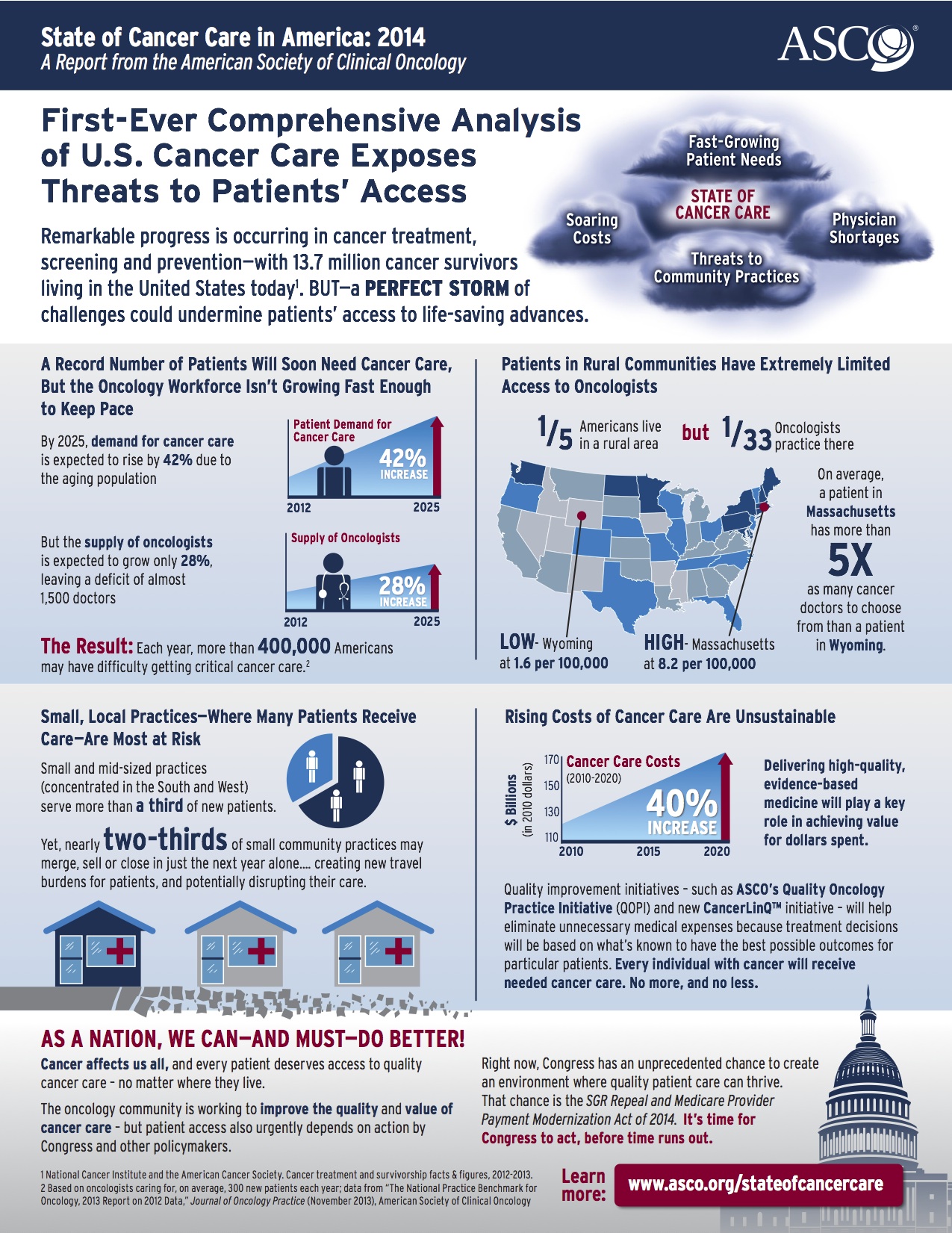
ASCO recently published their paper on State of Cancer Care in America 2014. In this paper, authors outline concerns and possible courses of action. The report addresses cancer costs, increasing treatment options, growing number of cancer survivors, disparities of care and the challenges of meeting these needs and concerns. (ASCO created a great infographic on Cancer Care in the US which you will find at the end of this post)
ASCO predicts that by 2030, new cancer cases in the US will rise by 45%. By 2022, there will be almost 18 million cancer survivors, about a 35% increase from today. But ASCO is also predicting a national shortage of oncology specialists by 2025. New treatment options will increase the number of cancer survivors, which is a good thing, but the shortage of specialists will result in a strain on the existing providers and a possible decrease in quality or continuum of care for some patients. Disparities of care for certain ethnic groups coupled with rising costs of medications and treatment could further result in problems with quality or access to care. Besides shortage of oncologists and disparities of care, uneven geographic distribution of physicians leave those in rural areas wanting. ASCO cites an analysis of demographics showing that nearly 90% of oncologists practice in urban areas and that more than 70% of US counties analyzed had no medical oncologist at all.
More Read

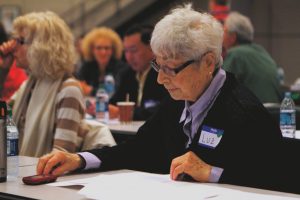
- Patient studying information at City of Hope patient forum

As a direct result of the above challenges, cancer patients (and their families and caregivers) will most likely have to become more responsible for their care. It is of course most important to have the best medical team possible, but it is also important for patients to take care of themselves in between visits. Patients will need to monitor themselves better, and lead healthier, better lives. Those taking the oral cancer medications will need to be extremely compliant and take measures to remember to take their medication at correct times and not forget doses. They will need to eat right and keep fit and do all they can to maintain a healthy lifestyle. They should also avail themselves of all information about their illness in order to keep up with the latest news and research.
Researching online, joining patient communities, conversing with other patients, using mHealth, social media or fitness trackers are all ways that patients can educate themselves and improve their knowledge during their journey.
Online research can greatly improve a patient’s knowledge about the course of their disease, possible treatment options, side
- Patient looking at resource information at City of Hope patient forum

effects from medication, clinical trials and much more. And many patients are fully aware of the wealth of information, embrace it and check online daily for updates and news. (For a good list of online resources, please look at our “Resources” page). However, for some patients, the diagnosis of cancer takes its toll and the patient is overwhelmed emotionally and needs help from family or caregivers. And for others, the internet is a mystery that they do not want to approach alone.
Older patients especially need help with gaining health literacy. They can be helped by a spouse or other family member if that is possible. If they live alone, there are some other options. Senior centers often offer courses in internet research and community colleges offer such courses as well. As soon as a patient is able to go online, email and do a simple search, the possibilities open up. Numerous online sites cater to the older population. Health in Aging, AARP, NIH Senior Health are some commonly known sites. But although these sites are great and do have a lot of information centered around seniors and health, I did not see any very easy visible step-by-step guide to internet searching. NIH Senior Health did have a “Trainer Toolkit” that explains how to help others research online, but there was no such toolkit for novices.
- Patient discussion at City of Hope patient forum

Patient communities are extremely helpful in supporting and educating cancer patients. Patients have said to me time and time again that there is nothing like talking to someone who has walked in your shoes. There are many online patient communities (again, check our resources page). There are also some live Patient Forum events that patients can attend to listen to expert physicians and talk directly face-to-face with other patients. These events are extremely well-received by patients, families and caregivers alike. For a testimonial about such an event by a patient attendee, please click here.
Another option is to contact Imerman Angels and get matched to a cancer patient that has issues and needs similar to your own. Jonny Imerman is a testicular cancer survivor who started Imerman Angels with the belief that no one should have to fight cancer alone. Imerman Angels partners anyone seeking cancer support with a cancer survivor “mentor”. These partners can meet face-to-face, on Skype or email – whatever method is most practical for them.
Online research is great and patient communities are great also, but there is a lot to be said about meeting and seeing someone face-to-face. As I mentioned above, the live, cancer-specific patient forums are extremely well-received; some patients had never met a “fellow” patient before and almost can’t stop talking to them once they do.
In the near future, we are going to initiate some “virtual” cancer-specific patient meetings on a video communications channel such as Skype or Zoom. We will invite patients to join us and talk virtually to other patients. I think this could work for older patients as well who are not so versed in searching online. If they have someone to help them set up a computer and webcam, then all they would have to do is join in the conversation…or just listen. And perhaps this could open up future meetings for them with other patients. Technology is improving and becoming so user-friendly. All Zoom requires in order to join a Zoom meeting is that you answer the email and click on “join meeting”.
One great advantage of virtual meetings is that patients can join in regardless of where they live or what their mobility status is. Patients in remote rural areas can join in the conversation as well as patients who do not have easy access to transportation or those that are house-bound.
With the number of cancer survivors growing and the number of physician specialists shrinking, patients need to do all they can to help themselves and to help one another. Patients helping patients will increase health literacy, patient empowerment and improve cancer care.
Infographic: State of Cancer Care in America 2014
Resources:
http://jama.jamanetwork.com/article.aspx?articleid=1866090
http://www.asco.org/practice-research/cancer-care-america