By using this site, you agree to the Privacy Policy and Terms of Use.
Accept
Health Works CollectiveHealth Works CollectiveHealth Works Collective
  • Health
    • Mental Health
  • Policy and Law
    • Global Healthcare
    • Medical Ethics
  • Medical Innovations
  • News
  • Wellness
  • Tech
Search
© 2023 HealthWorks Collective. All Rights Reserved.
Reading: Recent Clinical/Technology Distribution of Medtech Startups
Share
Notification Show More
Font ResizerAa
Health Works CollectiveHealth Works Collective
Font ResizerAa
Search
Follow US
  • About
  • Contact
  • Privacy
© 2023 HealthWorks Collective. All Rights Reserved.
Health Works Collective > Business > Recent Clinical/Technology Distribution of Medtech Startups
BusinessTechnology

Recent Clinical/Technology Distribution of Medtech Startups

PatrickDriscoll
PatrickDriscoll
Share
2 Min Read
startups-2011-2013
SHARE

Since January 2011, we have identified 158 medical technology companies that have been founded globally. As in the past when we have discussed “medtech” companies, whether in the context of startups or in fundings, we would like to make clear what we define as medtech:

What is “medtech”?:  We view medical technology (medtech) as principally medical devices and equipment, but also all technologies that are directly competitive with or complementary to technologies represented by therapeutic or diagnostic medical devices/equipment.

Since January 2011, we have identified 158 medical technology companies that have been founded globally. As in the past when we have discussed “medtech” companies, whether in the context of startups or in fundings, we would like to make clear what we define as medtech:

What is “medtech”?:  We view medical technology (medtech) as principally medical devices and equipment, but also all technologies that are directly competitive with or complementary to technologies represented by therapeutic or diagnostic medical devices/equipment.

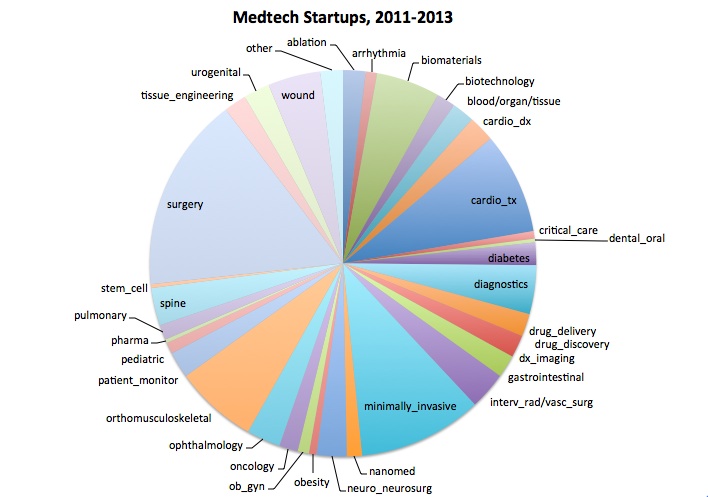
An enormous range of technologies are under development at this company (see our detailed list of technologies from past years at link). For the sake of our database subscribers interested only in specific clinical/technology areas, we categorize the companies accordingly (based on the nature of their technologies or clinical application). Below is represented the distribution of technologies at the companies identified from 2011 to May 2013. Note, please, that multiple clinical/technology categories are possible for each company, so the pie chart below represents the whole not as the total number of companies, but a multiple of the number of companies and clinical/technology areas.

startups-2011-2013

Source: MedMarket Diligence, LLC; Medtech Startups Database.


TAGGED:health start-ups!medtech
Share This Article
Facebook Copy Link Print
Share
By PatrickDriscoll
Follow:
I serve the interests of medical technology company decision-makers, venture-capitalists, and others with interests in medtech producing worldwide analyses of medical technology markets for my audience of mostly medical technology companies (but also rapidly growing audience of biotech, VC, and other healthcare decision-makers). I have a small staff and go to my industry insiders (or find new ones as needed) to produce detailed, reality-grounded analyses of current and potential markets and opportunities. I am principally interested in those core clinical applications served by medical devices, which are expanding to include biomaterials, drug-device hybrids and other non-device technologies either competing head-on with devices or being integrated with devices in product development. The effort and pain of making every analysis global in scope is rewarded by my audience's loyalty, since in the vast majority of cases they too have global scope in their businesses.Specialties: Business analysis through syndicated reports, and select custom engagements, on medical technology applications and markets in general/abdominal/thoracic surgery, interventional cardiology, cardiothoracic surgery, patient monitoring/management, wound management, cell therapy, tissue engineering, gene therapy, nanotechnology, and others.

Stay Connected

1.5KFollowersLike
4.5KFollowersFollow
2.8KFollowersPin
136KSubscribersSubscribe

Latest News

medicare mistakes seniors usually make
The Hidden Healthcare Costs Seniors Should Plan For
Global Healthcare Senior Care
July 15, 2026
The Complex Reality of Medication Management During Recovery
Addiction Recovery
July 15, 2026
exercise benefits
How Exercise Shapes The Teenage Body And Mind
Infographics
July 12, 2026
How Healthy Meal Kits Are Helping Millennials and Gen Z Build Better Eating Habits
Health
July 9, 2026

You Might also Like

Continuous Insulin Infusion in Diabetes Management

March 21, 2011
pfizer and clinical data transparency
BusinessMedical RecordsPolicy & Law

Pfizer to Expand Clinical Trial Data Access, Takes Step Toward Transparency

December 6, 2013
How to Improve Outcomes and Satisfaction of New Surgery Patients
Hospital Administration

How to Improve Outcomes and Satisfaction of New Surgery Patients

November 5, 2017
The ACA has put patients at the center of healthcare services. A patient-centric healthcare approach in this digital era means a revised definition of quality in the physician-patient relationship. When it comes to healthcare services, patients shell out a hefty amount from their pocket and want nothing less than the best. The services in healthcare are no longer limited to just cost as consumers now evaluate quality and experience in the same equation. Research highlights from the 2015 Healthcare Consumer Trends by National Research Corporation states that reputation in healthcare matters more to consumers when choosing a brand than any other industry, e.g. hospitality, retail, airline, etc. The new generation of quality measurements in healthcare require a different mind-set and a different 'toolbox' to handle the hurdles. It’s the need of the hour for healthcare providers and others across the healthcare value chain to adopt the patient-centric approach for surviving in the vast competitive ocean of healthcare services. Patient-centric care is an approach that develops through effective communication, empathy and a positive physician-patient relationship. The primary purpose is to improve patient care outcomes and satisfaction and to reduce patient symptoms and unnecessary costs. It’s a win-win situation for both physicians and patients. While healthcare providers are able to support their patients in becoming more compliant with treatment and management of their conditions/diseases, patients feel more satisfied with the care that they are receiving. PwC’s Health Research Institute’s annual report 2016 states that health systems should keep an eye on the consumer experience as they expand and extend. More partnerships and more caregivers could mean confusion for patients and poor customer experiences. To differentiate their practice among competitors, patient satisfaction can be used as a competitive distinguishing factor. Although patient satisfaction cannot really provide tangible benefits, but an experience that exceeds patient expectations for what a practice/hospital can provide is very important as it creates loyal patients who return for future health needs and refer their family and friends. Happy and satisfied patients are a secret marketing weapon for healthcare providers, whether they are physicians, dentists, physiotherapists or hospitals. Your patients are the new-age digital health decision-makers. In this era of Internet and social media, they now have multichannel access to information related to health. Needless to mention, they have gained new power to make their decisions; whether it’s choosing a healthcare provider or referring a physician to family and friends. By converting your satisfied patients to be your brand advocates, you can capitalize and use their voice as an effective marketing strategy to reach out to many other potential patients. To strive and thrive, in the U.S. many healthcare organizations are applying patient-centric approaches to healthcare. It’s all about what matters to patients, so it makes a lot of sense for the healthcare industry to place patients' healthcare experience at the center of their policies and procedures. The best deliverables are a combination of great communication for a positive physician-patient relationship, disciplined measurement and analysis of patient feedback and commitment to technology innovation – the formula for improving patient engagement and care.
BusinessHealth ReformWellness

The Link Between Patient Satisfaction and Long-Lasting Relationships

April 28, 2016
Subscribe
Subscribe to our newsletter to get our newest articles instantly!
Follow US
© 2008-2026 HealthWorks Collective. All Rights Reserved.
  • About
  • Contact
  • Privacy
Welcome Back!

Sign in to your account

Username or Email Address
Password

Lost your password?