As October 1st– the opening date of the Health Insurance Exchanges mandated by ObamaCare–is approaching, health care reform once again attracts a lot of media attention.
As October 1st– the opening date of the Health Insurance Exchanges mandated by ObamaCare–is approaching, health care reform once again attracts a lot of media attention.
The policy change is affecting every stakeholder in health care, from government agencies, pharmaceutical companies, physicians, insurance companies, medical device manufactures to hospitals. Some of the effects are imminent while others will be felt overtime. Working at one of the largest health care public relations (PR) firms in this country, it is fascinating to witness how PR is playing a vital role in navigating different parties through the convoluted health care world and transforming messages into public actions at this particularly interesting time.
If history is any indication, PR can be a defining force to influence health care policies.
In 1945, President Harry Truman sent Congress a special message, advocating a national health care program. But the American Medical Association (AMA) stood out to block the proposal, suggesting anyone who supported the proposal must be a communist. AMA hired Clem Whitaker and Lenone Baxter, founders of the first political consulting firm in the U.S. and launched a 3-year long public relations campaign. Historian Jill Lepore from Harvard University has provided vivid details about the campaign in a New Yorker article published in September 2012:
At the beginning of 1949, Whitaker and Baxter, the directors of the A.M.A.’s National Education Campaign, entered national politics, setting up headquarters in Chicago, with a staff of thirty-seven. “This must be a campaign to arouse and alert the American people in every walk of life, until it generates a great public crusade and a fundamental fight for freedom,” their Plan of Campaign began…
…
As Whitaker and Baxter put it, in an earlier version of the plan, “Basically, the issue is whether we are to remain a free Nation, in which the individual can work out his own destiny, or whether we are to take one of the final steps toward becoming a Socialist or Communist State. We have to paint the picture, in a slogan: “KEEP POLITICS OUT OF MEDICINE.”
Pamphlets, public speakers, private contacts, volunteerism—then considered innovative PR tactics were used by Whitaker and Baxter to convince the physician community and then the general public that Truman’s program was “Socialized Medicine” and extremely dangerous.
The campaign completely shifted public opinion: in 1945, polls showed 58% Americans favored health care reform. But by 1949, the number had dropped to 36%. Whitaker and Baxter, as Lepore put it, “turned the President’s sensible, popular, and urgently needed legislative reform into a bogeyman so scary that, even today, millions of Americans are still scared.”
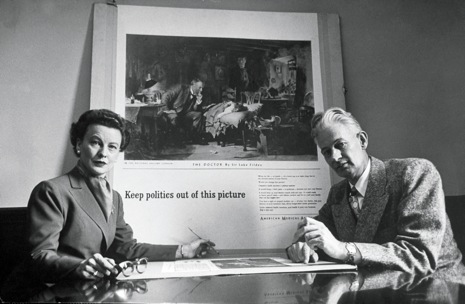
Whitaker and Baxter (photo credit: http://www.newyorker.com/reporting/2012/09/24/120924fa_fact_lepore)
The legendary case is still relevant today when digital and social media has given PR even more power to bring impact on health care policymaking.
Media’s enthusiasm about ObamaCare suggests although the policy does not impact everyone to the same extent, the amplification of messages through mass media creates political rhetoric, depicting these discussions as equally important to all of us. From Benghazi, Snowden, Egypt to Syria, public relations, is often served as the ultimate strategy for interest groups to achieve political gain.
Compared to 1945, today’s media landscape is quite different—we have a well-connected global audience empowered by mobile devices and social networks. Stakes for a PR campaign can be extremely high—we see success or failure on a scale with global impact, something the industry has never seen in the past.
What does this mean for health care policymaking?
Effective PR is critical to transform policy into action.
Take obesity control for instance.
NIH has invested significantly to tackle the issue. However, the PR execution for some of the programs is poorly managed. For example, the NIH website where Clinical Guidelines on the Identification, Evaluation, and Treatment of Overweight and Obesity in Adults are listed not only lacks basic web design but also includes a BMI calculator for “Palm OS,” a system that is no longer available.
Interestingly, a PR campaign by Coke that targets people who worry about their weight is well-conceived.
The video campaign, called “The Slender Vendor,” portraits how “the world’s thinnest vending machine” can make diet coke available in places that regular vending machines just can’t fit in–in the middle of a sidewalk, between two bowling lanes and even between two treadmills in a gym. The design of the vending machine is indeed thing, modern and sleek. The message: because there’s no sugar and calories, diet coke is “the perfect fit for your day.”
Which program will more likely to motive people to take action? Most people will probably pick the latter.
In the age of globalization and social media, if we can truly convince the public to choose one thing over another, that might just mean that “one thing” is indeed a better choice. To that end, PR professionals might agree that “PR is the last best hope of democracy.”