By using this site, you agree to the Privacy Policy and Terms of Use.
Accept
Health Works CollectiveHealth Works CollectiveHealth Works Collective
  • Health
    • Mental Health
  • Policy and Law
    • Global Healthcare
    • Medical Ethics
  • Medical Innovations
  • News
  • Wellness
  • Tech
Search
© 2023 HealthWorks Collective. All Rights Reserved.
Reading: Smokers Die Ten Years Sooner Than Nonsmokers
Share
Notification Show More
Font ResizerAa
Health Works CollectiveHealth Works Collective
Font ResizerAa
Search
Follow US
  • About
  • Contact
  • Privacy
© 2023 HealthWorks Collective. All Rights Reserved.
Health Works Collective > Policy & Law > Public Health > Smokers Die Ten Years Sooner Than Nonsmokers
NewsPublic Health

Smokers Die Ten Years Sooner Than Nonsmokers

StephenSchimpff
StephenSchimpff
Share
2 Min Read
SHARE


We all know that smoking is bad for our health. But how bad is bad? The answer is very bad. It takes a decade off of life.
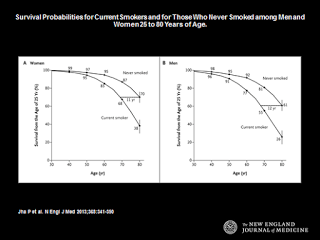
Death rates are about 3 times higher for smokers than nonsmokers. The chance that a young person will live to age 80 is about 70% for nonsmokers but about 35% for smokers. Stated differently, a smoker loses about 11(women) to 12 (men) years of life compared to nonsmokers.
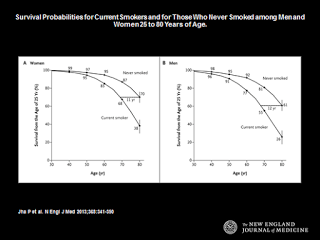
 
Now that women have been smoking for long periods of time, their risks match those of men who smoke. “Women who smoke like men die like men who smoke.” Women’s relative risk of developing and dying from lung cancer (compared to nonsmoking women) is about 25, same as for men. For chronic lung disease, the relative risks are 23 and 25 for women and men, respectively. For ischemic heart disease the relative risks are 2.9 and 2.5 and for stroke they are 2.1 and 1.9.
These are the results presented from two studies of very large populations of Americans published January 24, 2013 by the New England Journal of Medicine, one by Prabhat Jha and colleaguesand another by Michael Thun and colleagues. Each analyzed different populations but arrived at essentially the same conclusions. 
Alarming as these numbers appear, there is hope. Those who quit smoking will gain back substantial years of life, with more years gained the sooner one ceases smoking. For example, in Jha’s analysis, those who quit in the age range 25-34 reverted almost to the nonsmoker status – they gained back 10 years of life. Stopping between 35-44 years of age gained 9 years and between 45-54 years of age the gain was 6 years.
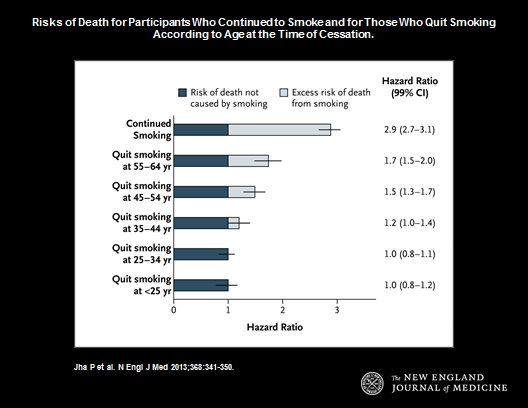
 
It is never too late to quit and the benefits are clearly substantial.



TAGGED:smoking
Share This Article
Facebook Copy Link Print
Share

Stay Connected

1.5KFollowersLike
4.5KFollowersFollow
2.8KFollowersPin
136KSubscribersSubscribe

Latest News

weight loss surgeon
How to Choose the Best Surgeon for Weight Loss Surgery
Weight Loss Wellness
February 11, 2026
aging care healthcare system
The Growing Role of Terminal Care Specialists in a Rapidly Aging Healthcare System
Global Healthcare Senior Care
February 11, 2026
Why Trauma and Addiction Are Linked and How Effective Programs Treat Both
Addiction Addiction Recovery
February 10, 2026
car accident injuries
The Hidden Healthcare Impact of Car Accident Injuries
News Policy & Law
February 8, 2026

You Might also Like

Addressing Medicare Cuts

April 17, 2015
get compensation for a wrongful death to cover medical bills
News

Get Compensation for a Wrongful Death Claim to Cover Medical Bills

July 1, 2022
eHealthPublic HealthSocial Media

4 Common Myths About Online & Social Media Health Content Debunked

December 11, 2012
common foot pain problems shutterstock image
NewsPublic HealthWellness

Common Foot Problems and How You Can Solve Them

June 30, 2017
Subscribe
Subscribe to our newsletter to get our newest articles instantly!
Follow US
© 2008-2025 HealthWorks Collective. All Rights Reserved.
  • About
  • Contact
  • Privacy
Welcome Back!

Sign in to your account

Username or Email Address
Password

Lost your password?