What the trials establish
A guide to thymosin alpha-1’s clinical results and the regulatory decisions they can support.
Thymosin alpha-1 has reached substantial clinical trials, but the main results reviewed here did not establish the tested benefits. Drug approval and pharmacy compounding are separate regulatory questions. December 2024 FDA committee votes concerned the compounding list; they were not decisions about drug approval.
- The hepatitis trials did not establish benefit in their main analyses.
- The TESTS trial found no clear reduction in sepsis mortality.
- FDA committee votes concerned compounding-list inclusion, not drug approval.
Thymosin alpha-1 has reached randomized trials involving hundreds of patients, including a large phase III sepsis study. That makes it a substantially studied peptide, but the principal results reviewed here did not establish the benefits investigators were testing. Its clinical record also needs to be separated from decisions about drug approval and pharmacy compounding.
A medicine in Italy, not in the US
This jurisdictional contrast needs a date. In its December 4, 2024 review, FDA stated that it had approved no drug products containing thymosin alpha-1. The agency described Italy as an exception to the absence of approval in Europe, while noting that it could not independently verify all manufacturer claims about approvals elsewhere. Those statements do not establish independently checked global approval status in 2026.
Immune effects provide a reason to investigate a molecule. They do not tell researchers whether patients survive longer or clear an infection. A clinical trial tests a defined outcome in a defined population; marketing authorization concerns a drug product and its use; a 503A bulks-list proceeding addresses a substance’s inclusion for compounding. These are separate questions.
What the record shows
The studies below tested different conditions and outcomes. Their results cannot be combined into a general verdict that thymosin alpha-1 “works.” The COVID-19 entry is a systematic review, not a single randomized trial.
| Condition and study | Population/sample | Main endpoint or pooled outcome | Result |
|---|---|---|---|
| Hepatitis B, 1999 | 97 patients with chronic hepatitis B | Complete response | 14% with thymosin alpha-1 versus 4% with placebo; P=0.084 |
| Hepatitis C, 2012 | 552 previous treatment nonresponders | Sustained viral response, intention-to-treat analysis | 12.7% versus 10.5%; P=0.407 |
| Sepsis, TESTS, 2025 | 1,106 adults enrolled; 1,089 analyzed | 28-day all-cause mortality | 23.4% versus 24.1%; hazard ratio 0.99, 95% CI 0.77–1.27 |
| COVID-19 review, 2023 | Nine studies; 5,352 patients | Pooled mortality | RR 1.03, 95% CI 0.60–1.75; substantial heterogeneity, I²=90% |
The hepatitis B study was randomized, double-blind and placebo-controlled. Its numerical response difference did not confirm the efficacy reported in other studies. A higher percentage alone is insufficient when the statistical analysis leaves substantial uncertainty.
The hepatitis C trial tested thymosin alpha-1 added to peginterferon alfa-2a/ribavirin in previous nonresponders. The intention-to-treat analysis did not show a statistically significant improvement. A higher response among treatment completers was a subgroup finding: restricting analysis to people who finished treatment changes the population being compared.
TESTS ran at 22 Chinese centers from September 2016 to December 2020 and was published in 2025. Its modified intention-to-treat analysis included participants who received at least one dose. Neither the primary mortality endpoint nor secondary or safety outcomes differed statistically significantly. Prespecified age and diabetes subgroup analyses suggested possible differences in effect, but did not establish an overall survival benefit. The full trial report follows earlier, smaller sepsis studies whose encouraging results had rested on low-quality evidence.
The COVID-19 review likewise found no statistically significant overall mortality change. Its wide confidence interval and high heterogeneity show uncertainty and considerable variation across studies. Favorable subgroup findings did not overturn that pooled result.
The wider research record also includes ETASS, a severe-sepsis trial, and randomized studies in predicted severe acute necrotising pancreatitis and hepatitis B-related acute-on-chronic liver failure. These are distinct patient populations, not interchangeable confirmations of efficacy:
The results of this meta-analysis do not support the use of Ta1 in hospitalized adult COVID-19 patients.
Weifeng Shang, with coauthors in the published COVID-19 systematic review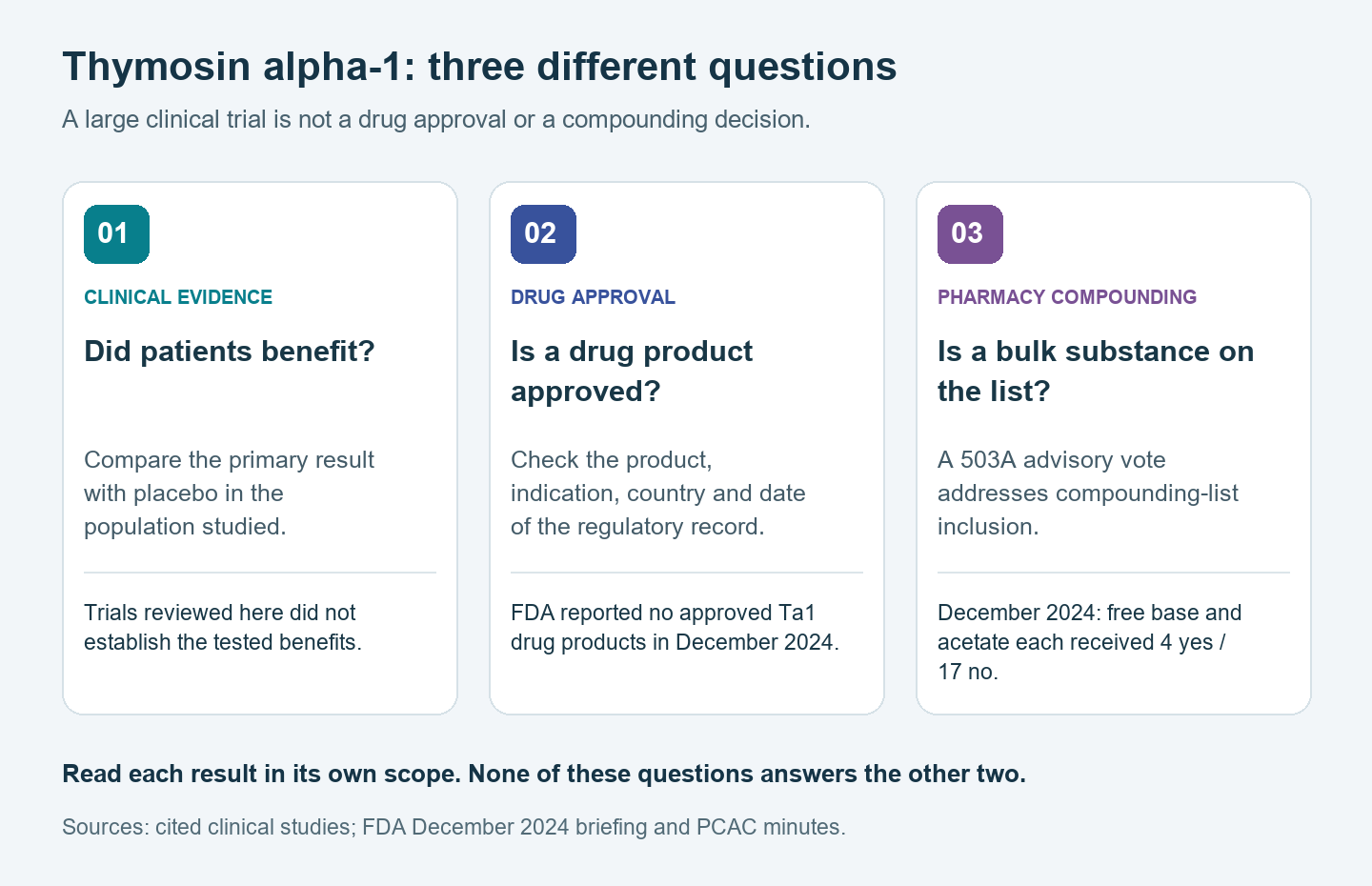
Two committee votes
On December 4, 2024, FDA’s Pharmacy Compounding Advisory Committee voted separately on thymosin alpha-1 free base and acetate for the 503A Bulks List. Each received four yes votes and 17 no votes. The meeting minutes attribute the majority position to insufficient convincing effectiveness data. Neither vote was a marketing-authorization decision.
Those votes preceded the 2025 TESTS publication; that paper should not be presented as their basis. Separately, FDA’s July 23–24, 2026 meeting agenda covered BPC-157 and TB-500 for possible 503A inclusion. The retrieved page supplied agendas and briefing materials, not minutes or a tally. It does not establish a favorable vote, and advisory recommendations are non-binding.
Why the contrast matters
Substantial trials make a peptide’s claims more testable. They can also weaken those claims. Here, the hepatitis trials did not establish benefit in their main analyses, TESTS did not demonstrate reduced sepsis mortality, and the COVID-19 review left considerable uncertainty. None proves that every possible use is ineffective. Each limits what can credibly be claimed for the population and outcome studied.
Thymosin alpha-1 is 28 amino acids long, first isolated from thymus tissue and now made synthetically, and its international nonproprietary name is thymalfasin. Despite the similar names, the thymosin alpha-1 peptide and thymosin beta-4, the parent of the TB-500 fragment, are different molecules, so evidence for one says nothing about the other. FDA describes its mechanism as immunomodulatory, acting at least in part through Toll-like receptor 9 on dendritic and lymphoid progenitor cells.
Wu J, et al. The efficacy and safety of thymosin α1 for sepsis (TESTS): multicentre, double blinded, randomised, placebo controlled, phase 3 trial. BMJ. 2025;388:e082583. https://pubmed.ncbi.nlm.nih.gov/39814420/
Wu J, et al. The efficacy of thymosin alpha 1 for severe sepsis (ETASS): a multicenter, single-blind, randomized and controlled trial. Critical Care. 2013;17(1):R8. https://pubmed.ncbi.nlm.nih.gov/23327199/
Ke L, et al. Immune enhancement in patients with predicted severe acute necrotising pancreatitis: a multicentre double-blind randomised controlled trial. Intensive Care Medicine. 2022;48(7):899-909. https://pubmed.ncbi.nlm.nih.gov/35713670/
Mutchnick MG, et al. Thymosin alpha1 treatment of chronic hepatitis B: results of a phase III multicentre, randomized, double-blind and placebo-controlled study. Journal of Viral Hepatitis. 1999;6(5):397-403. https://pubmed.ncbi.nlm.nih.gov/10607256/
Ciancio A, et al. Thymosin alpha-1 with peginterferon alfa-2a/ribavirin for chronic hepatitis C not responsive to IFN/ribavirin: an adjuvant role? Journal of Viral Hepatitis. 2012;19 Suppl 1:52-59. https://pubmed.ncbi.nlm.nih.gov/22233415/
Shang W, et al. Thymosin alpha1 use in adult COVID-19 patients: a systematic review and meta-analysis on clinical outcomes. International Immunopharmacology. 2023;114:109584. https://pubmed.ncbi.nlm.nih.gov/36527881/
Chen JF, et al. Safety and efficacy of Thymosin α1 in the treatment of hepatitis B virus-related acute-on-chronic liver failure: a randomized controlled trial. Hepatology International. 2022;16(4):775-788. https://pubmed.ncbi.nlm.nih.gov/35616850/
US Food and Drug Administration, Center for Drug Evaluation and Research. Pharmacy Compounding Advisory Committee briefing presentation: thymosin alpha-1 (free base) and thymosin alpha-1 acetate. 4 December 2024. https://www.fda.gov/media/183892/download
US Food and Drug Administration. Pharmacy Compounding Advisory Committee meeting transcript, 4 December 2024. https://www.fda.gov/media/185640/download
Frequently Asked Questions
Did FDA reject thymosin alpha-1 approval in December 2024?
No. The committee voted against recommending the free base and acetate for the 503A Bulks List. Those were compounding-list advisory votes, not drug-approval decisions.
Does phase III testing mean thymosin alpha-1 works?
No. Phase III describes a stage of clinical investigation. The outcome still determines the finding: TESTS found no clear evidence of lower 28-day mortality in adults with sepsis.
Read the result for the intended use
For any thymosin alpha-1 claim, identify the condition, patient population and measured outcome first. Then check whether the claimed benefit appeared in the main analysis or only a subgroup. That is the useful consequence of having substantial trials: claims can be checked against patient results. For related context, see How Researchers Study Tissue Repair: From Growth Factors to Peptide-Based Research.