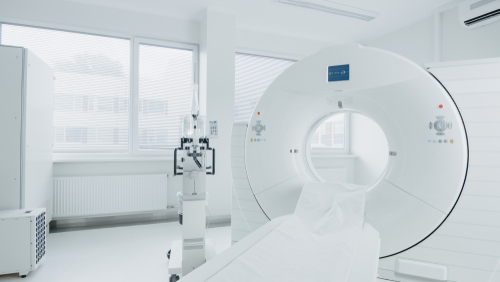
Healthcare providers are searching for ways to invest in capital equipment that positively impact their patient care and bottom line. Now more than ever it’s important to make smart decisions during initial planning in order to save money in the long run. In this article, we break down the different costs that comprise purchase and operation of a CT scanner. These costs include: hardware, software, accessories, siting and environment, services for radiopharmacy and radiopharmaceuticals, and repair and maintenance costs. We will delve deeper into what these costs mean and how they contribute to the total cost.
Cost Factor #1: Hardware
The biggest cost factor for a CT scanner is the detector and x-ray tube configuration. Detectors come in 1, 2, 4, 8, 16, 32, 64, 128, 256, 512, and 640-slice varieties, with 16, 64, and 128 being the most common. Essentially, the higher the slice count, the higher the price tag. Many find that the best trade-off between price and quality can be found with 64-slice machines, which produce good quality scans at an affordable price. Opposite the detector is the x-ray tube. The tube type will determine the output, life expectancy, and maximum usage. Higher end systems may also feature dual energy configurations which have two x-ray tubes.
Here is a breakdown of the cost variances of the most popular CT scanners as determined by slice count:
More Read

- 16-Slice CT Scanners
- New: $285,000-$360,000
- Refurbished: $90,000-$205,000
- 64-slice CT Scanners
- New: $500,000-$700,000
- Refurbished: $175,000-$390,000
- 128+ Slice CT Scanners
- New: $675,000-$1,000,000
- Refurbished: $225,000-$650,000
Cost Factor #2: Software
A system with all the options can be an exciting proposition. However, best practice is to buy based on your clinical needs. There are software packages specially designed for almost every application. These include cardiac, emergency medicine, low-dose lung, metal artifact reduction processing, CT perfusion and many more. Each package will come with a cost and these range from $15,000 – $100,000 or more. Assess which studies your department(s) will perform before purchasing can help you get the most value from the purchase.
Cost Factor #3: Accessories
Like software, accessories are a complement to the scanner. Specific accessories are required to produce CT images for certain specialties or patients. For instance, you will need a heart rate monitor for cardiac imaging, an injector for contrast, or a bariatric table when the extra weight capacity is required.
Cost Factor #4: Siting and Environment
While not intrinsic to the cost of the CT scanner itself, siting and environment costs should also be considered before purchasing a CT scanner. These can include the renovation costs for preparing CT suite, special lighting, ceiling art or patient entertainment systems. You may also have to consider shipping costs and installation costs, which are typically around $25,000.
Cost Factor #5: Service and Maintenance
Service contracts add up to a significant portion of the lifetime cost of a CT. These contracts are designed to keep the system operational and cover the replacement costs of the system’s components. The two components are parts and labor and there exist a variety of service options with varying levels of coverage. The basic coverage is known as Time and Materials. For a few thousand dollars a year you will get a qualified preventative maintenance visit at regular intervals but be responsible for the total cost of any necessary repairs.
Parts only contracts cover the replacement of necessary components. This is an attractive option for facilities that want to reduce their repair risk but don’t want to pay for a premium coverage.
The third type is the full parts and labor contract that will cover all necessary repairs. This is the most expensive option but eliminates any surprise bills. With any contract look at the fine print. Specifically for a CT you’ll want to check the x-ray tube language as that is one of the biggest cost driver.
Finally service can be provided by a number of groups. The most common is directly from the OEM. Cost savings and improved service in some areas can be achieved through multivendor, maintenance insurance, or 3rd party service providers.
Final Thoughts
A CT scanner can be one of the most important imaging devices used in your facility. Knowing what is factored into the cost will help you choose the right unit. As experts in diagnostic imaging technology, we are here to answer your questions and help you acquire the right technology at the right price.