I saw a very interesting patient today. She’d been referred to me by a gynecological oncologist who had made a diagnosis of early endometrial adenocarcinoma and had sent her to me because she wanted to find out what her reproductive options were. This was a young 24-year-old woman with polycystic ovarian disease who had just got married six months ago. She had gone to a doctor for an evaluation because she had heavy menstrual periods and the doctor found she had a uterine polyp , which is why she performed a hysteroscopy .
I saw a very interesting patient today. She’d been referred to me by a gynecological oncologist who had made a diagnosis of early endometrial adenocarcinoma and had sent her to me because she wanted to find out what her reproductive options were. This was a young 24-year-old woman with polycystic ovarian disease who had just got married six months ago. She had gone to a doctor for an evaluation because she had heavy menstrual periods and the doctor found she had a uterine polyp , which is why she performed a hysteroscopy . Much to her dismay , when the histopathology report came back , it showed she had complex hyperplasia with atypia with early endometrial adenocarcinoma .
Further evaluation showed this was a localized cancer with no invasion , and she wanted to know whether it was possible for her to conserve her uterus because she wanted to complete her family. Now the standard advice in this situation is to go ahead and do a hysterectomy. This is what most doctors would advise because it is actually much safer for them. For one , it’s standard medical advice. After all , when you have cancer , you remove it – who can argue with that ? For another, it actually helps to protect the doctor ! In case the doctor does not advice surgery and then the cancer spreads , the patient may come back and sue the doctor for not advising surgery in the first place. This is why many doctors are quite reluctant to advise nonstandard approaches – because of the fear of being sued.
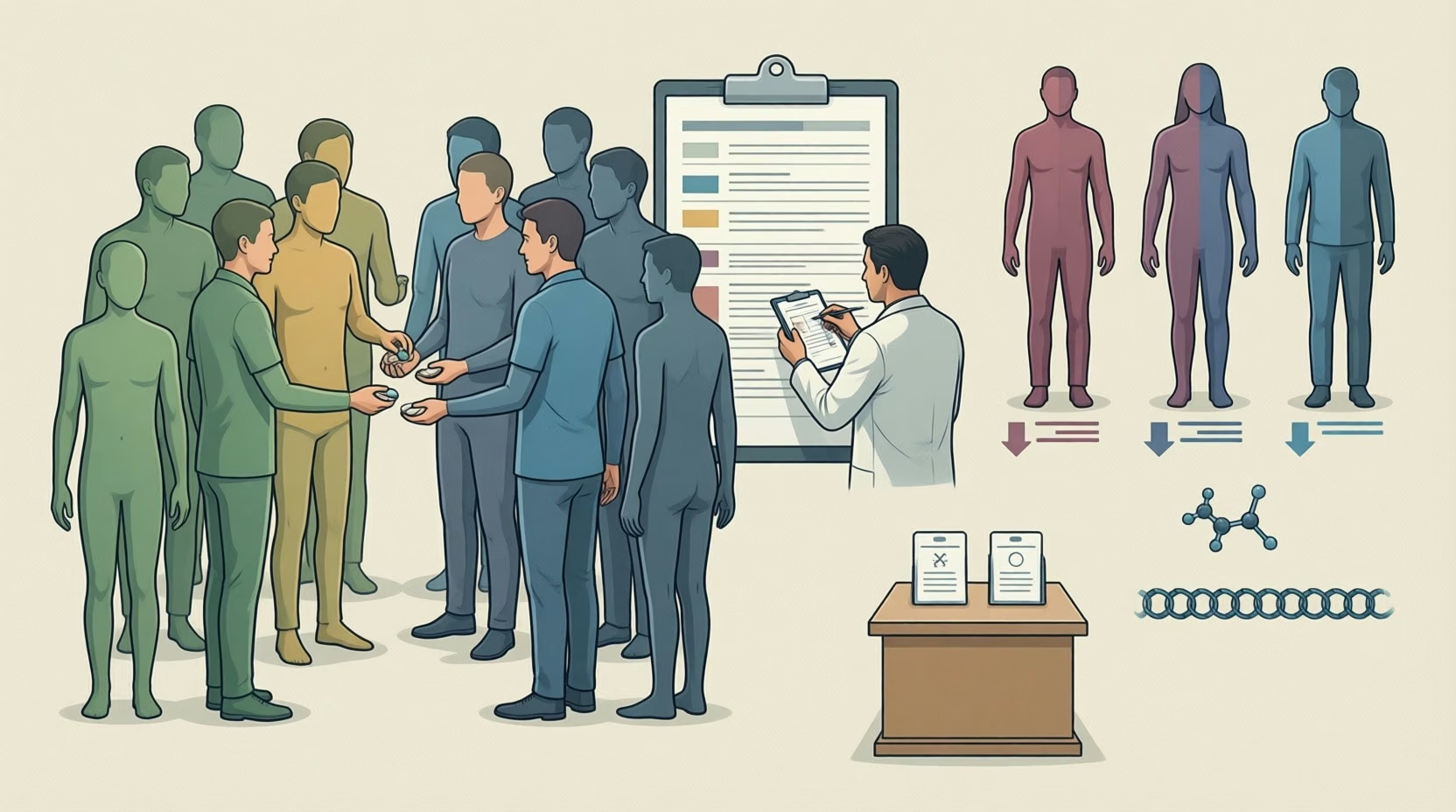
My approach was simple. I told the patient you are going to have to become an expert on your problem. Not only will you have to learn a lot about endometrial adenocarcinoma and its treatment options , you are going to have to learn about polycystic ovarian disease and fertility and infertility and IVF as well. The trouble is that I’m an IVF specialist and don’t know much about endometrial cancer – whereas your gynecological oncologist knows a lot about the endometrial cancer , but may not know much about IVF , which is why you need to inform and educate yourself. Not only do you need to understand the alternatives and options , you also need to provide your own personal preferences and inputs so that you make a decision you’re comfortable with.
The outcome for any treatment is always going to be uncertain , and you don’t want to beat up on yourself later on that you made a decision without having all the right inputs. Patients need to make a decision matrix of what their options are and then think through their personal preferences, so they can come to a conclusion which they comfortable with. It’s very helpful to document this in writing , so that patients can systematically walk their way through all the steps . Their doctor also is protected , because he can document that he’s explained the pros and cons ; and the patient has provided informed consent before making a decision which may have outcomes , some of which are likely to be unfavorable to the patient.
Unfortunately, few doctors in India take this approach. Most of them prefer being paternalistic – their approach is that patients come to us with their problems because we are the experts ; and it’s our job to provide solutions ! They will often provide just one simple solution with a black-and-white approach and then tell the patient – You can either accept this solution if you want to come to me ; and if not, you can find another doctor and go somewhere else. While this is a straightforward approach and something which works well for some doctors , it is not one which I’m comfortable with myself because it doesn’t allow the patient to play any role at all in such a complex decision-making process which will affect the rest of her life !