Why are healthcare costs in the United States twice that of other countries? Healthcare inflation has been going on for decades, and although its rise has slowed the last few years, the costs of healthcare threaten to consume both the federal and state budgets and are still a leading cause of bankruptcy in the United States. The main reason is price.
First a few simple statistics about US Healthcare from the International Federation of Health Plans, in their newly released annual report:
Average daily rate of hospital room in the United States: $4293
Why are healthcare costs in the United States twice that of other countries? Healthcare inflation has been going on for decades, and although its rise has slowed the last few years, the costs of healthcare threaten to consume both the federal and state budgets and are still a leading cause of bankruptcy in the United States. The main reason is price.
First a few simple statistics about US Healthcare from the International Federation of Health Plans, in their newly released annual report:
Average daily rate of hospital room in the United States: $4293
That cost is six times what it would be in Argentina and ten times what it costs in Spain.
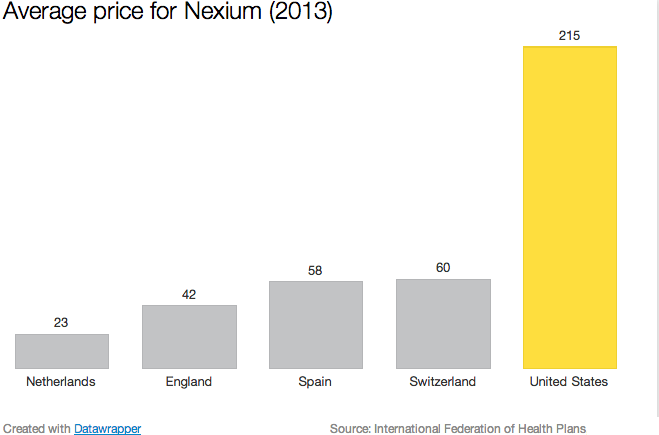
If the US paid for Nexium what The Netherlands did we would have paid 663 million last year instead of 6.1 billion
Market Economics Don’t Work
In single payer systems there is a single body that negotiates prices with hospitals and drug manufacturers. If the rates are not agreed to then the business is lost. Insurance companies use this locally in the U.S. to negotiate with physicians – and have driven the cost of physician prices lower. But the insurance companies do not have the power to negotiate with pharmaceuticals or hospitals the way a larger system does. In addition, the costs of the healthcare system are simply passed on to the insured with no consequence – hence, the US has the highest rate of healthcare inflation in the world. The British system has a unit of people whose whole job is negotiating with drug manufacturers to give the country a better price on prescription medications.
The British are buying in bulk for a country of 63 million people – and can successfully ask for steep discounts in return. In the US the marketplace does not do this. Pharmaceuticals are allowed to gouge the public for prices, then turn around and spend more on advertising to consumers than they do on research for more products. We discussed television ads for pharmaceuticals here.
Other costs: An MRI in Switzerland costs $138, but $1445 in the United States. All of those free-standing MRI machines provide quick access but at high prices and often unnecessary (according to the American College of Radiology).
Gleevic, an effective drug for some forms of leukemia, costs $6,214 in the United States and in New Zealand it costs $989. The same drug, same efficacy – but in the US where the average deductible for insurance is $5000 – this means the patient is getting gouged for the drug.
By expanding healthcare to all individuals in the border and setting up a system to negotiate prices, healthcare costs can dramatically decrease. Until then, the brunt of the cost will be the economy as more and more dollars that could be spent on other items: improving the nation’s infrastructure, providing better clean up of waterways, increasing budgets for research, or developing better fuels that are not carbon intense.
While some tout reform of the tort system (which needs reform) it is the inflated cost of items that provide for the runaway costs of healthcare.