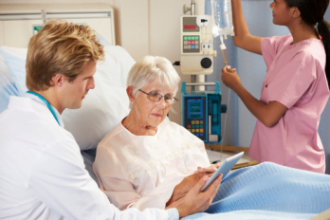
The power of interactive patient-driven TV.
The power of interactive patient-driven TV.
I started as a television reporter at age 22 in 1972 in Charlotte, North Carolina. I was terrified. I won a job at the largest television station in the Carolinas, and they had an audience of 300,000 people. But I overcame the butterflies and went on camera, first on film, then videotape and finally live. The only audience that I saw was usually a middle-aged videographer pointing the camera at me. But I knew there were real people, individuals, who were at home watching, and I learned to speak to them. That was broadcasting. In school, a couple of years before, I had heard the concept of “narrowcasting,” of bringing information to a very select audience. But at that time, technology and cost didn’t make it feasible. Today, more than ever, it does. And what’s really cool is that the audience can not only talk back, the viewers can broadcast—or narrowcast—back! This has great application for far-flung people with serious health conditions. Now, years after starting in journalism, I have two such conditions, chronic lymphocytic leukemia (CLL) and myelofibrosis.
As you know, since 1984 I have dedicated myself to patient education, and, in 1996, I became a patient, too. The truth is other patients have probably educated me more than I have facilitated education of them. It was other patients who connected me with specialists, clinical trials, and helped save my life. And they have supported me every step of the way. In 2015, we can step up our two-way connection in communities of people affected by serious illnesses with what you might call “interactive television.” At Patient Power, our plan is to stream many of our programs on video live and where patients can ask questions or make comments in text or on their webcam. Soon it won’t matter where they are and, ultimately, what language they speak. Leading experts in a condition—whether they be researchers, physicians, nurses, or experienced patients or care partners—will be in real-time conversation with others in the community anywhere. This has huge implications for healthcare providers, pharmaceutical companies, other stakeholders and, of course, patients.
Finally, the walls of the “black box” of healthcare will be torn down by your fingertips on your keyboard and your webcam and higher speed Internet connection. I am thrilled to be a part of this positive advance. In 2015, look for all our “town meetings” for patients to not only be streamed but where a patient-reporter will be the anchorperson for the viewing audience, where some interviews and Q&A will be done just for you. Plus, we will have live Ask the Expert sessions during the year and from medical conferences. We tried this out at ASH 2014 with Dr. James Berenson, and you can see the replay now. We’ll also be introducing the Patient Cafe™ where newly diagnosed patients can meet live on video.
The truth is broadcasters could do this with all their resources, but they have to focus on the big news and what has “mass appeal.” I feel blessed that the tools are there for us now to produce the same quality and with the same speed for audiences of people with conditions like the ones I have and where those audiences can talk back. 2015 will be an exciting year in patient communications, and I believe it will begin a transformation in the way doctors and patients interact, the speed at which research advances, and how quickly the breakthrough products are understood and used.
I welcome your comments.
See you on TV, and I look forward to hearing YOUR voice and seeing YOUR face.