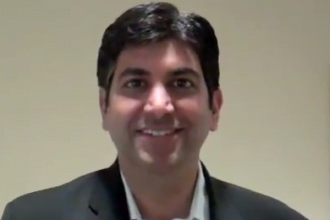
In one of my earlier posts, I talked about the impact that citizen scientists will have on the medicine, technology and the marketplace. Today, I want to introduce you to one. His name is Mike Schultz, and he designs and manufacturers prosthetic legs and feet for amputees, especially those who want to once again enjoy a more active lifestyle. The interesting thing about Mike is that he’s not a trained engineer—he’s a guy who grew up on a farm in Minnesota, and was a professional snowmobiler who lost his own leg in a snowmobile accident in 2008. Within 7 months of his amputation, Mike was back up and running—this time on a motorcycle riding motocross at the Summer X Games—using the prosthetic leg he’d…wait for it…designed and manufactured himself! Not one to sit around, Mike started on his prosthetic prototype—which he’d end up calling the Moto Knee—within a couple months of his accident, sketching design ideas on paper before contacting his friends at the local FOX sales and service facility. The shop’s GM invited Mike in to use their equipment, and told his team to set aside some time to show Mike how to use it. Within a week, using a FOX mountain bike air shock and some aluminum, Mike’s prototype was born. He took it home, attached it to his socket, and hopped on his motorcycle…and says that he knew within moments that he was really onto something. The Moto Knee felt much more natural than anything else he had tried, and was able to give him the right amount of resistance and spring that active stance sports like motocross and snowmobiling require How is Mike’s Moto Knee different than other prosthetics on the market? Mike explained that most traditional prosthetics get to the 80-90 degree point (or less) and then no longer offer resistance—so if you’re standing up on a dirt bike going over a jump and you land, it isn’t adept at absorbing the impact and doesn’t have the spring return necessary to return you to that active stance—meaning you’d likely fall off of your bike after the jump. The Moto Knee uses a patented linkage system that includes a cam roller system, along with the FOX compressed air shock absorber. This allows the knee joint to bend well past the 80-90 degree point to nearly 135 degrees, and it keeps resistance the entire time, meaning that you have the ability to both bend and extend through a much larger range of motion. And unlike other prosthetics, the Moto Knee also includes several interchangeable parts that allow it to be fine-tuned depending on the specific activity, whether it be snowboarding, mountain biking, water skiing, or wherever your desire takes you. Since developing his prototype back in 2009, Mike has not only won many more competitions, but has also started a company called Biodapt to make his prosthetics available to other amputees. According to Mike, many of the people who buy his Moto Knee and Versa Foot are soldiers who lost limbs overseas, which isn’t surprising given that the vast majority (83%) of amputees who have lost a major limb during combat lost one or both legs, most commonly as the result of improvised explosive devices or IEDs. What started out as a way for Mike to get back to the sports and lifestyle he loved has turned into something much bigger. And this citizen scientist—also known by friends and family as a mad scientist—is now an award-winning inventor who is giving hope and a bit of normalcy back to folks who thought they’d never get back on that snowboard or hop on that mountain bike again. I’m not sure if this is a simple or complex story. In the simplest of terms, Mike took control of his life and leveraged his skills and connections to change his world. And the speed in which he did it is simply amazing. Yet on the other hand, according to Best MTB Gear, the inherent complexities of building a bio-mechanical device are staggering. Any device company development time line would support this. But that’s were I think this is a story about complexity and human ingenuity. Healthcare is a similar complicated web of issues, and solutions can often come from unexpected resources driven by atypical or personal motivations. Mike’s story is also a parable to how consumer and patient empowerment can a profound difference for an individual and the world. Original Post
The Amazing Saga of Mike Schultz, Citizen Scientist