
The healthcare industry has various job opportunities with high demand. If you are considering a career in the healthcare industry, consider nursing. Pursuing a nursing career can have various advantages and can be very gratifying. You enjoy a high salary, job security, and excellent work benefits. Additionally, you also have multiple opportunities to advance your career in the future. If you are still unsure about the career you want to pursue, here are four benefits of pursuing a career in nursing to help you decide.
1. Multiple Ways to Start Your Career
There are multiple ways to enter the workforce if you pursue nursing. Getting a four-year bachelor’s degree is unnecessary, and some nursing courses can enable you to get a state license in as little as one year.
You can become a nurse by pursuing either of these three degrees: a Licensed Practical Nurse (LPN), an Associate Degree in Nursing (ADN), or a Bachelor of Science in Nursing (BSN) degree. An LPN is the quickest way to start your nursing career. The degree takes one year to complete, and after passing the NCLEX-PN licensing exam, you can obtain the state license to start working as a practical nurse. Practical nurses have more task-driven roles, mainly focused on treating and overseeing patients rather than management.
A better entry point into the nursing career is becoming a Registered Nurse (RN) as it offers better job stability and salary. You can pursue an ADN or a BSN degree to become an RN. An ADN degree takes two years, and a BSN requires four years. After completing these degrees, you have to pass the NCLEX-RN exam to obtain your state license to work as an RN. Employers prefer BSN holders over ADN holders as they have coursework that better prepares them for supervisory and managerial roles.

2. High Job Security, Salary and Benefits
Nurses are in high demand in the healthcare industry. Statistics from the US Bureau of Labor Statistics (BLS) show that the employment of registered nurses is projected to grow 6% from 2021 to 2031. Over the decade, we can expect about 203,200 openings for registered nurses annually. The ever-growing need for nurses means greater job stability and security.
Nurses are among the highest-paid professionals in the healthcare field. They also get excellent employer-sponsored benefits like paid sick time, paid vacation and holidays, family leave, retirement benefits, and health and life insurance. According to the latest BLS data, nurses have an average annual income of $77,600.
3. Various Career Advancement Opportunities
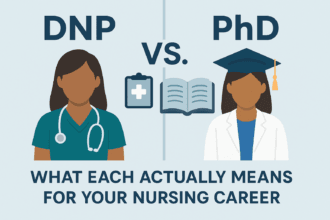
A career in nursing gives you various opportunities to advance your career, with the option to work in different healthcare fields. You can become an Advanced Registered Nurse Practitioner (APRN) by completing either a Master of Science in Nursing (MSN) or a Doctor of Nursing Practice (DNP). Getting either of these degrees will also allow you to progress your career by earning a specialization in a specific area of healthcare. For example, you can become a family nurse practitioner by completing an online DNP family nurse practitioner program. Other options include a Certified Registered Nurse Anesthetist (CRNA), Clinical Nurse Leader (CNL), and Clinical Nurse Specialist (CNS).
DNP and MSN would prepare you for advanced clinical, managerial, and leadership roles and open up job opportunities with better salaries. A DNP is a doctoral program and a terminal degree helping prepare nurses at the highest level of their practice, whereas an MSN is only a master’s degree.
4. Flexible Schedule
Work for nurses is organized into shifts rather than specific hours each week. This offers more opportunities for flexibility in schedule. Nurses can work eight, 10, or 12-hour shifts depending on the employer, and working long shifts would decrease the days you work each week. Some small hospitals even offer the opportunity of self-scheduling to nurses, giving them greater autonomy and control.
Nurses working for employers other than hospitals have flexibility and ease in their schedules in different ways. School nurses often get two months off each summer, homecare nurses work within business hours with only some weekends, and travel nurses can choose their assignments based on location.
Endnote
A career in nursing is demanding and challenging, requiring long working hours and immense hard work and effort. However, it can also be personally rewarding. Nurses constantly have the opportunity to care for unwell patients, try to improve their health, help those in need and pain, and save lives every day. They can also make a difference in the lives of friends and family with their skills and knowledge. If you love helping people and want a high salary, job security, and excellent work benefits, a career in nursing might be the perfect choice for you.