By using this site, you agree to the Privacy Policy and Terms of Use.
Accept
Health Works CollectiveHealth Works CollectiveHealth Works Collective
  • Health
    • Mental Health
  • Policy and Law
    • Global Healthcare
    • Medical Ethics
  • Medical Innovations
  • News
  • Wellness
  • Tech
Search
© 2023 HealthWorks Collective. All Rights Reserved.
Reading: Demographics of CDHP Enrollees
Share
Notification Show More
Font ResizerAa
Health Works CollectiveHealth Works Collective
Font ResizerAa
Search
Follow US
  • About
  • Contact
  • Privacy
© 2023 HealthWorks Collective. All Rights Reserved.
Health Works Collective > Policy & Law > Public Health > Demographics of CDHP Enrollees
BusinessPublic Health

Demographics of CDHP Enrollees

Greg Scandlen
Greg Scandlen
Share
3 Min Read
demographics bar graph
SHARE

EBRI has released the latest in its series of surveys on “Characteristics of the Population With Consumer-Driven and High-Deductible Health Plans.”

EBRI has released the latest in its series of surveys on “Characteristics of the Population With Consumer-Driven and High-Deductible Health Plans.”

This is the ninth year in which Paul Fronstin has looked at the people enrolling in “consumer driven health plans” (CDHPs), which include both HRA and HSA models. He also surveys people with stand-alone “high deductible health plans” (HDHPs), and “traditional” plans, though I am not sure what traditional means anymore. It is defined as any plan with a deductible below $1,000 for an individual, so I guess it includes PPOs, HMOs, and POS plans.

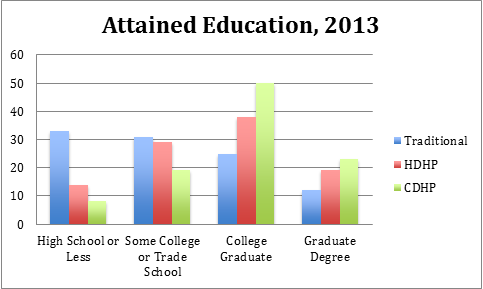
In any case, as usual he finds that CDHP enrollees are very much like everybody else, with these exceptions — they are much better educated, have somewhat better incomes, and are slightly healthier. There are “statistically significant” differences in some other categories, but they are not great and they tend to bounce around from year to year. For instance, in 2013 70% of CDHP enrollees were married, compared to 63% for HDHPs and 61% for traditional. But in 2012 the rates were 78% for CDHP, 70% for HDHP, and 76% for traditional. It is hard to see much of a trend there.

More Read

States Should Stop Diverting Stop-Smoking Money
Walking at Work Does a Body More Than Good
Being Your Own Patient Advocate
Engaging Specialty Practices in the Patient Centered Medical Neighborhood
5 Tips for Using an EMR to Increase Profitability

But there is a definite trend in education levels. Here is the comparison of the completed education levels for enrollees of each type of plan for 2013, but the differences are similar for every year surveyed.
demographics bar graph


This should not be remotely surprising. People who are better educated are more willing to be risk-takers and try out new things, plus they are likely to be more confident in their ability to navigate the health system and make their own decisions about what to do.

And, of course, people with better educations tend to make more money and tend to be healthier. But there does not seem to be as much disparity in these categories (health and wealth) as there is for education. It would be fascinating to control for education and then see what if any differences there are in health and wealth. My hunch is that CDHP enrollees would prove to be less healthy and less wealthy than people in other plans with similar educations — just the opposite of what critics predicted.

Alas, this test will probably never be done, so we will never know.

Share This Article
Facebook Copy Link Print
Share

Stay Connected

1.5KFollowersLike
4.5KFollowersFollow
2.8KFollowersPin
136KSubscribersSubscribe

Latest News

cooling vests healthy workplace
How Cooling Vests Improve Health and Workplace Safety
Health Policy & Law
January 22, 2026
talk therapy
When Emotional Healing Requires Physical Awareness
Addiction Recovery Health
January 21, 2026
Career Mobility in the Modern Nursing
The Growing Importance of Career Mobility in the Modern Nursing Workforce
Career Nursing
January 18, 2026
advancement in nursing career
How Nursing Leadership Shapes Organizational Culture and Patient Outcomes
Global Healthcare Nursing
January 18, 2026

You Might also Like

Can Digitally Driven Kiosks Help Patients Find Medications?

March 24, 2012

The Adopt One! Challenge: The First Step to Better Patient Engagement and Patient Experiences

August 16, 2013

The Value of Healthcare Portals for Patient Engagement

February 10, 2015

Empowering Healthcare Improvement with the Community Needs Assessment

January 27, 2013
Subscribe
Subscribe to our newsletter to get our newest articles instantly!
Follow US
© 2008-2025 HealthWorks Collective. All Rights Reserved.
  • About
  • Contact
  • Privacy
Go to mobile version
Welcome Back!

Sign in to your account

Username or Email Address
Password

Lost your password?