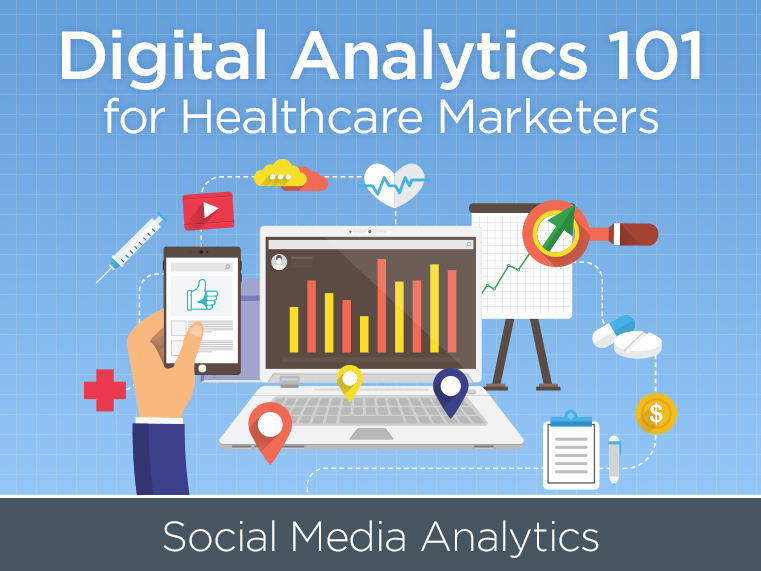
This is part of our series, Digital Analytics 101 for Healthcare Marketers, where we provide short briefs on the What’s, Why’s, and How’s of digital strategy. This post takes a look at social media and the ways healthcare marketers can garner influence and track their success.
In our last installment, we discussed how healthcare marketers can better track and engage visitors to their websites. We also explored the fact that online prospects can come from many places, and that two of those traffic sources are highly scalable. One of them is search, and the other is social media.
Social media is critical for expanding your marketing reach and creating brand awareness among healthcare consumers. The more posts and followers you have, the more rapidly new customers will stream in — already, more than 65% of adults use social media, according to Pew Internet, and in 2014, it drove nearly one-third of website referral traffic, according to Shareaholic.
However, out of all the channels in your digital marketing toolbelt, social media’s impact can be the hardest to assess. For this reason, analytics is a critical component of any successful social campaign. But before sending out your first tweet, every healthcare marketer must answer a two-part question: “What are my concrete goals for our social media strategy, and which metrics best measure our progress towards those goals?” Identify and work backwards.
Social Media Analytics in the Healthcare Space
To begin answering this critical question, you’ll need to first subscribe to an analytics application, where you’ll chart all of your metrics — Google Analytics, Buffer, and True Social Metrics are just a few of the most popular platforms.
There are a many different kinds of metrics to track — conversions, impressions, leads, engagement, applause — but at the end of the day, customer actions are always more valuable than passive views, as Buffer emphasizes. ‘Retweets’ and ‘replies’ indicate brand championing, ‘likes’ signify approval, and ‘comments’ translate to direct engagement.
While it will definitely take some experimenting to find the perfect strategy, marketers should strive to determine which social actions most frequently translate into warm leads and, ultimately, conversions. This way, you can gear your social strategy to better target those outcomes, as well as your ultimate goal: a positive ROI.
It can be tempting to post gimmicky clickbait to generate leads (“You’ll never guess which deadly disease lurks inside every home” etc.) but remember, the quality of interactions is more important than the quantity — in the world of healthcare marketing, high-quality, informative content will always lead to higher conversion rates than being an alarmist, even if the latter tends to get more clicks. When it comes to maximizing the overall return on your digital marketing spend, it’s all about the quality of your leads, not the quantity.
Driving Online Community Engagement
Social media impressions are often highly subjective, but doing everything you can to garner positive reviews is critical to your ongoing success — especially in the healthcare space. Consumers regularly participate in health-centric social communities, and place a massive amount of trust in the opinions they find there.
According to a recent report by PwC, 90% of consumers between the ages of 18 and 24 trust the health information they find on social media, and 61% of all users are likely to trust info posted by their doctors.
So how do you turn all this interest into meaningful traffic to your website? Well, all medical marketers should be looking to their analytics for direction in developing targeted paid ad campaigns for all the major social media platforms — and Facebook is a great place to start.
More than on any other platform, Facebook ads drive highly qualified traffic to your hospital or medical practice’s site, and each of these potential customers arrive ready to book an appointment or — at the very least — learn more about your company. Of course, once they get there, your website better be prepared to greet them with the right information and an effective customer journey.
Key Takeaways
What’s clear is that today, healthcare marketers must actively monitor the social landscape in order to effectively gauge public opinion about their brand. Moreover, they must regularly post informative dispatches on relevant and compelling health topics, and engage various social “influencers” and communities in order to maintain control over their brand’s reputation.
Despite the somewhat esoteric nature of social media marketing, it’s fast becoming a non-negotiable requirement for every industry across the globe. After all, Adweek reports that 97% of marketers across all industries use social media to promote their brand, and 94% of that segment use Facebook.
But armed with the proper knowledge and in some cases, expert guidance, healthcare marketers can start incorporating this channel into their existing digital strategies as an impactful tool, rather than an impediment to success.