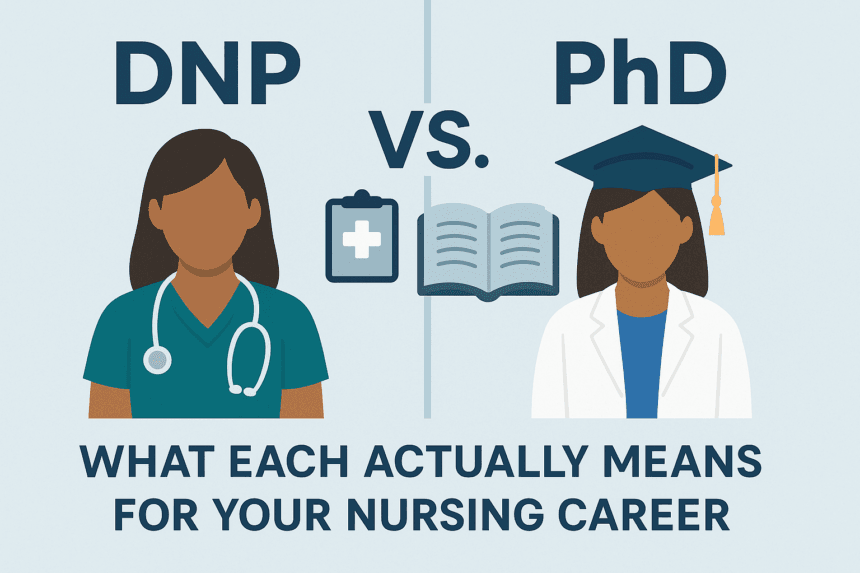
When comparing a DNP vs PhD in nursing, start with purpose: a Doctor of Nursing Practice prepares nurses to apply evidence in clinical and systems leadership, while a Doctor of Philosophy prepares nurse researchers to create new evidence. Both are doctorates, and both demand serious time and money.
- What Is a DNP Degree For?
- What Is a PhD in Nursing For?
- DNP and PhD in Nursing: Practice Versus Research
- How Should You Choose Between Doctoral Nursing Degrees?
- Question One: What Do You Want to Do Every Day?
- Question Two: What Do Your Target Roles Require?
- Question Three: What Are Your Timeline and Financial Limits?
- What Should You Do Before Applying?
The similar titles hide a major difference in training and daily work. The choice can shape a nurse’s entire career.
A mismatch costs more than tuition. A nurse who earns a DNP for a role that requires a PhD may lose years of time, income, and professional momentum.
Neither credential is better in every case. The right degree depends on your career goals, preferred work, and financial situation. Here is what each nursing doctorate prepares you to do.

What Is a DNP Degree For?
The Doctor of Nursing Practice (DNP) is a practice-focused doctorate. It prepares nurses for advanced clinical work, organizational leadership, and health policy roles.
The DNP degree is built for nurses who want to translate evidence into better care or lead healthcare organizations. It is not a research doctorate, although DNP graduates often lead quality improvement and evidence implementation projects.
DNP programs develop practical systems-level skills. Coursework often covers evidence-based practice, policy analysis, organizational leadership, and a clinical or operational specialty.
The final scholarly project reflects that focus. Students identify a real clinical or organizational problem, apply evidence, carry out a solution, and measure the results.
The credential can support several paths, including chief nursing officer positions, policy work, and doctoral-level advanced practice nursing. The exact options depend on the student’s prior education, specialty, certification, and state licensure.
What Is a PhD in Nursing For?
The Doctor of Philosophy (PhD) in nursing is a research-focused doctorate. It prepares nurses to generate new knowledge through original research rather than focus mainly on applying existing evidence.
This path suits nurses who want to build the evidence base itself. Many graduates lead research programs, study patient and health system outcomes, and train future nursing scholars.
PhD programs go deep into research methods. Students build skills in statistical analysis, theory development, scientific writing, study design, and grant writing across the full research cycle.
The dissertation reflects that depth. It requires a substantial original contribution to the scientific literature in a defined area of study.
For anyone weighing whether a PhD in nursing fits their goals, the daily work matters as much as the title. Research involves long projects, repeated review, data analysis, and competition for funding.
Research-intensive tenure-track faculty positions generally require or strongly prefer a PhD or another research doctorate. Nurse scientist, research center leadership, federal agency, and principal investigator roles also commonly call for research training that a DNP program does not provide.
DNP and PhD in Nursing: Practice Versus Research
The core distinction is straightforward. A DNP prepares nurses to apply and translate evidence, while a PhD prepares nurses to produce original research.
A nurse who wants to use research to improve care, redesign workflows, or lead teams may be better served by a DNP. A nurse who wants to design studies and produce findings for others to apply is likely looking for a PhD.
The size of each educational pipeline also differs sharply. The American Association of Colleges of Nursing reported 44,976 DNP students and 4,077 PhD students enrolled in 2025. Those numbers do not make one degree more valuable, but they show how much smaller the research-doctorate path has become.
The difference is clear in daily work. A DNP-prepared chief nursing officer may spend much of the day leading teams, reviewing performance data, and putting evidence-based changes into practice across a health system.
A PhD-prepared nurse scientist is more likely to design studies, analyze data, publish findings, and write grant applications. These are different professional lives. The better fit is the one whose routine still appeals after the title is stripped away.
The paths are not mutually exclusive. Some nurses complete both degrees and develop a career that combines practice leadership with independent research.
That dual route can suit academic roles that blend clinical practice, implementation work, and research. For most nurses, however, one credential is the better investment; earning both makes sense only when the intended work requires both forms of training.
How Should You Choose Between Doctoral Nursing Degrees?
Question One: What Do You Want to Do Every Day?
Start with a practical question: What do you want your workday to look like ten years from now?
Nurses drawn to leading organizations, shaping policy, improving care delivery, or practicing at the highest clinical level are describing DNP work. Nurses drawn to designing studies, publishing findings, and building a funded research program are describing PhD work.
Separate the idea of research from its routine. Research can be rewarding, but the work also includes grant applications, detailed revisions, complex data problems, and publication timelines that may stretch for months.
Leadership deserves the same honest test. An executive title may sound appealing, yet the job can involve staffing disputes, budgets, compliance demands, and difficult organizational decisions. Choose based on the work, not the prestige.
Question Two: What Do Your Target Roles Require?
Actual job postings can narrow the choice quickly. Review openings for chief nursing officers, nursing faculty, advanced practice leaders, and nurse scientists to see which degree employers require or prefer.
This check often produces surprises. Some roles are open to nurses with a master’s degree, relevant certification, and strong experience, which may change the value of pursuing a doctorate.
Research-focused tenure-track positions provide the clearest example of a firm distinction. Schools that expect faculty members to publish original studies and secure grants usually seek candidates with a PhD or another research doctorate.
Clinical and practice-focused faculty positions work differently. Many accept the DNP as a terminal credential, especially when the role centers on clinical teaching, practice improvement, or professional leadership rather than independent research.
Question Three: What Are Your Timeline and Financial Limits?
Time matters as much as career fit. Many full-time DNP pathways take roughly two to four years, depending on the entry point, while PhD study often takes four to six years or longer.
The difference adds up. Tuition, reduced work hours, travel, childcare, and lost income can turn an attractive program into an unworkable choice for nurses balancing family or financial obligations.
Part-time options exist for both degrees. Continuing to work can protect income and clinical skills, but it may extend the program and leave less time for projects, research, and family life.
PhD applicants should compare funding packages rather than looking only at published tuition. The National Institute of Nursing Research lists individual predoctoral fellowships and institutional research training grants for nurses preparing for research careers, although funding depends on the school, award, and applicant.
Program workload and completion time vary widely by format. Ask each school for recent completion rates, typical time to graduation, required in-person work, project or dissertation expectations, and the amount of funding students actually receive.
What Should You Do Before Applying?
The choice between these nursing doctorates rests on the work you want to perform. A DNP centers on applying evidence to improve practice and systems; a PhD centers on creating evidence through original research.
Before committing, speak with people living both versions of the career. Ask DNP-prepared leaders and PhD-prepared researchers how they spend a normal week, what their training did not prepare them for, and which costs surprised them.
Then take one concrete step: collect five job postings for the role you want and compare their degree, experience, certification, and research requirements. That short exercise will make a DNP-or-PhD decision far more reliable than choosing by title alone.