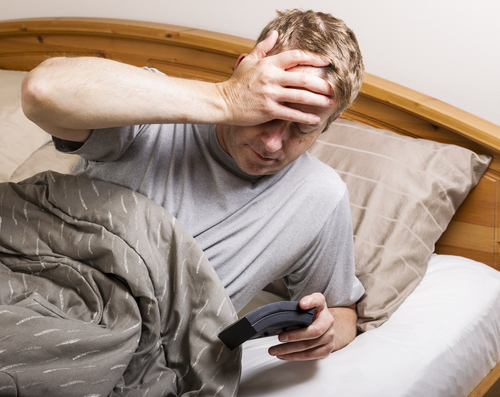
What are two major miseries of our well-off modern society? Obesity and sleeplessness. No surprise that they seem to be connected; looks like those who fail to get enough sleep are more likely to be overweight.
What are two major miseries of our well-off modern society? Obesity and sleeplessness. No surprise that they seem to be connected; looks like those who fail to get enough sleep are more likely to be overweight.

They’re connected in another way: for some folks, no matter what they try, nothing is effective. Behavioral treatments usually fail, and drugs have serious side effects and often fail to work on top of that. Pharmaceutical companies are working like mad to solve both woes. The company that does so will become very rich, if it’s not later sued for all profits plus penalties.
Although over-eating is sometimes connected to anxiety (people eat to soothe themselves), this post is addressed to the anxiety people feel about insomnia. Those with long-standing cases talk about it frequently and find their lives are constricted by it. Just as fear of flying causes people to avoid traveling, so does insomnia. Even occasional sufferers find sleep more elusive on vacation. Chronic insomniacs consider sleep issues before any other considerations. Where will I sleep? What are the beds like? How should I schedule flight times? What will I do in a strange hotel room if I can’t sleep?
But if travel were the only problem, insomniacs could stay home. And sometimes they do, missing out on special occasions with friends and family, avoiding professional opportunities, straining a marriage.
Sleep, unlike flying, however, is a necessity and occurs once every day–can’t get away from it. Sleepless individuals fear their problem during much of their waking time–which, for them is a lot of hours. And they talk about it: I didn’t sleep at all last night (to quote my European-born grandmother, “I didn’t close mine eye.”). I had a horrible night. I’m so tired I don’t know how I can make it through the day. I’m worried I won’t be able to….fill in your own blanks: take care of my kids, complete a work project, drive safely, or, in my case, see clients all day without yawning (Clients hate it when I yawn; they think they’re boring me.)
The dread of not sleeping becomes an obsession, and a boring one to the non-sufferers. In the words of Kenneth Lichstein ,PhD, director of the sleep research project in the psychology department University of Alabama at Tuscaloosa, “even before they lie down to sleep these worrisome thoughts are already there.” Anxiety is defined as a future anticipation of threat, as distinguished from fear, which is a fight or flight response in the face of something that’s occurring immediately.
In her charming and self-aware book Wide Awake: a Memoir of Insomnia Patricia Morrisroe details the excessive, continuous, nagging worry of the insomniac. She describes endless drug and therapist adventures, alternative treatments, and hotel rooms that she “sleeps’ in for under an hour, before dragging her drowsy husband to some other hoped-fore respite. Her insomni-phobia seems to come from her mother, who complained about sleeplessness, requiring silence from the family during the day to make up for her nights. Morrisroe finally achieves peace after learning to meditate–a real challenge for her.
The more I listen to their worries, the clearer it seems that the treatment for insomnia, like that of other phobias, needs a shot of Exposure-Response Prevention, where the patient is exposed to the fear (sleeplessness) and lives moment by moment in the experience until the fear subsides. The classic example is fear of flying, with the patient is rides in an actual airplane, with the doors shut, of course, despite sweaty palms, rapid heart rate, and increasing anxiety. The physiology works like this: the patient’s anxiety climbs, gets more intense, peaks, and then subsides. Bingo! What was feared has been accomplished.
When the patient can tolerate the discomfort of insomnia–the future prediction of insomnia–she’s more than halfway there. It’s a bit like tough love, where the tough part is not sleeping and the love part is being OK with whatever happens.
I’ll offer more specific how-to’s in Part II. It this post gets much longer, it might cure insomnia by itself.
image: insomnia/shutterstock