By using this site, you agree to the Privacy Policy and Terms of Use.
Accept
Health Works CollectiveHealth Works CollectiveHealth Works Collective
  • Health
    • Mental Health
  • Policy and Law
    • Global Healthcare
    • Medical Ethics
  • Medical Innovations
  • News
  • Wellness
  • Tech
Search
© 2023 HealthWorks Collective. All Rights Reserved.
Reading: Harsh Questions for Complex Medtech
Share
Notification Show More
Font ResizerAa
Health Works CollectiveHealth Works Collective
Font ResizerAa
Search
Follow US
  • About
  • Contact
  • Privacy
© 2023 HealthWorks Collective. All Rights Reserved.
Health Works Collective > Technology > Medical Devices > Harsh Questions for Complex Medtech
Medical DevicesMedical InnovationsTechnology

Harsh Questions for Complex Medtech

PatrickDriscoll
PatrickDriscoll
Share
4 Min Read
medical devices
SHARE

medical devicesOn the one hand, as I track medical device technology development, I see the increasing trend toward a reduction in the complexity of approaches to accomplish therapeutic ends.

medical devicesOn the one hand, as I track medical device technology development, I see the increasing trend toward a reduction in the complexity of approaches to accomplish therapeutic ends. The underlying force seems to be, “healthcare technology is expensive, so let’s minimize the technological complexity, minimize the invasiveness, reduce collateral damage, make treatments more specific to the resolution of symptoms and/or disease…” The result is that, for example, endoscopic surgery leads to laparoscopic surgery, which leads to single port laparoscopic surgery, which leads to natural orifice transluminal endoscopic surgery, potentially competing in its minimally invasiveness against alternatives like transcatheter interventional procedures — even for procedures like cardiac valve repair or replacement or coronary artery bypass grafting.

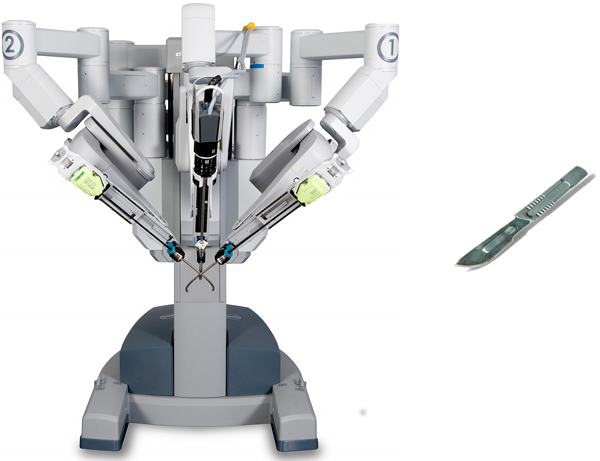
Then, on the other hand, I see technological development moving in the entirely opposite direction of increasing complexity with developments like robotic surgical systems, intraoperative imaging and others, all of which raise the question as to whether we are simply developing technologies for technology’s sake. Do these increasingly complex technologies provide a clinical endpoint not achievable with alternative technologies, or more importantly, procedural approaches? Certainly, I think that technologies that enable a surgeon to perform a procedure that he otherwise simply could not perform, such as those involving the use of intraoperative imaging technologies that enable the surgeon to see healthy versus pathological tissues and differentiate his actions accordingly can arguably result in a better clinical outcome. And as part of this process, one must consider the cost of the accompanying technology such as imaging systems.

Accordingly, when one considers the range of different complex robotic surgical technologies on the market or under development, one has to ask whether these systems truly allow the performance of procedures that the average, well-trained surgeon could not perform without that technology. Certainly, there are complex surgical procedures, such as delicate neuro procedures that, if not performed with extremely precise accuracy, might result in serious collateral damage. But hernia repair? Appendectomy? Colon resection? Hysterectomy? Some of these fairly high-volume procedures have indeed been presented as justification for the enormous expenditure needed to acquire robotic surgical systems.

More Read

ebola virus
What the Ebola Outbreak Shows Us About Modern Health Technology
“Google Calico” and Modern Healthcare: Can Google Make Us Live Forever?
The Impending Accountability of Health IT
Telehealth Chair Lets You Take Your Vitals While You Relax
Social Media and TEDMED

Forgive me for stating the obvious, but it seems incumbent upon healthcare systems to critically evaluate the cost/benefit of new technology, given the limited resources in healthcare.

For this reason, it does not surprise me in the least that recent reports of complications or, in the least, device problems associated with the use of Intuitive Surgical’s robotic systems have promptly led to a precipitous decline in that company’s stock value. If a technology can’t enable the performance of a procedure that otherwise could not be performed, then its value is in question. Further, if the technology cannot perform a procedure flawlessly, and without complication or error that can arguably be performed without that technology, then its value is seriously in question.


TAGGED:medtech
Share This Article
Facebook Copy Link Print
Share
By PatrickDriscoll
Follow:
I serve the interests of medical technology company decision-makers, venture-capitalists, and others with interests in medtech producing worldwide analyses of medical technology markets for my audience of mostly medical technology companies (but also rapidly growing audience of biotech, VC, and other healthcare decision-makers). I have a small staff and go to my industry insiders (or find new ones as needed) to produce detailed, reality-grounded analyses of current and potential markets and opportunities. I am principally interested in those core clinical applications served by medical devices, which are expanding to include biomaterials, drug-device hybrids and other non-device technologies either competing head-on with devices or being integrated with devices in product development. The effort and pain of making every analysis global in scope is rewarded by my audience's loyalty, since in the vast majority of cases they too have global scope in their businesses.Specialties: Business analysis through syndicated reports, and select custom engagements, on medical technology applications and markets in general/abdominal/thoracic surgery, interventional cardiology, cardiothoracic surgery, patient monitoring/management, wound management, cell therapy, tissue engineering, gene therapy, nanotechnology, and others.

Stay Connected

1.5KFollowersLike
4.5KFollowersFollow
2.8KFollowersPin
136KSubscribersSubscribe

Latest News

CRM Software for healthcare
A Beginner’s Guide to Medical CRM Software for Clinics, Medspas, and Telehealth
Global Healthcare Technology
December 29, 2025
The Evolving Role of Nurse Educators in Strengthening Clinical Workforce Readiness
Career Nursing
December 22, 2025
back health
The Quiet Strain: How Digital Habits Are Reshaping Back Health
Infographics
December 22, 2025
in-home care service
How to Choose the Best In-Home Care Service for Seniors with Limited Mobility
Senior Care Wellness
December 19, 2025

You Might also Like

Cervical Cancer Vaccine Yields Long Term Positive Effects

July 16, 2011

RSNA 2013: What Does the Power of Partnership Really Mean?

December 13, 2013
artificial intelligence medical research
Medical DevicesMedical InnovationsTechnology

Robot Scientists Offer New Drug Discoveries, Improved Research Efficiency

February 12, 2015
pulsepoint
eHealthMedical DevicesMobile HealthTechnology

Crowdsourcing Citizen Superheroes

January 16, 2015
Subscribe
Subscribe to our newsletter to get our newest articles instantly!
Follow US
© 2008-2025 HealthWorks Collective. All Rights Reserved.
  • About
  • Contact
  • Privacy
Welcome Back!

Sign in to your account

Username or Email Address
Password

Lost your password?