Massachusetts Health Quality Partners (MHQP) just launched Healthcare Compass, an informative and easy-to-navigate site for patients seeking comparative information on the quality of physician practices in the state. The site presents data on 19 elements of patient experience and clinical quality for adult practices and 14 for pediatric practices.
Massachusetts Health Quality Partners (MHQP) just launched Healthcare Compass, an informative and easy-to-navigate site for patients seeking comparative information on the quality of physician practices in the state. The site presents data on 19 elements of patient experience and clinical quality for adult practices and 14 for pediatric practices.
For example, patient experience includes feedback on how well doctors communicate with their patients and willingness to recommend the provider to family and friends. Clinical quality includes measures such as yearly follow-up to monitor patients on long-term medication and appropriate use of imaging for lower back pain.
I tested the site out and recommend it for those who are seeking a new primary care doctor or who are curious about how their current practice compares with others.

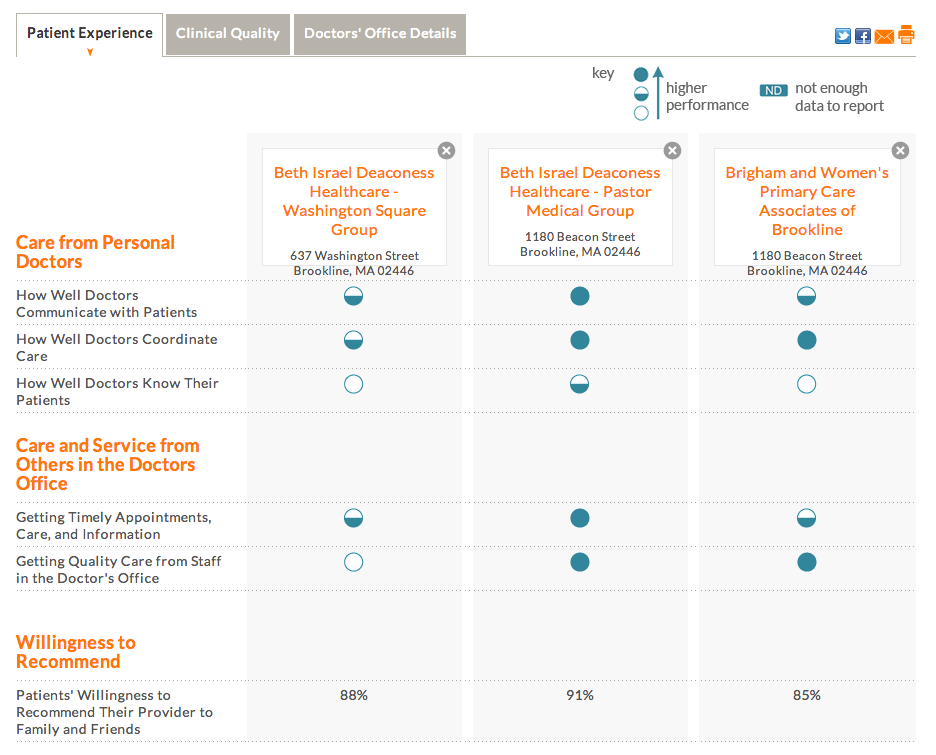
Local practice comparison
Here’s what I especially like:
- The information presented is based on sound methodologies. Sample sizes are significant and where there is insufficient data (pretty rare for the practices I reviewed) no rating is given
- The ratings are done on a three point scale (full circle, half circle, empty circle) and all three ratings are used, even for some of the top practices
- It’s possible to compare multiple practices on one page
- Each rating has a clickable link that provides four tabs: a summary of the measure and how it’s derived, what you can do, what your doctor can do, and helpful resources
- Every comparison page can be emailed or printed
- In general, the ratings are consistent with my perception of the strengths and weaknesses of the practices with which I am familiar
- The organization behind the ratings (MHQP), is an independent, multi-stakeholder collaborative whose goal is to provide useful, unbiased information. You don’t see advertising on this site or some other business model that exploits the consumer
Of course, one website is not going to provide everything one could want. I do have a wish list of things I’d love to see, perhaps in future iterations of the site
- Information is presented at the practice site level. There is no information on individual physicians. The practice site level does have real advantages: many of the measures are more reflective of the practice than the doctor, it helps with achieving statistical significance, and it keeps physicians from rebelling against the ratings. Still, some measures such as “how well doctors communicate with patients” are doctor specific and in my experience there is real variation within a practice
- Users can compare specific practices that are close to a specific zip code or address. That’s useful but it prevents patients from generating a ranking of the top practices. I would be willing to travel if practices elsewhere were significantly better than those near my home
- The measures are all interesting and useful on their own, but there’s no composite measure. The closest is “willingness to recommend,” which incidentally is the only measure expressed on a percentage basis. My practice gets a top rating on tests to monitor kidney disease and a poor rating on yearly follow-up to monitor patients on long-term medication. It’s hard to make a decision on that basis
- The physician search functionality is somewhat weak. Put in a name like “Smith” and the site will bring up several practices but without revealing which Dr. Smith it is. (Joe Smith? Patti Smith? Smith Wesson?)
- The information is limited to primary care. I don’t know that MHQP is in a position to do much about that in the near term but I put it out there because it’s important
All in all, Healthcare Compass is a great edition to the resources available to consumers.