One of the joys of being a physician is learning the patients’ histories. A joy, you say? Isn’t taking the history simply part of the doctoring routine? You’ve all been there.
One of the joys of being a physician is learning the patients’ histories. A joy, you say? Isn’t taking the history simply part of the doctoring routine? You’ve all been there.
When did the pain start?
What made it worse?
Did it move around or stay in one place?
I agree that inquiries like these are not intrinsically joyful, but this is not my meaning here. I refer to history here in the conventional sense. I am interested in who the patients are as people, what they did and what they saw.
It is amazing how many seemingly ordinary folks have extraordinary tales and vignettes that they are quite willing to share, if they are asked. I have a sense that they are a reservoir of wisdom that we must actively draw from, as they may not volunteer their advice.
I recall a science teacher whose prior occupation was serving as a commander of a nuclear submarine. Even years later, his secrets remained tightly held, despite my gentle entreaties. He was, to borrow a phrase, a tomb of confidentiality. Perhaps, the sedation I would be administering prior to a future colonic violation might loosen his tongue. Oh, the secrets I’ve extracted in the endoscopy suite! Relax, patients. What’s uttered in the endoscopy suite, stays in the endoscopy suite, our own version of the Vegas Rules.
Another patient, now elderly participated in a historical event that changed the world. He took a leisurely boat ride across the English Channel on June 6, 1944 reaching the shores of Normandy. I’ve been to beaches many times in my life, but his experience was quite different. I was mesmerized as he recalled the fear that he and his men suffered as their craft approached the French shoreline. He told me of a chilling order that he never had to carry out. If any soldier refused to leave the craft, he was to shoot him. When I was an 18-year-old, I was a comfortable pre-med student. When he was the same age, he walked through the valley of the shadow of death and, unlike the psalmist, he did fear evil.
Another patient, now a nonagenarian, was a scrawny 17-year-old kid who awoke up one morning to hear bombs bursting in air. This quiet and modest man, several decades ago, was stationed in Pearl Harbor on the date that lived in infamy. I was tingling.
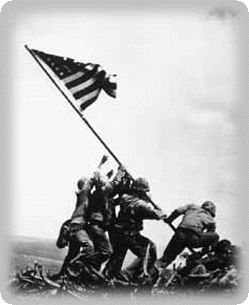
Just a few weeks back, an old man came to see me wearing one of the veteran baseball- style caps that many aging vets wear. For me, these caps are a reliable sign that there will be more to talk about than just heartburn and hemorrhoids. “Where we’re you stationed,” I asked. “Iwo Jima,” he answered. You know what’s coming now, readers. This man witnessed the marines raising the flag on Mount Suribachi in, perhaps, the most iconic image ever captured in American military history.
Over the years, I have related these treasured vignettes to the kids, who rightly wondered if I actually performed any medical work in the office. For the years that we home schooled the 2 boys, my patients’ experiences became part of their curriculum whenever possible. On more than one occasion, these gracious individuals met with us so that we could hear history directly from the folks who made it happen.
Seasoned physicians may not know the answers. But, they know what questions to ask. When your doctor is taking your history, is he asking the right questions? Am I?