“Huh?? What do you do? What’s that?” Those are the usual responses we get when people find out we are Interventional Radiology nurses. Not many people, including other nurses really know what an IR nurse does and what Interventional Radiology involves.
“Huh?? What do you do? What’s that?” Those are the usual responses we get when people find out we are Interventional Radiology nurses. Not many people, including other nurses really know what an IR nurse does and what Interventional Radiology involves.
So, what is Interventional Radiology? Interventional Radiology is a sub-specialty of radiology that involves the use of minimally invasive image-guided procedures to diagnose and treat disease in almost every organ system. Interventional radiologists perform these procedures utilizing needles and catheters instead of making large incisions into the body like traditional surgery.
Interventional Radiology (IR) goes back to 3000 BC when the Egyptians performed bladder catheterizations with the use of metal pipes. In 1711, Stephen Hales performed the first cardiac catheterization on a horse with the use of brass pipes, a glass tube and the trachea of a goose. The development of the cardiac catheter was considered the “key in the lock” according to Dr. Andre Cournand, who received the Nobel Prize in 1956. From this breakthrough came the development of angioplasty and stents, which were first used in the treatment of peripheral vascular disease. Dr. Charles Dotter is known as the Father of Interventional Radiology and was nominated for the Nobel Prize in Physiology and Medicine in 1978.
In 1977, Sinai’s Interventional Radiology department consisted of one radiologist, one technologist and one nurse. Albert Austin was the Director of Radiology at that time. An angiogram would take three hours to perform with a gigantic machine called a Schonader unit. Hundreds of films would then be taken to a dark room to be processed. Each film took three minutes to process. The team only performed three cases per day because of the long and tedious steps involved. In 1981, Karen Steinhice was the first female angio-technologist in the department to assist Dr. Wityk in an angiogram case. Karen went on to become the Director of Radiology in 1999.
Dr. John Brunson is currently the Director of Neuro-Interventional & Interventional Radiology. There are two other IR physicians who cover Northwest Hospital, Sinai Hospital and St. Agnes – Dr. Dale Johnson and Dr. Andrew Long. Carol Sue Hart manages the department. Shelly Smith was hired earlier this year as the Nurse Coordinator. There are four nurses and three technologists.
Today, Sinai’s interventional radiologists perform a variety of more than 40 procedures. These include but are not limited to:
- Biopsy of various body parts (i.e. liver, pancreas, kidney, bone marrow, thyroid)
- Placement of vascular access devices (i.e. port-a-cath, PICC, dialysis catheters)
- Angiogram and Embolization therapy (i.e. UAE, chemo-embolization)
- Paracentesis & thoracentesis
- Placement of fiducial beads for cyber knife therapy
- Drains such as nephrostomy tube, biliary tubes, abscess drains
- Lumbar puncture, myelogram and blood patch
- Baclofen pump study
- Kyphoplasty and vertebroplasty
- Neurological procedures such as the WADA test, aneurysm repairs and revascularization of stroke patients.
You can see an entire list of procedures here.
Sinai’s IR department is gearing up to receive its first group of patients for this relatively new procedure called Y-90 or radio-embolization therapy. Radio-embolization is a combination of internal radiation therapy and embolization. This procedure is used in patients with liver cancer.

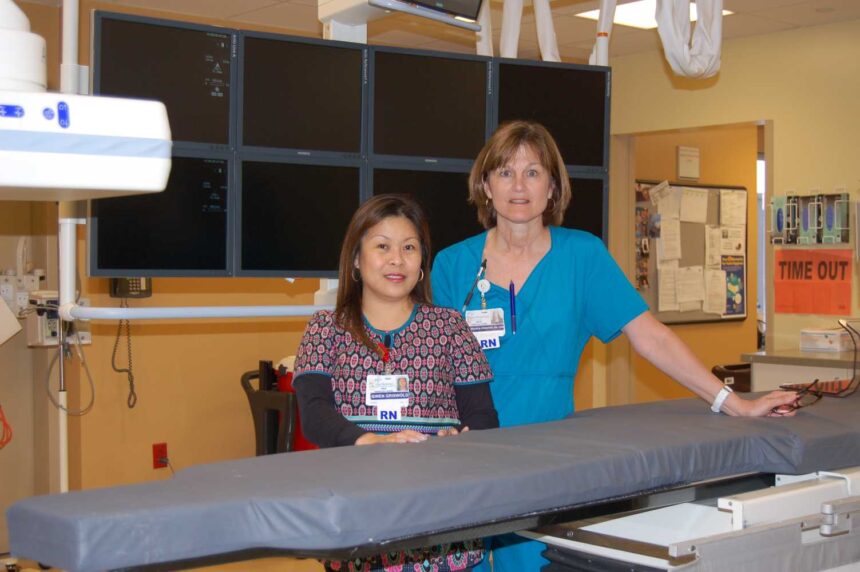
Gwen Griswold and Kris Prentice
During the procedure, tiny beads called microspheres are delivered into the blood vessels that supply the tumor to block the blood supply to the cancer cells. Once lodged in the tumor, these microspheres deliver a high dose of radiation from a radioactive isotope called yttrium 90; hence, the nickname Y-90. This does not cure cancer, but it slows down the growth of the tumor, helps with the symptoms and improves the patient’s chances for surgical resection and transplantation.
After Y90, who knows what’s next? Interventional Radiology remains at the forefront of these technological advances. It is always evolving, always improving – to provide a safer and least invasive way of helping our patients.
Stay tuned for another blog next week titled “What is an Interventional Radiology Nurse.”
– Written by Kris Prentice, RN and Gwen Griswold, RN BSN, Division of Interventional Radiology, Sinai Hospital