We use cookies, including third-party cookies from Google to serve personalized ads through AdSense, to operate this site and understand how it is used. By continuing to browse, you accept this use. See our Privacy Policy and Terms of Use for details, including how to opt out of personalized advertising.
Accept
Health Works CollectiveHealth Works CollectiveHealth Works Collective
  • Health
    • Mental Health
  • Policy and Law
    • Global Healthcare
    • Medical Ethics
  • Medical Innovations
  • News
  • Wellness
  • Tech
Search
© 2023 HealthWorks Collective. All Rights Reserved.
Reading: Medical Devices or Medtech? (Yes, There’s a Difference)
Share
Notification Show More
Font ResizerAa
Health Works CollectiveHealth Works Collective
Font ResizerAa
Search
Follow US
  • About
  • Contact
  • Privacy
© 2023 HealthWorks Collective. All Rights Reserved.
Health Works Collective > Technology > Medical Devices > Medical Devices or Medtech? (Yes, There’s a Difference)
Medical DevicesTechnology

Medical Devices or Medtech? (Yes, There’s a Difference)

PatrickDriscoll
PatrickDriscoll
Share
4 Min Read
Medical devices
SHARE

In 1900, if you manufactured buggy whips, did you see yourself in the buggy whip industry — or the transportation industry?

In 1900, if you manufactured buggy whips, did you see yourself in the buggy whip industry — or the transportation industry?

I am not a big believer in conventional wisdom. Yes, of course, conventional wisdom does get things right sometimes, but the problem with conventional wisdom is that (here’s the problem) it is sometimes failingly conventional. That means it tends to be stuck with entrenched definitions and ways of looking at the world that tend to miss the fact that the world is not a statue that can be admired from different angles, but a moving, dynamic, fluid object that can only be understood from a moving perspective.

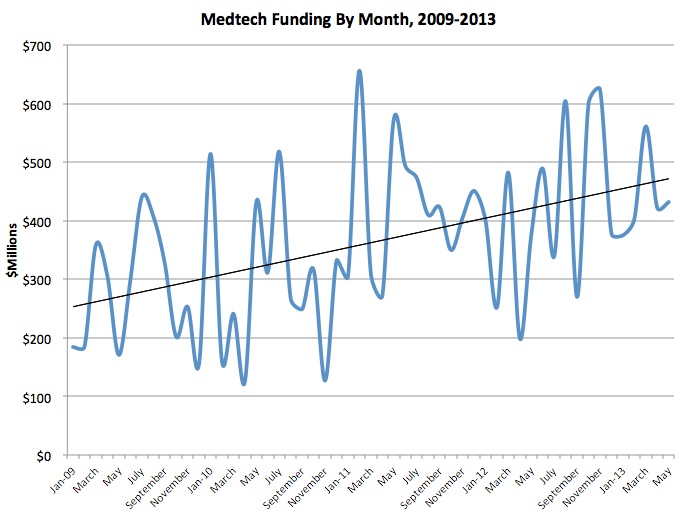
So, conventional wisdom has it that investment in medical technology is down. I don’t buy it.  I have seen the emergence of so many new medtech companies, even since the Great Recession of 2008 (see link). I have witnessed hundreds of millions of dollars flow into medtech — early-, mid-, late-stage and the occasional IPO — and I have tracked those dollars. Below is the month-by-month tally of medtech investment from 2009 through 2013:

More Read

How To Accommodate Data Entry Services For Healthcare Industry
Person-Centered HealthCare; BeClose Home Monitoring System Helps Keep Track of the Elderly
The PCMH and Home Care Data: An Interview with Melissa McCormack
5 Ways Big Data Is Improving Patient Outcomes
How To Protect Patient Health Data With Security Testing

Medical devices

Source: Compiled by MedMarket Diligence, LLC (data at link)

Here’s what I will buy:

  • Investors are increasingly inclined to delay investments in later-stage medtech as a hedge against risk. They want to see highly promising clinical results and strong indicators that the FDA will reach decision to approve before they lay their money down.
  • Early-stage medtech companies are now less likely to derive funding from outside investment than they are from outright acquisition. Face it, new technologies are risky and costs of development to get through the R&D and regulatory minefield are high. At the same time, big medtech companies don’t have great incentive to carry expensive R&D activity on the books when they can alternatively bide their time watching young medtechs until the time is right to buy them up along with their fervent entrepreneurs committed to commercial success of their new widget.
  • Yesterday’s medtech is not today’s medtech (see link). Devices no longer compete against other, similar devices alone. They compete against any and all therapeutic alternatives to achieve the same desired clinical outcome.  Therefore, if you are analyzing medtech, you can’t just consider coronary stents and angioplasty in their varied embodiments. You have to also consider their competitors (and isn’t a medtech competitor also a medtech?) to be any and all therapeutic options targeting that same endpoint.  Hence, you have to look at Esperion Therapeutics for their cholesterol lowering drugs (BTW, Esperion just filed for IPO, so count that in, too).

The forces and developments that dictate success and failure evolve as new technologies, new operating practices, new variables are injected into the equation.

I am therefore left with the old business school adage about the buggy whip manufacturers I alluded to earlier. What is your industry? Horse motivation, or transportation?


TAGGED:medtech
Share This Article
Facebook Copy Link Print
Share
By PatrickDriscoll
Follow:
I serve the interests of medical technology company decision-makers, venture-capitalists, and others with interests in medtech producing worldwide analyses of medical technology markets for my audience of mostly medical technology companies (but also rapidly growing audience of biotech, VC, and other healthcare decision-makers). I have a small staff and go to my industry insiders (or find new ones as needed) to produce detailed, reality-grounded analyses of current and potential markets and opportunities. I am principally interested in those core clinical applications served by medical devices, which are expanding to include biomaterials, drug-device hybrids and other non-device technologies either competing head-on with devices or being integrated with devices in product development. The effort and pain of making every analysis global in scope is rewarded by my audience's loyalty, since in the vast majority of cases they too have global scope in their businesses.Specialties: Business analysis through syndicated reports, and select custom engagements, on medical technology applications and markets in general/abdominal/thoracic surgery, interventional cardiology, cardiothoracic surgery, patient monitoring/management, wound management, cell therapy, tissue engineering, gene therapy, nanotechnology, and others.

Stay Connected

1.5KFollowersLike
4.5KFollowersFollow
2.8KFollowersPin
136KSubscribersSubscribe

Latest News

Workers Comp Claim Denied – Now What?  -- AI-generated illustration
Workers Comp Claim Denied – Now What? 
Policy & Law
October 9, 2026
The Case for Proactive Nutrient Support and Where IV Therapy Fits In -- AI-generated illustration
The Case for Proactive Nutrient Support and Where IV Therapy Fits In
Health Therapies
October 5, 2026
Biofeedback Technology in Addiction Treatment: What the Evidence Shows So Far -- AI-generated illustration
Biofeedback Technology in Addiction Treatment: What the Evidence Shows So Far
Addiction Addiction Recovery
September 28, 2026
Charity Care Is Written Into Hospital Policy. It Rarely Makes It Onto the Bill. -- AI-generated illustration
Charity Care Is Written Into Hospital Policy. It Rarely Makes It Onto the Bill.
Business Hospital Administration
September 25, 2026

You Might also Like

Health Insurance Exchanges: Will State IT Departments be Able to Meet the Deadlines?

February 27, 2013
digital health
eHealthTechnology

Is Digital Health Helping or Failing Patients? A Conversation Between a Futurist and ePatient

April 15, 2014

V-Go™ Disposable No-Needle Insulin Delivery Device Receives FDA 510(k) Clearance to use Valeritas Drug

March 2, 2011

Compliance Does Not Equal Security: 3 Emerging Security Themes in Healthcare

June 8, 2016
Subscribe
Subscribe to our newsletter to get our newest articles instantly!
Follow US
© 2008-2026 HealthWorks Collective. All Rights Reserved.
  • About
  • Contact
  • Privacy
Welcome Back!

Sign in to your account

Username or Email Address
Password

Lost your password?