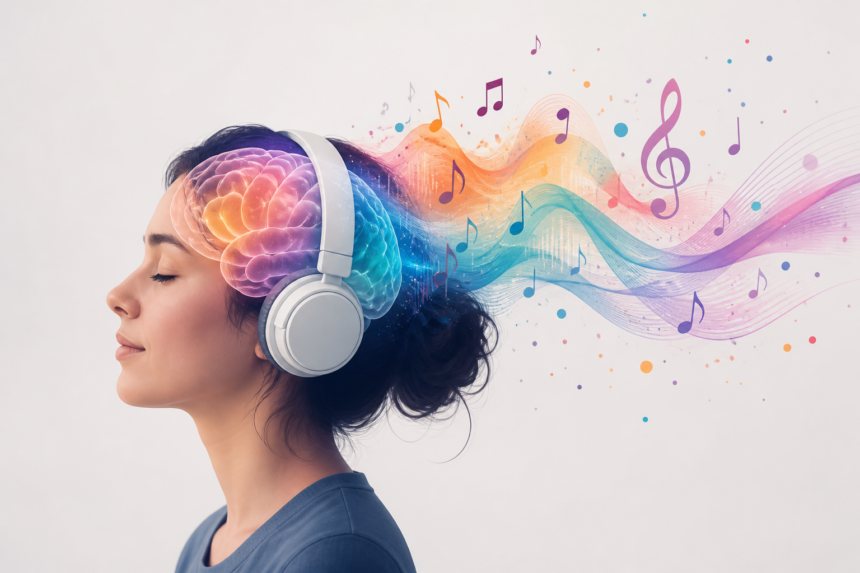
Music and the brain interact through an active workout that engages neural networks far beyond simple sound processing. Listening to a familiar song, keeping time with a rhythm, or learning to play an instrument requires several brain systems to work together. Researchers continue to study how these activities relate to memory, attention, and mood, as well as physical movement and healthy aging. In a 2025 Monash University study of 10,893 adults aged 70 and older, listening to music most days lowered dementia risk by 39% compared with rarely or never listening. Music is not a treatment for every neurological concern, but it can be a meaningful part of activities that keep your brain sharp.
Music Activates Multiple Brain Systems
Listening to music involves much more than processing sound. As you follow how music affects the brain, auditory regions track pitch and tempo while deeper structures link those patterns with memories and emotions.
A familiar song can be powerful because the brain may associate it with a specific person, place, or period of life. This connection helps explain why music is sometimes incorporated into care programs for people experiencing cognitive decline.
Music can also affect movement. A steady beat provides an external rhythm that the brain can use to coordinate actions, which has led clinicians to use rhythmic mechanisms in music therapy and physical rehabilitation settings.

Playing Music Demands Even More
Actively making music adds physical and cognitive tasks. A musician has to read notes and coordinate both hands while staying on tempo. At the same time, they must recall the sequence and listen closely for a mistimed note.
Adult learners in structured studio programs, such as the private sessions or 55-minute small-group labs offered by guitar lessons provider Musicians Made in Mesa, Arizona, have to translate visual chord charts into precise finger placements on the fretboard while monitoring pitch in real time. Practicing a chord progression repeatedly requires attention and motor coordination while gradually building memory for the sequence.
Learning an instrument can therefore provide ongoing mental stimulation. In a four-year study of older adults with an average starting age of 73, Kyoto University researchers found in 2025 that participants who continued practicing a new instrument maintained their verbal working memory and preserved gray matter volume in the right putamen, whereas those who quit experienced age-related declines in both. The goal does not have to be professional-level performance. Working through new songs and techniques gives the brain fresh tasks to process.
Familiar Songs Can Support Memory and Emotion
Music has close ties to autobiographical memory. According to University of California San Francisco cognitive neuroscientist Julene Johnson (2025), neural networks that process music are distinct from language networks, allowing older adults with Alzheimer’s disease to retain musical memories and sing lyrics even after losing the ability to speak.
This relationship has practical applications in healthcare. Carefully selected music may be used as part of activities for some older adults and in music therapy and dementia care programs. Familiar songs can encourage engagement, conversation, or emotional responses even when other forms of communication become difficult.
Responses vary, however. A song that relaxes one person could upset another because of the memories connected to it.
For families and care teams, the takeaway is practical: building a personalized playlist or picking up an instrument doesn’t require clinical equipment, yet it engages memory and focus in ways passive screen time rarely matches.
Kayla Matthews, Influencer & Contributor to HealthWorks CollectiveMusic Can Also Provide a Mental Break
Stress and brain health are closely connected to everyday wellness habits such as sleep, physical activity, and social interaction. Music can fit into these routines as a way to relax, focus attention, or connect with other people.
Singing in a group, playing an instrument with friends, or simply listening to a favorite album can combine mental stimulation with social and emotional benefits.
Music should not be viewed as a substitute for medical care or as a guaranteed way to prevent cognitive decline. Its real value is the cognitive benefits of music across multiple neural systems at once. Listening and remembering tax different pathways than moving or practicing an instrument. If you want to put this link between the brain and music into practice this week, set aside 20 minutes for an active session, whether that means working through a difficult measure on an instrument or building a playlist of songs from a patient’s twenties to spark conversation. Check out the infographic below for more information.