Nobody wants a fat child. Thin parents don’t, and fat parents don’t, especially those who suffered from fat-kid syndrome themselves. Even Michelle Obama weighs in on this topic. Yet nobody knows what to do about it, except make September a National Child Obesity Awareness Month. Thanks a lot.
Nobody wants a fat child. Thin parents don’t, and fat parents don’t, especially those who suffered from fat-kid syndrome themselves. Even Michelle Obama weighs in on this topic. Yet nobody knows what to do about it, except make September a National Child Obesity Awareness Month. Thanks a lot.
One thing surely won’t work: a parent trying to control her child’s eating. Parental anxiety around the child’s eating has powerfully negative effects upon the child’s relationship with food.
The youngest case I’m aware of is a 10-month-old girl who refused to eat. She got the U.S. medicine’s expensive tests to examine the cause, but the cure turned out to be free. When the parents went away for 2 days, the baby ate just fine with grandma wielding the spoon. An “ahah” moment for worried Mom and Dad.
My practice has seen its share of moms with overweight daughters. Their chubby little girls becomes less appealing in middle and high school, especially as eating-disordered teen-aged peers grown thinner and thinner. The moms try the usual tactics, some subtle, some not so: arguing, lecturing, negotiating, spying, threatening, and bribing. Mom’s disapproving looks are obvious; the daughters talk about the pain they feel when Mom watches what they eat at family dinners, criticizes their clothing choices, and offers “gifts” of diet plans. Sometimes Mom volunteers: “Lets join Weight Watchers together.” (Perhaps this painful duet occurs between fathers and sons as well; I haven’t seen that in my practice–yet).
Mom tells herself, her daughter, and me, that she’s just concerned for her daughter’s health. I remind her that all my anorexic patients say they’re “eating healthy,” too. Sure, fat is unhealthy. It’s harder for heavy boys and girls to date, to find “cute” clothes, etc.. With the opprobrium of contemporary culture, the heavy child–boy or girl–is at risk for shame.
This self-esteem injury is exacerbated by parent disapproval, no matter how subtle. When the child becomes defensive from parental nagging, the parent resorts to what one of my client’s overweight adult daughters labels “drive-by criticism.” Mom or Dad: “I’ve stopped eating after dinner recently and noticed how much weight I lost,” Hint, hint. My warning to such parents is two-fold: the nagging doesn’t work (has it ever?), and you’ll be crying yourself a river if your offspring becomes anorexic or bulimic to “fix” the weight problem.
The parents’ challenge is to let go, to let go deep inside. The more a child’s over-eating is the parents’ problem, the less ownership the child has. The only overweight woman in my practice who never mentioned her weight had a mom who constantly did so. The younger woman gained weight consistently until she moved into her own apartment.
There are, however, important parental behaviors that may predict better or worse outcomes before the problem eating starts.
My first piece of parenting advice: encourage children to make their own choices as early as possible. Begin early with the two areas that affect the child more than anyone else: what she eats and what she wears. Of course, the parents provide the food and the clothing, so the child is limited to what’s in the house. But if he wants to wear long-sleeves in the summer, plaid with polka dots, no boots in the snow–let it be.
Same with food. A child knows if she’s hungry. I’ve watched parents in my office repeatedly stick a bottle in the child’s face (I didn’t say “mouth” because the kid won’t open), despite clear signals even from a new-born that the answer is “no.” Naturally, the parent hopes that if he can get more food into the kid, the result will be a longer nap. We’re force feeding so we can get some sleep. This might be reasonable if it worked, but it doesn’t.
Next on my don’t list: using food to quiet a child. Maybe with cell phones and iPads, the centuries-old child-soothing method of lollipops and cookies may be supplanted.
Watch and modify your remarks about your own weight, figure, and food. Remember your children observe you like no one else ever will. You are their everything. When you say, “Oh, I’m disgusted with myself; I can’t believe I ate that,” or “That was the most fabulous chocolate cake; I’ve got to get the recipe,” you model for your child. Same with, “I never eat peanut butter,” or “I’m off to the gym to work off Thanksgiving dinner.”
What should your statements about food convey? What do you want your son or daughter to feel about eating? Food serves 3 main functions: filling us when hungry, tasting good, and a ritual for socializing. It should not make us feel better when we’re sad, be worth going into debt on credit cards (fine dining), nor be the only way we can celebrate with others.
Your kids won’t necessarily model after you if you restrict your food or exercise daily. Your obsessions may have a paradoxical effect. Instead, a relaxed attitude about food and a fun attitude toward exercise set a good direction. Enjoy card games., TV, book clubs or movie nights without snacks; just good company and laughs. The intense link between pleasure and food is not a given. Much of it’s learned. What if we changed ”comfort food” to “comfort walk” or “comfort talk”?
It’s essential to remember, however, that our children are not in our control. You can do all of the above and still have an obese child.
I conclude by addressing the hidden reason we’re upset with a fat child: shame. We feel embarrassed as parents that our child is imperfect in a way that can be seen at first glance by everyone. Maybe others are secretly thinking it’s your fault. Be honest with yourself. If you need help freeing yourself and your child from this clinging, damaging feeling, see a therapist or coach. Maybe this is the moment for the Alcoholics Anonymous mantra: ” Let go and let God.”
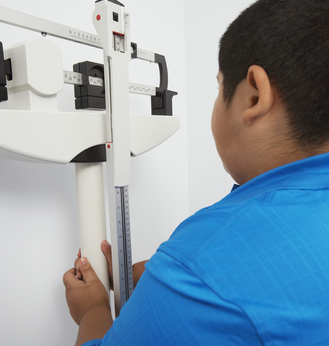
image: childhood obesity/shutterstock