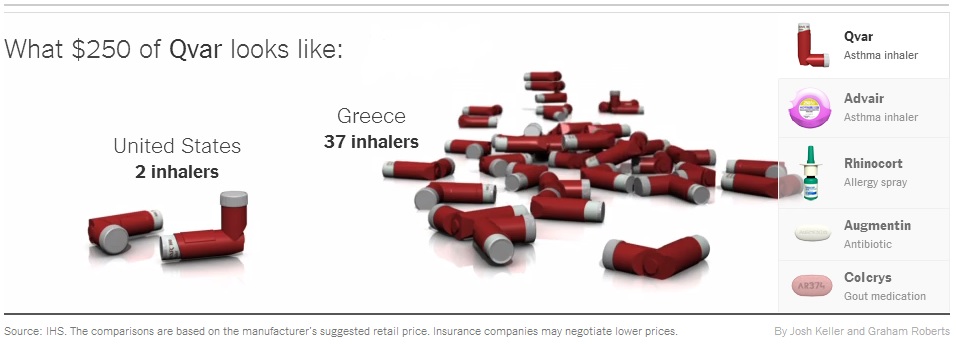
Over the weekend, a New York Times article once again highlights the soaring health care costs in the United States. The article reveals that asthma medications that tens of million people in this country rely on to control their conditions can be 35 times more expensive than in Europe—a $250 branded prescription of nasal spray that lasts for one month costs less than $7 dollar in Europe. In other words, $250 can buy two inhalers in the U.S. while 37 of them in Greece.
Over the weekend, a New York Times article once again highlights the soaring health care costs in the United States. The article reveals that asthma medications that tens of million people in this country rely on to control their conditions can be 35 times more expensive than in Europe—a $250 branded prescription of nasal spray that lasts for one month costs less than $7 dollar in Europe. In other words, $250 can buy two inhalers in the U.S. while 37 of them in Greece. Although the out-of-pocket expenditures for consumers are less than the listed price, Americans still pay more for health care services compared to other OECD countries.
Probably we do not need another article to remind us a simple fact that everyone can testify with vivid personal anecdotes—the price tags for health care services—from doctor visit, surgery, hospital care, emergency medicine to prescription drugs—are just too high!
Last year, a group of doctors from Memorial Sloan-Kettering Cancer Center wrote Sanofi’s new colon cancer drug Zaltrap out of its treatment protocols, based on doctors’ judgment that it was too expensive for the benefits it delivered to patients; last month, the National Institute for Health and Care Excellence (NICE), a UK health care regulatory body, published final guidance rejecting the use of Xalkori (crizotinib) for previously treated ALK-positive non-small-cell lung cancer patients. The drug costs more than $100,000 a year in the United States; this summer, I made an ER visit because a bug flew into my ear as I was hiking in a New York state park. The ER doc used tweezers to take the bug out within 10-second (in addition to the one-hour wait). I soon got a bill for over $1,400.
More Read

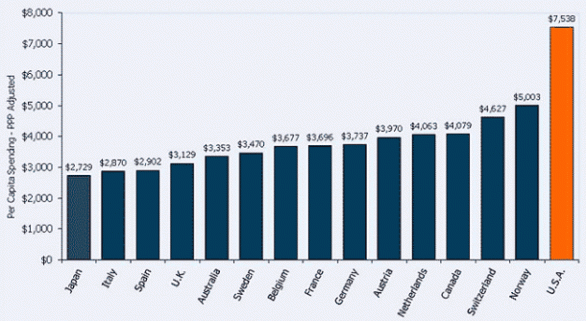
US health care costs are rising disproportionately compared to quality of care (Source: http://bit.ly/192WoBo )
Everyone is concerned with health care costs and policymakers have been enthusiastically seeking solutions. The landmark Affordable Care Act, although includes several mechanisms to contain costs, has almost no direct measures to address high prices for health care services. According to Jonathan Oberlander, professor of social medicine at the University of North Carolina at Chapel Hill, despite the ACA has three major policies that can deal with the cost issue (reduce administrative costs and promote competition among insurers via the Exchanges; the marginal tax to be imposed on high-cost insurance plans in 2018; delivery system reform), but little evidence suggests any of these reforms will generate sizable savings in the short-term.
Finding the answers to reducing health care costs can be extremely complicated. Yet, it can also be quite straightforward: on one hand, competition, less administrative costs and payment reform will reduce costs by enhancing the efficiency of the system; on the other hand, directly addressing the price for health care services will have a larger and more immediate effect on cost reduction. Unfortunately, a lot of discussions around cost containment have been focused on how we should pay for medical care, but little attention has been given to how much we should pay.
Solutions to lower health care costs may not be that difficult to find— measures taken by other OECD countries have demonstrated better patient outcomes can be achieved at lower costs. However, as Oberlander says, “Americans are determined to try all available cost-control options except those that actually succeed elsewhere.”
It is probably unreasonable to blame the Obama administration for not pushing cost reduction harder in the ACA—after all, the biggest task was to get the legislature passed in Congress. As Michael Gusmano, a research scholar at The Hastings Center, points out, Obama was able to contain opposition from powerful organizations such as American Medical Association, American Hospital Association and the pharmaceutical industry by creating a plan that minimizes the threat to the incomes of those who benefit from the existing system—a valuable lesson learned from his predecessors’ success and failure in health care reform.
With an almost intact system and a culture that promotes entrepreneurship and is designed to generate expenditures, reducing health care costs will continue to be a difficult task under the ACA. Sizable savings can only be achieved by introducing policies that directly deal with price and costs such as centralized budgeting and purchasing, prospective payments and price regulation—things that will require significant policy and political maneuver in a country that is religiously ruled by freedom, individualism and free-market.