For those who are engaged in social media, nothing is more powerful than an active Twitter account. Twitter demands engagement and fosters a sense of community. Medicine, although quick to adopt many new technologies has been slow to embrace social media outlets and, in particular, Twitter. The ability to share ideas and information in 140 characters provides a unique platform for physicians to communicate with one another, with patients and with the world.
For those who are engaged in social media, nothing is more powerful than an active Twitter account. Twitter demands engagement and fosters a sense of community. Medicine, although quick to adopt many new technologies has been slow to embrace social media outlets and, in particular, Twitter. The ability to share ideas and information in 140 characters provides a unique platform for physicians to communicate with one another, with patients and with the world. Twitter allows physicians to teach, to counsel, to support and to dispel rumors and myths. Twitter allows physicians from different parts of the world to consult with one another and share knowledge in order to determine the best treatment plan for a particular disease process or patient. Twitter affords patients with an opportunity to connect with other patients who may have similar medical problems and challenges.
Recently, as many who follow the financial markets are aware, the Dow Jones average took a 144 point plunge in 2 minutes.
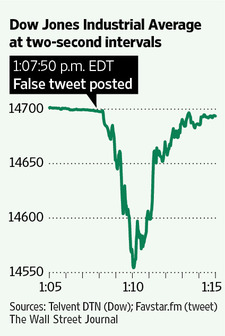
Fortunately, the market quickly rebounded and within a few minutes was back to its opening level. The SEC determined that a tweet suggesting violence or terrorism at the White House was responsible for the plummet. The tweet had been produced from a “hacked” Associated Press (AP) twitter account. As reported in the New York Times today, regulators have taken notice to the power of social media. The incident with the stock market serves to further demonstrate the influence that twitter and other social media outlets can have on human behavior as their repercussions on government and financial institutions. In the case of the Boston bombing tragedy on April 15th, social media and mobile technologies provided much needed evidence and assisted in police efforts to apprehend the men who carried out the senseless attack.
So, why are physicians and other healthcare providers so reluctant to embrace Twitter?
I think that there are several reasons and many valid concerns. Here are some of the most common: (The Top Three Questions I get when discussing social media with physicians)
1. “Silly Rabbit, Twitter is for kids”–Dispelling the Myth

Most often, when I ask colleagues, they respond by saying that twitter is something that their kids use on their iphones. They do not see it as a viable option for a serious medical professional. However, done correctly, Twitter has the potential to impact patients, physicians and healthcare as a whole.
2.” I’m Late, I’m Late, I’m Late !” Twitter is time consuming–This is absolutely the truth
Providing engaging and meaningful twitter content takes time and research. Physicians must commit to the daily effort of developing new tweets that make people want to follow you and engage in conversation. Just as time management during residency and fellowship was critical to success, time must be set aside every single day and devoted to producing content and engaging with those in cyberspace.

3. Twitter may not be something my lawyer wants me to use–Legal implications of online engagement are real.
Before embarking on a social media campaign in medicine, it is essential that you meet with a legal professional and develop guidelines for your social media presence. Understanding exactly what constitutes a doctor-patient relationship and the nuances of HIPAA laws are important considerations. An excellent resource is www.lawandmedicine.com. Victor Cotton, a MD, JD provides wonderful insight into these issues and can be a great place to start. By having a good understanding of the legal issues surrounding online professional interactions and using a little common sense, many pitfalls can be avoided completely.

So, What is the bottom line?
Twitter is a powerful tool. To date, only a very small percentage of healthcare professionals are engaged. Not surprisingly, the new generation of physicians that are training today are much more involved in twitter and other social media outlets. A recent survey found that 95% of all medical students use at least one form of social media as compared to 40% for practicing physicians. Twitter provides an enormous opportunity to impact disease, educate our patients and interact with and learn from colleagues. WE, as physicians, must act now–we must shape the way in which social media will be utilized in medicine in the future. The time is now–we can move markets AND impact disease.