By using this site, you agree to the Privacy Policy and Terms of Use.
Accept
Health Works CollectiveHealth Works CollectiveHealth Works Collective
  • Health
    • Mental Health
  • Policy and Law
    • Global Healthcare
    • Medical Ethics
  • Medical Innovations
  • News
  • Wellness
  • Tech
Search
© 2023 HealthWorks Collective. All Rights Reserved.
Reading: Top 5 Most Expensive Conditions Treated in US Hospitals
Share
Notification Show More
Font ResizerAa
Health Works CollectiveHealth Works Collective
Font ResizerAa
Search
Follow US
  • About
  • Contact
  • Privacy
© 2023 HealthWorks Collective. All Rights Reserved.
Health Works Collective > Policy & Law > Health Reform > Top 5 Most Expensive Conditions Treated in US Hospitals
BusinessHealth ReformHospital AdministrationPolicy & LawPublic Health

Top 5 Most Expensive Conditions Treated in US Hospitals

thielst
thielst
Share
2 Min Read
most expensive health conditions
SHARE

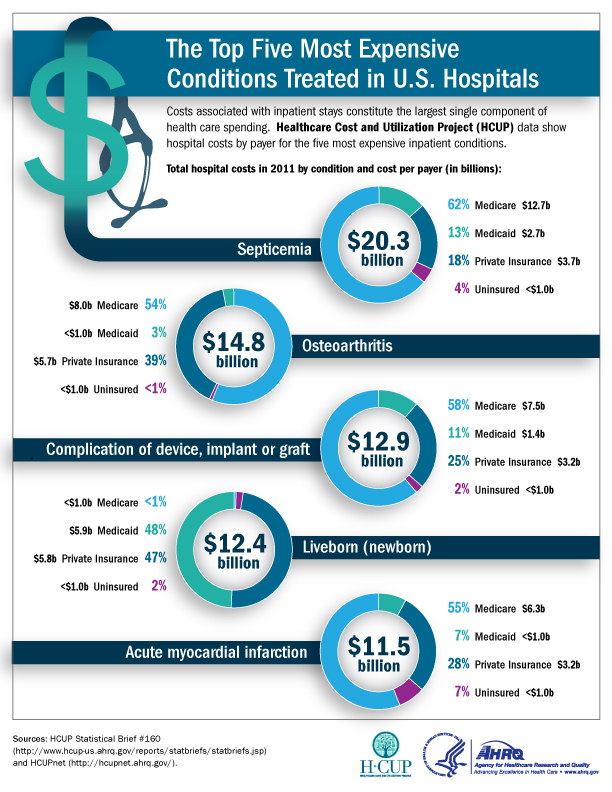
According to AHRQ, the 39 million inpatient hospital stays in 2011 cost an aggregate $387 billion.

According to AHRQ, the 39 million inpatient hospital stays in 2011 cost an aggregate $387 billion.

  • Medicare and Medicaid shared 63% ($242.3 billion)
    • Medicare was the primary payer for roughly 15.3 million inpatient stays, totaling $182.7 billion
    • Medicaid was billed for an estimated 7.6 million hospital stays ($60.2 billion).
  • Uninsured accounted for 2.1 million inpatient stays, accounting for 4.4% ($17.1 billion) of total aggregate hospital  
  • Private insurance was billed for 12.2 million inpatient stays, incurring approximately 29.0% ($112.5 billion) of total aggregate hospital costs in 2011.

The quality of care a patient receives during a hospital stay can contribute to the cost of care and the adverse events or complications that occur during a patient’s stay. In addition, some of the conditions highlighted in the infographic are potentially disproportionately more expensive if a patient receives care in a poor quality setting relative to a high quality setting. 

Two of the top 5 conditions – osteoarthritis and AMI (heart attack) – are the result of chronic conditions that develop over time. Preventing unnecessary hospitalizations associated with these two conditions are important in containing rising health care costs. Early detection and proactive care (often with lifestyle modification and targeted medical treatment) can significantly reduce these costs.  Engaging patients and their family caregivers with tools to help them better manage their condition can also help reduce overall costs.

More Read

Health Care Buzz Today
Boomers Reluctant to Curtail Lifestyle in Retirement
How do we get past “notification overload” in healthcare?
Do You Know What’s in Your Pain Pill?
How Long Do Mass Tort Injury Claims Usually Last?

most expensive health conditions

Share This Article
Facebook Copy Link Print
Share

Stay Connected

1.5KFollowersLike
4.5KFollowersFollow
2.8KFollowersPin
136KSubscribersSubscribe

Latest News

Advances in Diagnostic Tools for Early Detection of Dementia -- AI-generated illustration
Advances in Diagnostic Tools for Early Detection of Dementia
Diagnostics
August 1, 2026
How Virtual Schools Deliver Therapy and Special-Education Support for Children With Disabilities -- AI-generated illustration
How Virtual Schools Deliver Therapy and Special-Education Support for Children With Disabilities
Health News Therapy
July 31, 2026
mri technology
Why Preventive MRI Maintenance Is Essential for Hospitals
Business Hospital Administration
July 24, 2026
senior on computer
Health and Digital Safety Risks Older Adults Should Know
Senior Care
July 24, 2026

You Might also Like

Biological Growth Factors in Wound Care Drive Big Revenue Growth, Too

June 25, 2014
what are the warning signs of a brain injury
NewsPolicy & Law

Which Part of The Brain Is Affected After An Accident?

July 5, 2022

AdvaMed 2011 Featuring Over 70 Company Presentations

September 9, 2011
Finance

An Important Guide To Budgeting For Doctor Appointments

March 12, 2020
Subscribe
Subscribe to our newsletter to get our newest articles instantly!
Follow US
© 2008-2026 HealthWorks Collective. All Rights Reserved.
  • About
  • Contact
  • Privacy
Welcome Back!

Sign in to your account

Username or Email Address
Password

Lost your password?