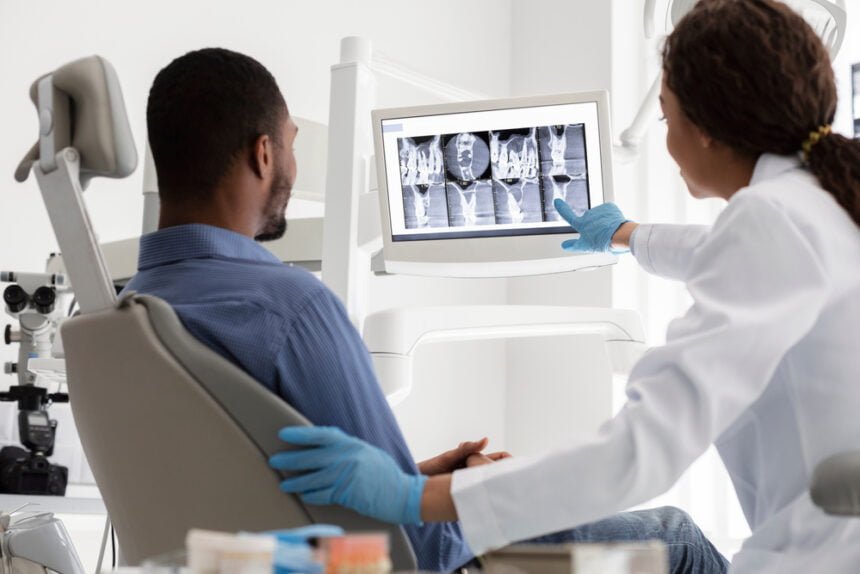
Digital dental x-rays help dentists better diagnose problems that need to be fixed. Radiographs (or x-rays) of the teeth have become standard practice in contemporary dentistry. These diagnostic methods help dentists detect and treat a broad variety of oral health issues by shedding light on previously unseen facets of patients’ oral hygiene.
The American Dental Association has some information on the importance of them, but we wanted to provide some more insight. Keep reading below.
I asked my local Brampton dentist who shared that dental x-rays are crucial for dentists in many ways, including the early detection of cavities and gum disease and the evaluation of a patient’s growth and development.
Dental X-rays provide a more in-depth look than can be seen during a regular checkup since they capture pictures of the teeth, bones, and surrounding tissues. In this article, we’ll look at the value of dental X-rays and how they affect people’s overall oral health and wellness.
Diagnostic Accuracy
Dental X-rays play a crucial role in improving the precision of diagnoses for a number of reasons. A visual examination of the mouth may be informative, but it may not pick up on certain underlying dental issues. X-rays of the teeth let dentists discover problems that can’t be seen otherwise, helping them to make an accurate diagnosis.
X-rays are able to provide an in-depth picture of the oral cavity, including the teeth, roots, and supporting bone structures. Dentists can then diagnose issues such as tooth decay, cavities, gum disease, infections, and jawbone anomalies. X-rays are a vital tool for early identification and management since many illnesses may not present obvious symptoms in their early stages.
Additionally, dental X-rays provide a more precise evaluation of the breadth and depth of tooth issues. They are useful for diagnosing cavities, determining how close deterioration is to nerves, and gauging bone health. Dentists may use this information to create effective, individualized treatment strategies for their patients.
Early Detection of Dental Issues
The ability of dental X-rays to identify problems at an early stage is another major benefit. Dentists may miss the early stages of many oral health problems because their symptoms are subtle in the early stages. However, these issues may be uncovered by dental X-rays, leading to prompt diagnosis and treatment.
Tooth decay is a frequent dental problem that may be caught in its early stages with the use of X-rays. Cavities between teeth or under existing fillings are not always obvious to the human eye but may be shown via an x-ray. Dentists may prevent further harm by treating cavities as soon as they are detected, before the decay has a chance to spread.
Dental X-rays may also be used to detect gum disease in its early stages. Bone loss surrounding teeth is an important symptom of gum disease, and X-rays may demonstrate how much of a loss there is. If dentists can detect gum disease early enough, they may treat it and avoid further damage to the gums and the teeth.
Treatment Planning
Dental X-rays play an essential role in helping dentists plan patients’ care. They provide crucial data that dentists may use to create individualized treatment regimens for their patients. Dental X-rays provide a more thorough analysis of the patient’s oral health by taking pictures of the teeth, roots, and supporting structures. This allows for more targeted and successful therapy.
Dental X-rays play a crucial role in the treatment planning process, especially when it comes to identifying the full scope and severity of any dental disorders. Cavity depth, concealed decay, and diseases affecting the dental roots may all be seen on an X-ray. The dentist may evaluate the tooth’s condition and choose the best course of treatment with this data in hand.
Dentists may also use dental X-rays to assess the teeth’s alignment and location. Overcrowding, misalignment, and impacted teeth are just a few of the problems they may see and recommend treatment for. Dentists may determine whether or not a patient might benefit from orthodontic treatment, such as braces or aligners, by analyzing X-rays of their teeth’s current positions.
Safety and Minimized Radiation
When taking dental X-rays, it is crucial to ensure the patient’s safety and to limit their exposure to radiation. Although radiation is produced by dental X-rays, the amount has been much decreased because of technological progress and rigorous safety standards, making them perfectly safe and well-regulated for use in contemporary dentistry.
Here are some important considerations for radiation protection and dose reduction while taking dental X-rays:
- Today’s dental offices often employ digital X-ray technology. Digital imaging may cut patient radiation exposure by as much as 80% compared to film-based X-rays. Since there is no need for chemical processing after taking a digital X-ray, there is less downtime and more productivity.
- Lead aprons and collars are often used to shield patients from excessive radiation exposure during dental X-rays. The thyroid gland, reproductive organs, and other important tissues may be protected from radiation damage by using these barriers.
- Extra shielding devices, including thyroid collars and shields, are used to protect the thyroid gland from radiation. The thyroid collar is a lead shield worn around the neck during dental X-rays to protect the thyroid gland from unnecessary radiation exposure.
- Collimation of the x-ray beam precisely guarantees that only the required region is exposed to radiation, minimizing scatter radiation and protecting nearby tissues from needless exposure.
Final Words
The possible dangers associated with radiation exposure are outweighed by the advantages of dental X-rays in enhancing oral health, allowing precise diagnosis, directing treatment choices, and avoiding future issues. Optimal oral health and wellness may be achieved via a multifaceted strategy that includes regular and proper use of dental X-rays, in addition to oral exams and preventative measures.
Better care, more reliable treatments, and better long-term oral health results are all possible thanks to dental X-rays. For dentists to deliver optimal treatment and positively contribute to their patient’s oral health and well-being, dental X-rays remain an integral part of contemporary dentistry.