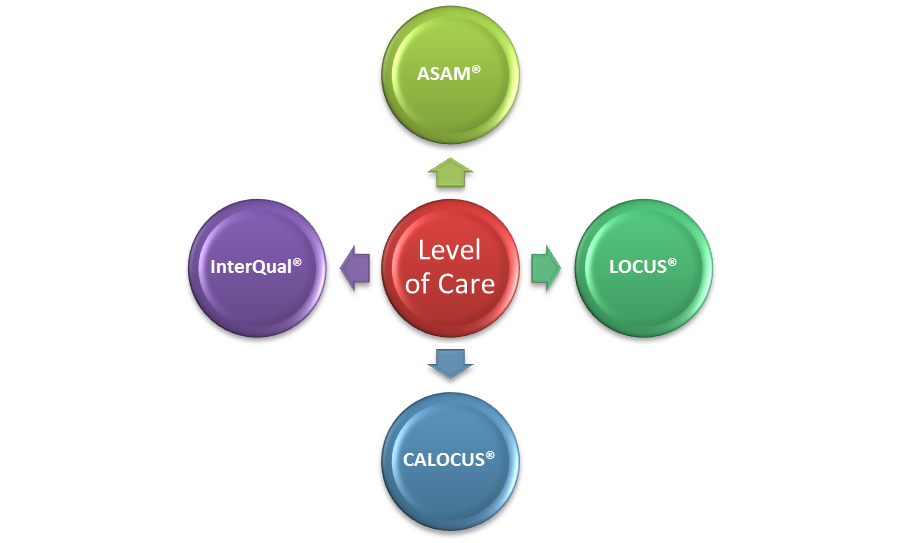
Summary: What do ASAM®, LOCUS®, CALOCUS®, and InterQual® all have in common? They are all level of care assessment tools, each with a different perspective.
Summary: What do ASAM®, LOCUS®, CALOCUS®, and InterQual® all have in common? They are all level of care assessment tools, each with a different perspective.
Level of care isn’t a new concept, but has gained in popularity in recent years. A level of care is used to indicate a level of intensity or severity and determine in what type of facility specific care should be performed. It is used to make sure the patient receives the right care in the right facility at the right time. While level of care tools may be determined by each individual state, all such tools must meet federal minimum guidelines. For a list of level of care tools which are approved for your state, please go to the Division of Health can Human Services website for your state. There are many level of care tools out on the market these days and there is no one assessment tool that is the end-all be-all. Some are known for their simplicity while others are more complex and comprehensive in nature.
4 of the more commonly known level of care assessment tools
More Read

ASAM® level of care
The American Society of Addiction Medicine (ASAM®) has separate assessment criteria for adolescents and adults and determines levels of care by using both levels of treatment and dimensions. The levels of care include:
- Degree of direct medical management provided
- Structure
- Safety
- Security provided
- Intensity of treatment services provided
ASAM Dimensions include:
- Acute intoxication and/or withdrawal potential
- Biomedical conditions and complications
- Emotional, behavioral or cognitive conditions and complications
- Readiness to change
- Relapse, continued use, or continued problem potential
- Recovery/living environment
LOCUS® level of care
LOCUS® and CALOCUS® were developed by the AACP and currently Deerfield Solutions is the sole software provider for the product. Level of Care Utilization System (LOCUS®) uses a combination of levels of care and variables within those levels of care.
The variables are:
- Care Environment
- Clinical Services
- Support Services
- Crisis Stabilization and Prevention
The levels of LOCUS® include:
- LEVEL ONE – Recovery Maintenance and Health Management
- LEVEL TWO – Low Intensity Community Based Services
- LEVEL THREE – High Intensity Community Based Services
- LEVEL FOUR – Medically Monitored Non-Residential Services
- LEVEL FIVE – Medically Monitored Residential Services
- LEVEL SIX – Medically Managed Residential Services
CALOCUS® level of care
Child and Adolescent Level of Care Utilization System (CALOCUS®) uses 7 levels of care to categorize the intensity of patients, interestingly enough starting at level 0:
Level 0: Basic Services
Level 1: Recovery Maintenance and Health Management
Level 2: Outpatient Services
Level 3: Intensive Outpatient Services
Level 4: Intensive Integrated Service Without 24-Hour Psychiatric Monitoring
Level 5: Non-Secure, 24-Hour, Services with Psychiatric Monitoring
Level 6: Secure, 24-Hour, Services With Psychiatric Management
InterQual® level of care
InterQual® is one of many products offered through McKesson. Currently, this level of care assessment tends to be the most comprehensive, while still providing ease of use. InterQual® has different level of care criteria based upon the setting.
The settings include:
- Acute Care
- Acute Pediatric
- Acute Rehabilitation
- Long-Term Acute Care
- Subacute and Skilled Nursing Facility
- Home Care
- Outpatient Rehabilitation and Chiropractic
Benefits of InterQual®
- Reduce over- and under-utilization
- Increase the defensibility of decisions and reduce risk
- Validate appropriate care with quality indicators, checklists and reporting
- Align stakeholders
- Support stakeholder performance management
- Ease of use
This is just an introduction to 4 of the most common level of care assessment tools. Which one is right for your organization depends on your organization, the level of ease of use, budgetary considerations, and the level of support required. As mentioned above, each state has their own variations of approved level of care assessment tools. Consult your Division of Health and Human Services for information specific to your state.