By using this site, you agree to the Privacy Policy and Terms of Use.
Accept
Health Works CollectiveHealth Works CollectiveHealth Works Collective
  • Health
    • Mental Health
  • Policy and Law
    • Global Healthcare
    • Medical Ethics
  • Medical Innovations
  • News
  • Wellness
  • Tech
Search
© 2023 HealthWorks Collective. All Rights Reserved.
Reading: Effective Technologies for Wound Hemostasis, Sealing and Closure
Share
Notification Show More
Font ResizerAa
Health Works CollectiveHealth Works Collective
Font ResizerAa
Search
Follow US
  • About
  • Contact
  • Privacy
© 2023 HealthWorks Collective. All Rights Reserved.
Health Works Collective > Technology > Medical Devices > Effective Technologies for Wound Hemostasis, Sealing and Closure
BusinessMedical DevicesTechnology

Effective Technologies for Wound Hemostasis, Sealing and Closure

PatrickDriscoll
PatrickDriscoll
Share
4 Min Read
SHARE

See the pending 2014 Report #S192, “Worldwide Surgical Sealants, Glues, Wound Closure and Anti-Adhesion Markets, 2013-2020″.

See the pending 2014 Report #S192, “Worldwide Surgical Sealants, Glues, Wound Closure and Anti-Adhesion Markets, 2013-2020″.

Tourniquet, pressure and sutures have been used for controlling excessive bleeding during surgical procedures for many hundreds of years. Fibrin sealants represented a revolution in local hemostatic measures for both bleeding and nonbleeding disorders. Fibrin sealant has the potential to provide life-saving control of excessive bleeding in many critical surgical operations and during a number of elective procedures. The terms “sealant” and “glue” are frequently used interchangeably in the surgical context, but there is actually a difference in adhesive strength between sealants, pioneered by fibrin products (sometimes homemade) and the later, stronger glues of which cyanoacrylate-based products are the most common.

In order for a sealant to be effective, the product should meet several parameters, depending upon the application. Among these are:

More Read

A Virtual Nurse for Hospital Discharge
Unintended Consequences: How HIEs Force Patients to Quit Their PCPs
5 Simple Apps For Health Professionals for Efficiency
Allergan’s Lap-Band Gains 26 Million More Customers
Why iPad EMRs are Better for Doctor Patient Interaction
  • Ability to close the wound
  • Strength of bond
  • Speed of curing
  • Protection of the wound from infection
  • Low surface friction
  • Breathability in order to aid healing
  • Lack of adverse side effects to skin and internal tissues
  • Cost-effectiveness
  • Ease of handling

Fibrin and other sealant products have been approved and used outside the United States for many years and their use has created strong awareness of their surgical and economic benefits in Europe, Latin America and Asia. As a result, many such products have been marketed in these regions for 20 years or more, and have been developed for a variety of surgical uses. In the U.S., these products were initially approved as hemostatic adjuncts to suturing. They are increasingly being used for sealing of tissues, but their use beyond simple hemostasis (i.e., as sealants and low-strength glues) lags that of markets outside the U.S.

Despite the development of novel sutures (e.g., resorbable), endoscopically applied clips and other innovations, fibrin sealants will remain a versatile option available to surgeons to achieve hemostasis and sealing of wounds (alone or adjunctively with sutures/staples). Their clinical track record, biocompatibility and ready availability match high demand. Their limitation in adhesive strength, however, does put some limit on their sales potential, since significant demand exists for tight sealing and strong bonding of tissues under stress, such as in lung and bowel resections, cardiovascular and other anastomoses and adhesion of muscle, that go beyond what fibrin sealants can achieve. For this reason, other naturally-occuring “bioglues” are under development that will achieve tighter tissue bonds than fibrin sealants, but without the toxic effects of cyanoacrylates (“superglues”).

There are more than 30 companies worldwide developing fibrin sealants and driving a market that will exceed $2.2 billion by 2017.
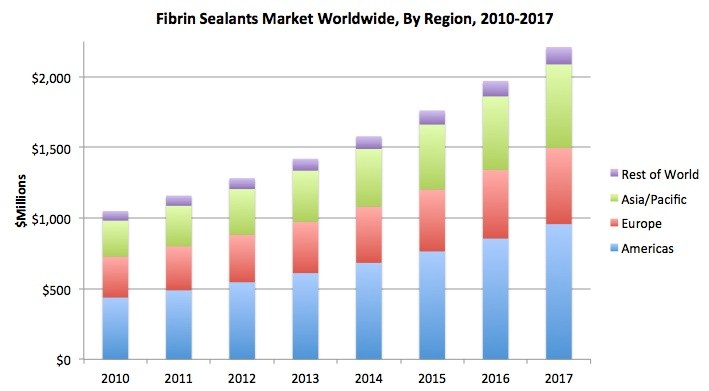
sealants-regional-forecast

 Source: MedMarket Diligence, LLC; Report #S190. (This report is being updated by the pending 2014 Report #S192.)

For complete analysis of the global market for fibrin sealants, see the MedMarket Diligence Report #S190, “Worldwide Surgical Sealants, Glues, Wound Closure and Anti-Adhesion Markets, 2010-2017.”

TAGGED:wound closure
Share This Article
Facebook Copy Link Print
Share
By PatrickDriscoll
Follow:
I serve the interests of medical technology company decision-makers, venture-capitalists, and others with interests in medtech producing worldwide analyses of medical technology markets for my audience of mostly medical technology companies (but also rapidly growing audience of biotech, VC, and other healthcare decision-makers). I have a small staff and go to my industry insiders (or find new ones as needed) to produce detailed, reality-grounded analyses of current and potential markets and opportunities. I am principally interested in those core clinical applications served by medical devices, which are expanding to include biomaterials, drug-device hybrids and other non-device technologies either competing head-on with devices or being integrated with devices in product development. The effort and pain of making every analysis global in scope is rewarded by my audience's loyalty, since in the vast majority of cases they too have global scope in their businesses.Specialties: Business analysis through syndicated reports, and select custom engagements, on medical technology applications and markets in general/abdominal/thoracic surgery, interventional cardiology, cardiothoracic surgery, patient monitoring/management, wound management, cell therapy, tissue engineering, gene therapy, nanotechnology, and others.

Stay Connected

1.5KFollowersLike
4.5KFollowersFollow
2.8KFollowersPin
136KSubscribersSubscribe

Latest News

The Invisible Bond Between Physical and Emotional Pain
Mental Health Wellness
June 16, 2026
photo of a woman with red hair holding a brown brush
How Long Does It Take to Recover from Hair Fall?
Fitness
June 12, 2026
a person putting a bandage on a woman s head
How a car accident can leave hidden injury patterns
Global Healthcare
June 12, 2026
emergency medical simulation with rescue team outdoors
How car accident injuries can reshape physical recovery and everyday health routines
Policy & Law
June 12, 2026

You Might also Like

First Treatments Completed for Parkinson’s Disease Study Sponsored by the Focused Ultrasound Foundation

October 24, 2012
BusinessSocial Media

Top 4 Branding Ideas For Yoga Teachers

July 31, 2017

Join me for my Public Sector State and Local Executives’ HIE webinar Wednesday, April 13

April 6, 2011

Small Business Coalition Launches National Anti-Reform Effort

May 24, 2011
Subscribe
Subscribe to our newsletter to get our newest articles instantly!
Follow US
© 2008-2025 HealthWorks Collective. All Rights Reserved.
  • About
  • Contact
  • Privacy
Welcome Back!

Sign in to your account

Username or Email Address
Password

Lost your password?