
A recent column in the Well section of the New York Times highlights a study in the journal Neuroscience published by DJ Bucci and his colleagues at the department of psychology and neuroscience, Dartmouth University. Although the study deals with the effect of exercise on brain mechanisms of memory, it has much wider implications.
The Study
As reported by Gretchen Reynolds of the Times, “the researchers recruited 54 adults, ages 18 to 36, from the college and the surrounding community. The volunteers were healthy but generally sedentary; none exercised regularly.
During their first visit to the lab, they completed a series of questionnaires about their health and mood, including how anxious they were both at that moment and in general.
They also gave blood for genetic testing. Earlier studies had shown that exercise can increase levels of a protein called brain-derived neurotropic factor, or BDNF, which is thought to play a role in the positive effects of exercise on thinking. But some people produce less BDNF after exercise than others because they have a variation in the gene that controls BDNF production, though it’s unknown whether they derive less cognitive benefit from exercise as a result. So the scientists wanted to determine each volunteer’s BDNF gene status.
Then the group submitted to a memory test, consisting of pictures of objects flashed across a computer screen. Soon after, another set of pictures appeared, and the volunteers were asked to note, with keystrokes, whether they’d seen each particular image before.
after completing the tests, the volunteers were randomly assigned to exercise or not during the next four weeks. Half began a supervised program of walking or jogging four times a week for at least 30 minutes. The other half remained sedentary.
After a month, the volunteers returned to the lab for retesting. But first, some exercised. Half of the exercising group walked or jogged before the testing; half did not. Ditto for the sedentary group: Half exercised that day for the first time since the start of the study; the rest did not.
The earlier tests of memory and mood were repeated”.
The results showed that those who exercised the whole month and the morning before the final test did by far the best on the memory and mood tests. Those who exercised the whole month but not the morning before the test did not do as well, but much better than the sedentary group. What that implies is that regular exercise has a cumulative effect on memory and mood.
BDNF in health and disease
Why didn’t all the exercising volunteers show the same degree of memory improvement? Turns out that about 30% of the population has a variant of the BDNF gene that reduces its activity in memory acquisition.
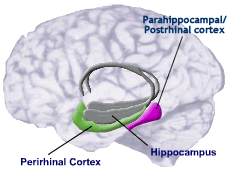
There is another fascinating aspect to the study. The memory tests involved visual memory, which is controlled by an area in the brain called the perirhinal cortex (PRC). This particular area is located in the temporal lobe, adjacent to the hippocampus. 
Now, the hippocampus is responsible for remembering facts. For instance, the information where you left you cellphone is stored there. But recognition of the cellphone as the object it is, is the function of the PRC. All these functions. object recognition and memory of facts are mediated by the all-important protein BDNF.
Now, let’s not forget the mood part of the experiment. The exercisers who had the non-variant BDNF experience mood elevation. The ones who had the variant gene did not. We can understand noq aomw people claim that exercise does nothing for them, or worse. Interestingly, other studies showed atrophy of the hippocampus and the PRC in patients with chronic depression. Antidepressants, elecroconvulsive therapy, and exercise, on the other hand, cause reversal of atrophy of the hippocampus and the PRC, and an increase in BDNF secretion.
Equally as interesting, the PRC recieves neural inputs not only from the visual cortex, but also from the auditory and olfactory areas. Which raises the possibility that disruption of the proper functioning of the PRC, possibly due to BDNF malfunction, could be the seat of the visual and auditory hallucinations of schizpohrenia.
Pretty heady stuff.
As Dr. Bucci stated, “the current data strongly suggests that people should be physically active if they wish to enjoy a sturdy, unporous memory in the long term”. And I might add, it may also suggest physical activity as an additional treatment for psychiatric disease.

I run therefore I remember