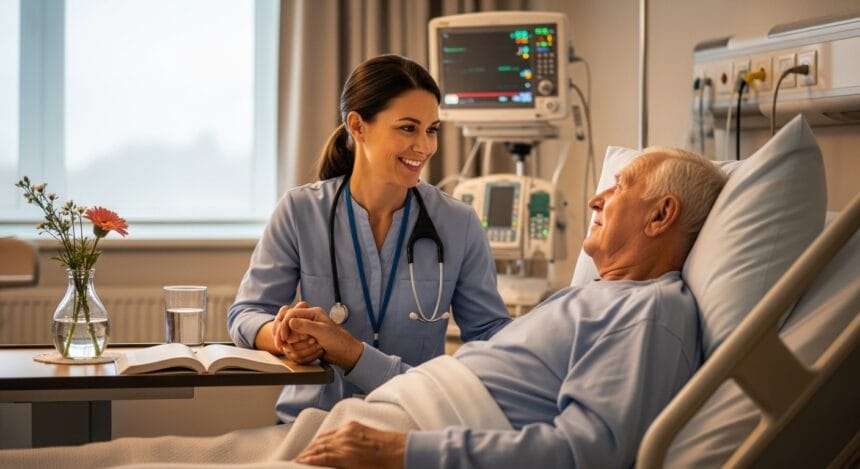
We live in a time where life expectancy is almost as high as it’s ever been. There have been acute adjustments owing to a variety of factors, but for the most part, people are as healthy today as they’ve been at any point in human history.
That’s a good thing, but it does create new challenges for the healthcare system, namely a higher demand for terminal care providers.
In this article, we take a look at what kinds of career options are available for those treating members of the aging population.
Overview
Hospice rates of Medicare utilization are close to a record high. Not only do more than 50% of Medicare patients utilize hospice, but the amount of time they spend under it has gone up to an average of 71 days.
The more people who require hospice care, the more intensely needed hospice nurses become. However, it’s not only people who are approaching the very final stages of life who require specialized medical attention.
Gerontology patients are increasingly prominent as well. These are people who may not have a diagnosis that will take their life in the immediate future, but have reached a stage of life where significant prognosis improvement is not plausible. Common examples include people with dementia or Alzheimer’s.
Gerontology can take place in the hospital environment, but it’s also often carried out at home.
Why Do These Distinctions Matter?
There’s a fundamental difference between preventative care and terminal care.
Preventive care is designed to help patients return to their daily activities, whereas terminal care is generally oriented around maximizing comfort and quality of life.
Do You Need a Special Degree to Become a Terminal Care Nurse?
If you are already a registered nurse, you may not need a specialized certification to pivot into terminal care. There are graduate degrees with a specific focus on gerontology or similar fields, but to work at a hospice center or even in a home health environment, you only need a BSN.
Most nurses will pivot into this field only after having acquired several years of experience. It helps to have worked in oncology units or with patients facing other terminal diagnoses.
The core skills required to do well in terminal care environments are:
- Compassion
- Communication
- Patience
- Emotional resilience
These are qualities that any good nurse will already have, but they do take on a special level of importance in the terminal care setting.
If you’ve worked in a hospital environment before, you may feel as though you’ve already been exposed to every imaginable form of human suffering.
Quite possibly this is true, but it’s nevertheless different when patient mortality is the only ultimate outcome.
Most nurses in a hospital environment will experience highs and lows. In hospice or gerontology settings, wins are a little more abstract.
You can succeed, but only in providing comfort. These patients won’t be getting better, and that can be hard for many nurses to deal with.
How to Become a Hospice Nurse
The first step in how to become a hospice nurse is to complete either an ASN, associate’s degree in nursing, or a BSN, bachelor’s degree in nursing, and then proceed to pass the NCLEX.
The NCLEX is a final test taken after graduation that enables you to acquire your nursing license.
Once you’ve gone through the credentialing stage, you’re ready to take a job in healthcare. Very few nurses start out in gerontology or hospice care.
It’s typical to begin by getting approximately three years of experience in one of the following settings:
- Acute care
- Oncology
- Home health
From there, you can begin to apply to hospice agencies. If you are interested in further increasing your chances of getting a job, consider a CHPN certification.
Though not explicitly mandatory, a CHSN, ACHPPN, or Certified Hospice and Palliative Pediatric Nurse Examination will help your application stand out in the long run.
Note that the Certified Hospice and Palliative Nurse certification requires approximately 1,000 hours of experience. You will typically be able to get that while working on the job.
It’s a good thing to include in your application. Simply mention that you’re in the process of getting your certification.
Agencies will often be glad to help you get the credential, knowing that it indicates both a commitment to this particular branch of the profession and an interest in career longevity.
Gerontology Specializations
If you are interested in specializing in gerontology, there are additional steps you can take, not the least of which is getting a graduate degree in gerontology care.
This will allow you to work as a nurse practitioner with a special focus on caring for the elderly.
While you don’t need this to start in an entry-level role, it is required for working within the profession at the highest possible level.
Gerontology nurse practitioners have higher salary expectations, more responsibilities, and significantly greater autonomy.
Why Terminal Care Is Worth Pursuing
Up until this point, we’ve described terminal care in terms that might not immediately appeal to the average nurse.
While everything that we have just said about the profession is accurate, that’s not to say that it’s the only viable perspective.
There are many reasons why people continue to consider hospice or gerontology roles. For example:
- You provide comfort to patients who need it the most.
- You play a key role in the lives of families at some of their lowest moments.
- You have the satisfaction of doing hard work that needs to get done.
The qualities that attract nurses to gerontology or hospice are ultimately very similar to those that bring people to the profession as a whole in the first place.
You became a nurse because you want to help people through hard times. Never are the times harder than at a hospice center.
If you are interested in making a difference where it is sorely needed, consider what role might be appropriate for you in the world of terminal care.