
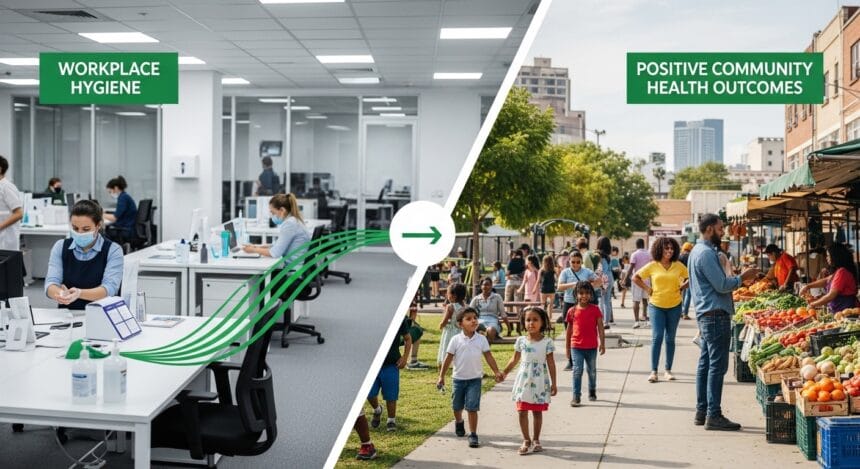
Healthcare facilities don’t operate in isolation. Any patient entering a facility comes from a neighborhood, household, or workplace. Every staff member goes home at the end of each shift. What happens inside a clinical environment has a direct effect on what happens outside of it, and infection control data has confirmed this relationship repeatedly. Clinical operations directly affect the surrounding community.
The Facility as a Transmission Node
Healthcare environments see a concentrated mix of immunocompromised patients and staff moving between rooms dozens of times per shift. The staff can act like carriers. Hospital-acquired infections affect millions of patients annually in the United States. A meaningful percentage of those infections involve organisms that patients or staff subsequently carry outside the facility. Pathogens spread like wildfire if not correctly handled.
Surface contamination is a big problem. High-touch areas – bed rails, remotes, door handles, IV poles, and nursing station keyboards – can harbor living pathogens for hours or even days. The selection and correct application of commercial cleaning products appropriate to each surface type is the first step in breaking the chain of transmission.
Staff Hygiene as a Front-Line Control
In studies about controlling infection in healthcare settings, hand hygiene is a top concern. Research consistently shows that compliance rates with hand hygiene in clinical settings don’t reach target rates. This seems to be true even where the facilities have adopted protocols.
More Read

Staff members that lack good hand hygiene habits inadvertently transfer pathogens from one patient to the next. That’s one problem. Visitors seeing the patient might also pick up the pathogen. A helping spouse uses the remote to change the channel on the TV. A friend adjusts some tubing, so the patient isn’t lying on top of it when they turn. Then the visitors end up being carriers, too, bringing it home to their community.
When the shift ends, staff might take public transportation home, stop to pick up groceries, meet friends for drinks, or visit the gym. Every single touch point has the potential to become a source of community contamination.
Hand hygiene isn’t the only critical component to all this. There’s respiratory hygiene, as we all learned from COVID. Consistent masking, proper cough etiquette, and staying home when symptomatic are all behaviors that can minimize transmission rates, both inside and outside the facility.
Healthcare organizations that reinforce these behaviors through training, accountability structures, and adequate staffing make a measurable contribution to community infection rates.
Environmental Cleaning Protocols and Patient Outcomes
Sanitary, professional cleaning of patient rooms, operating suites, and procedure areas directly affects the infection risk for the next patient admitted to that space. Inadequate, perfunctory cleaning, or cleaning with ineffectual disinfection formulas contributes to healthcare-associated infection rates that increase patient morbidity, extend hospital stays, and generate antibiotic-resistant organisms that are significantly harder to treat.
The CDC’s core infection control practices for healthcare personnel outline standards for environmental cleaning, hand hygiene, personal protective equipment, and respiratory protocol. Facilities that implement these standards faithfully see lower healthcare-associated infection rates, including those in the communities they serve.
Organizational Culture Drives Compliance
Hygiene protocols are only as effective as the culture that enforces them. Regular training, transparent data sharing on infection rates, and adequate access to supplies all contribute to a practice environment where hygiene standards hold.
The Broader Public Health Calculation
Community health outcomes are shaped by many variables, not just hygiene at local health facilities. But healthcare workplace hygiene is certainly one of the more controllable ones. Facilities that maintain strong sanitation standards, enforce hand hygiene, and support staff in following respiratory protocols reduce their contribution to community transmission. The effect compounds across facilities, regions, and time. For healthcare professionals working in infection control, quality improvement, or facility management, the connection between internal hygiene standards and external community health is a direct line worth following carefully.