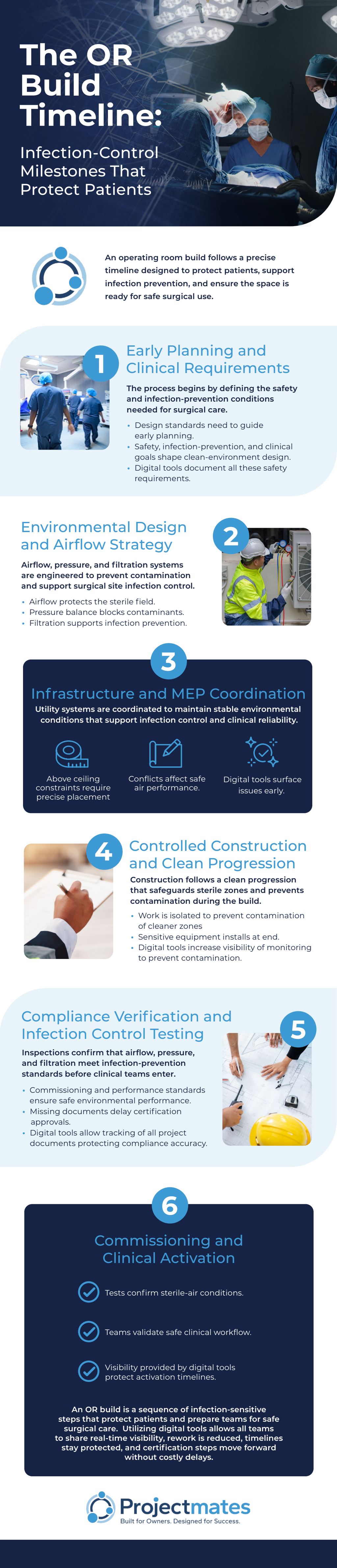

Operating room construction projects require careful coordination because healthcare facilities must maintain strict environmental and safety standards during every stage of development. Unlike traditional commercial construction, operating room builds involve infection control requirements, specialized ventilation systems, medical equipment integration, and regulatory inspections before the space can become operational.
Planning and Design Come First
The planning phase often takes several months before construction begins. Hospital leadership, architects, engineers, infection control teams, and medical staff typically work together to define room layout, equipment needs, workflow patterns, and compliance requirements.
Operating rooms require highly controlled environments with specific air pressure, filtration, lighting, electrical systems, and sterile material handling procedures. Early planning also helps identify potential operational disruptions during construction. Hospitals frequently need temporary patient routing plans or scheduling adjustments while projects remain active.
Mechanical Systems Require Specialized Coordination
Operating rooms rely heavily on mechanical and electrical systems that support sterile surgical conditions. Ventilation systems must control airflow, humidity, temperature, and airborne particle levels carefully throughout the surgical space. Backup power systems, medical gas lines, lighting controls, and communication systems also require coordination between multiple construction teams.
Installation sequencing becomes especially important because many systems depend on precise timing during construction. Project teams often use digital planning tools and a construction analytics dashboard to track schedules, contractor coordination, material delivery timelines, and inspection milestones during large healthcare projects.
Infection Control Remains a Major Priority
Construction activity inside active healthcare facilities creates additional infection control concerns. Dust, debris, noise, and airflow disruptions may affect nearby patient care areas if containment procedures are not managed properly.
Hospitals often use temporary barriers, negative air systems, restricted work zones, and specialized cleaning procedures during construction to reduce contamination risks.
Staff communication also plays an important role because hospital departments may need updated routing instructions or operational changes throughout the project timeline. Maintaining patient safety remains a primary focus during every construction phase.
Testing and Inspections Finalize the Project
Before an operating room can open, healthcare facilities must complete extensive testing and inspection procedures. Airflow performance, electrical systems, backup power, medical gas systems, lighting, and sterilization support systems all require verification before clinical use begins.
Regulatory inspections may also review safety compliance, environmental standards, and operational readiness before final approval is granted. Training hospital staff on equipment operation and emergency procedures may continue even after construction is complete.
Operating room construction projects involve far more than building walls and installing equipment. Planning, environmental control, infection prevention, mechanical coordination, and regulatory testing all affect project timelines and operational readiness. Healthcare facilities that manage these projects carefully are often better positioned to reduce delays while supporting safe surgical environments and stable hospital operations. Look over the infographic below for more information.