A look at the quiet communication gap most hospitals only notice when a patient does not return for follow-up care.
A community hospital admits a Mandarin-speaking grandmother for a hip replacement. The interpreter is on-site for surgery, present for the consult, and gone by discharge. The patient leaves with a printed packet in English. Her daughter, who works two jobs, tries to translate the medication schedule on her phone in the parking lot. A week later, the grandmother is back in the emergency department. Nobody calls it a translation failure. It gets recorded as a missed follow-up.
Language access in healthcare is the set of policies and practices that make medical information understandable for patients who do not speak English as their first language. It covers spoken interpretation during care and the translation of vital written materials a patient takes home: consent forms, discharge instructions, medication labels, and patient portal communication. In 2026, U.S. federal rules treat language access as a patient safety requirement, not a courtesy.
Stories like the one above are not rare, and they are not new. Health Works Collective has written about how often miscommunication leads to delayed diagnoses in patient care. What is shifting in 2026 is who notices, who is held accountable, and what counts as a reasonable response. For global healthcare administrators trying to make sense of the change, the heart of it is simple: language access is no longer something hospitals can quietly outsource to a phone line and a printed handout.

Why Is Language Access Important in Healthcare?
Language access matters because medical decisions cannot be safely made on information a patient does not understand. When a discharge instruction is unreadable, the patient does not call for clarification, they guess. When a consent form is signed without comprehension, the consent is not really consent. When a medication label is misread, the consequence shows up in an emergency department visit that nobody traces back to a translation gap.
A 2024 scoping review published by the National Institutes of Health found that medical errors experienced by patients with limited English proficiency are more likely to result in physical harm than the same errors experienced by English speakers. Communication breakdown is not the only reason, but it is consistently in the top three.
There is also the practical reality of who a hospital serves. Many U.S. communities have populations speaking Spanish, Mandarin, Vietnamese, Arabic, Tagalog, Haitian Creole, Russian, or Somali at home. A care plan that lives only in English is a care plan that does not survive contact with a meaningful slice of the patient population.
Why the Gap Shows Up in Writing, Not Just Speech
When most hospitals think about language access, they think about interpreters. That makes sense. Real-time conversation is where miscommunication feels most visible. But the part of patient care that follows the patient home is almost always written, and it is the written part that tends to break down first.
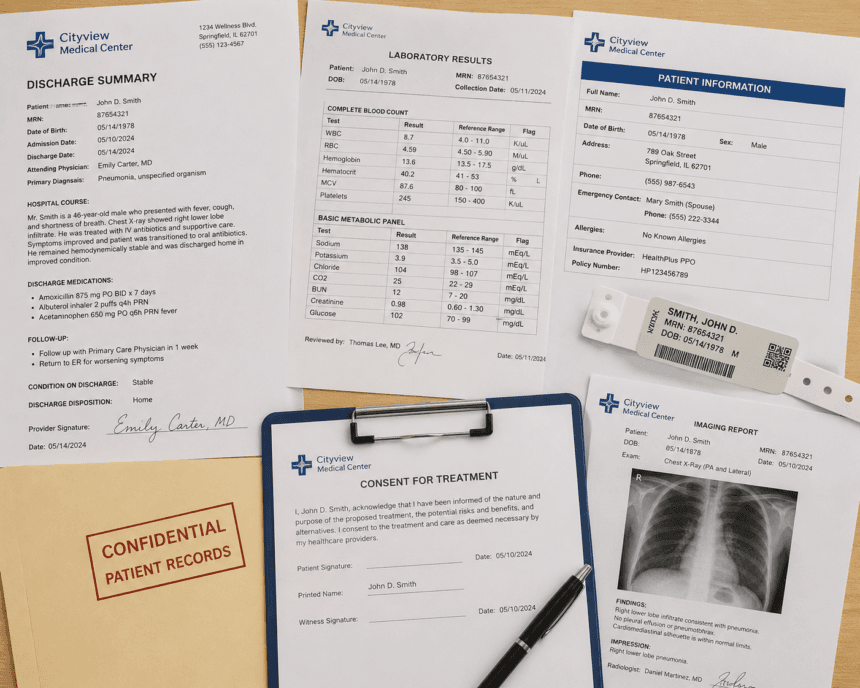
Discharge instructions. Medication labels. Pre-surgery prep guides. Consent forms. Follow-up appointment letters. Patient portal messages. These are the documents a patient reads alone, often days after the clinical conversation has ended. The grandmother’s daughter in the parking lot was not failing the system. The system was failing them. The English-only packet was a written communication problem dressed up as a translation problem. And that distinction is what the rules are starting to recognize.
The 2024 Rule Change That Quietly Raised the Stakes
In April 2024, the U.S. Department of Health and Human Services issued a final rule under Section 1557 of the Affordable Care Act, strengthening protections against discrimination in health care. The headline most administrators caught was the requirement to offer qualified interpreters and translators. The detail that has been quieter, and that matters more in practice, is the expectation that vital written documents be available in the languages most commonly spoken by the population a provider serves, and that machine-translated versions of those documents be reviewed by a qualified human before they reach a patient.
The shift is small in language and large in implication. Vital documents are not abstract. They include consent forms, discharge instructions, medication guides, and notices that a patient needs in order to make a decision about their own care. The rule does not ban AI translation. It does say that AI translation, on its own, is not enough when the document carries clinical weight.
Where AI Alone Falls Short, and Where It Helps
It is worth being honest about what AI translation does well in 2026. For high-volume, low-stakes content, it is genuinely useful. Internal scheduling messages, general wayfinding signs, marketing emails: AI translation gets these to a reasonable place faster and cheaper than a human-only workflow ever could.
What it does not yet do reliably is read context. A discharge instruction that says “take with food” looks simple in English, and most AI tools will translate the literal words accurately. What they miss is the local meaning. In some cultures, “food” implies a full meal at fixed times. In others, it might mean a snack or a piece of bread. A patient who reads the translated instruction at face value might take medication on an empty stomach, with consequences a clinician never sees. The translation was not wrong. It was just unsupervised.
This is what specialists in patient communication have been arguing for years, and what one Health Works Collective contributor framed as keeping real people at the heart of patient communication. The point is not that technology is bad. The point is that technology without an experienced reviewer in the loop tends to produce confident-sounding output that nobody on the clinical team can verify.
What One Healthcare Translation Project Showed in Practice
Tomedes, a translation company, recently completed medical translation work for a healthcare network that needed to serve a diverse patient community across Chinese, Arabic, and Spanish. On paper, that is three language pairs and a project plan. In practice, it is three very different problems.
Spanish-language patient materials had to account for regional variation: a phrase that reads naturally for a Mexican-American patient in Texas might feel formal or foreign to a Puerto Rican patient in New York. The Arabic content needed cultural awareness around how families discuss illness, particularly when an elderly patient may rely on adult children to read materials on their behalf. The Chinese-language materials had to choose between simplified and traditional characters based on the patient community, and translators had to recognize when a clinical term carried different connotations in everyday speech.
None of that is impossible. It is just not something a translation tool can decide on its own. The work required translators who lived and worked in those languages and who understood the kind of patient who would be reading the final document. The healthcare network did not need a faster translator. It needed a team that could think about who the document was for.
Ofer Tirosh, CEO and founder of Tomedes, has described the broader shift this way: “AI did not disrupt the translation industry. It revealed which providers never had a real quality system to begin with. The companies now scrambling to bolt AI onto their workflows are the same ones that were hiding bad translators behind fast turnarounds. At Tomedes, AI forced us to make our quality system visible, and that is the best thing that ever happened to us.
Two Frameworks Worth Knowing
Two frameworks come up often in language access conversations. They are useful as planning anchors, but neither is a substitute for actually doing the work.
The Five Sections of a Language Access Plan
Most healthcare language access plans are organized around the same five sections: a needs assessment of the patient population and the languages spoken; a description of the language assistance services offered, including interpretation and translation; staff training on identifying limited-English-proficient patients and accessing services; written notice to patients of the availability of free language assistance; and a monitoring and evaluation process to make sure the plan is working in practice. A plan that documents all five but only operates the first two is the most common failure mode.
The Five C’s of Communication in Healthcare
The Five C’s most commonly referenced in patient communication are clear, concise, correct, complete, and compassionate. The framework was not designed for translation specifically, but it transfers well: a translated discharge instruction is doing its job when it is clear enough for the patient to act on, concise enough to read, correct in clinical meaning, complete enough to cover the necessary instructions, and written with cultural awareness of the person reading it. AI translation can handle three of the five reasonably well. Compassionate and complete usually need a person.
What Hospitals Can Do This Quarter
None of this requires a transformation budget. It requires a short list of questions that compliance, clinical operations, and patient experience leaders can answer together.
Start with the documents themselves. Which materials does a patient actually take home, and which of those are currently produced only in English? A short audit, done by a clinician and a patient navigator together, usually turns up a smaller list than expected. Discharge instructions, medication schedules, surgical prep, and follow-up letters are the common four.
Next, look at who is producing the translated versions, if any exist. If the answer is a free online tool, that is not necessarily a failure, but it is a signal that nobody has been formally accountable for the output. The new rule expects a qualified human to be in the loop for vital documents. Identifying who that person is, before an audit asks, is the simplest improvement most hospitals can make this quarter.
Finally, pay attention to languages beyond the obvious. Spanish coverage is usually solid in U.S. hospitals. Arabic, Vietnamese, Haitian Creole, Mandarin, Tagalog, and Somali are often where the cracks show, depending on the community served. The rule asks providers to consider the patient population they actually have, not the one they once had.
The Path Forward
Language access in healthcare is not a new problem, and the people inside hospitals know it. What is new is that the regulatory framework has caught up with what clinicians and patient advocates have been saying for years: written communication matters, the documents patients take home matter, and the assumption that an interpreter at the bedside covers all of it is no longer enough.
The Mandarin-speaking grandmother in the parking lot is a specific story, but a familiar one across every hospital in the country. What changes in 2026 is whether her experience is treated as an unfortunate one-off or as a signal that the written side of the patient journey deserves the same care as the clinical side. For the hospitals that take that question seriously now, the answer is rarely a bigger budget. It is a better-defined process and the right partners in place to support it.